What The Hell

Oil-painting-The-Hell-Fresco

If you ask people what hell means to them, you’ll get a variety of answers.

Some people might say it loosely resembles the animated depictions in classic cartoons:

cartoon of hell.jpg

Other people might say it’s a cold place far away from God:

cold dark cave

Then, there are people who think hell is a myth:

myth of hades

Lastly, a few people think Heaven and Hell are one in the same:

bright light

Personally, I see hell as the latter.  Saint Isaac the Syrian (my favorite Saint) describes it beautifully:

“I also maintain that those who are punished in Gehenna are scourged by the scourge of love. For what is so bitter and vehement as the punishment of love? I mean that those who have become conscious that they have sinned against love suffer greater torment from this than from any fear of punishment. For the sorrow caused in the heart by sin against love is sharper than any torment that can be. It would be improper for a man to think that sinners in Gehenna are deprived of the love of God. Love is the offspring of knowledge of the truth which, as is commonly confessed, is given to all. The power of love works in two ways: it torments those who have played the fool, even as happens here when a friend suffers from a friend; but it becomes a source of joy for those who have observed its duties. Thus I say that this is the torment of Gehenna: bitter regret. But love inebriates the souls of the sons of Heaven by its delectability.”

Why do I choose to see hell in this way?  Because it makes sense to me.  God is through all and in all, and He is a consuming fire.  God is warmth and light.  So, in understanding this, the next step in my thought process is that because of free will given to us by God, we make choices daily and therefore, I choose to follow God or reject Him.  In my decisions, I decide my fate, my own judgment.  I’m the judge of my own destiny.  God honors my choice because He can’t impede on my free will.  He can’t go against Himself, as Father Thomas Hopko of blessed memory would say.

All of this is contingent on whether I truly know God or have just been told or read about Him.

Back to God being a consuming fire.  When I repose this life, I enter into His Light because He’s everywhere.  Nowhere is He not.  And the Light is bright and warm, and it brings me joy and peace if I love Him as best as I was able to truly understand and give love to Him and others.  If I knew Him intimately and chose to sever my relationship with Him, I’d feel His Light and Joy as a burning, tormenting fire.  This is why God revealed He is eternal and why the Apostles speak of those rejecting God as being eternally tormented.  He’s always there.  God loves every human who’s ever lived and will live until His Second Coming.  He wants us to be with Him.  That’s why we were created.

I made a choice to follow Him twenty-three years ago, and I hope to continue to choose Him daily until I pass this earth and am standing before Him.  I hope to hear the glorious words akin to what God told the thief on the cross:  “Truly I tell you, today you shall be with Me in Paradise,” (Lk 23:43) (NIV).

sunshine


~*~*~*~


Happy Easter to My Christian Friends and a Blessed Palm Sunday to My Orthodox Christian Brethren

palm sunday icon 1

Today is Western Christian Easter, and I wish all my Christian friends celebrating Christ’s Resurrection today a Blessed and Happy Easter.

Today is Palm Sunday for us Orthodox Christians.

palm cross 2

We Eastern Christians are on the Julian Calendar, whereas Western Christians follow the Gregorian Calendar.  If you are interested in learning a little more about this, click on this link.

Tonight (I think technically last night) starts Orthodox Christian Holy Week in which we participate and follow Christ through his Passion, Crucifixion, and Resurrection.  It’s the greatest feast and holiday of the year for us.  It’s also a very focused, holy, and busy week for us.  Reading my church’s bulletin, there are around sixteen services for Holy Week.

We call this celebration of Christ’s Resurrection on Sunday not Easter but Pascha.  This is the term that’s been used from the beginning, which follows the Jewish Passover (Pesach).  Here’s a couple excerpts of info on Orthodox Pascha and where the word originates from:

Pascha (Greek: Πάσχα), also called Easter, is the feast of the Resurrection of the Lord. Pascha is a transliteration of the Greek word, which is itself a transliteration of the Aramaic pascha, from the Hebrew pesach meaning Passover.

The resurrection of Jesus Christ from the dead is the center of the Orthodox Christian faith. Twelve weeks of preparation precede it. This is made up of pre-lenten Sundays, Great Lent, and Holy Week. The faithful try to make this long journey with repentance, forgiveness, reconciliation, prayer, fasting, almsgiving, and study. When the feast finally arrives, it is celebrated with a collection of services combined as one.

One of the hymns we sing on Palm Sunday:

Apolytikion: First Tone

By raising Lazarus from the dead before Your passion, You did confirm the universal resurrection, O Christ God! Like the children with the palms of victory, we cry out to You, O Vanquisher of death: Hosanna in the highest! Blessed is He that comes in the name of the Lord!

I’ll try to write a midweek post and one on Pascha to share the absolutely moving, beautiful, and profound services to give you a glimpse into what this week is like for us Orthodox.

Again, Happy Easter to all my friends celebrating today!


The Wood’s Song (3 Minute Video)

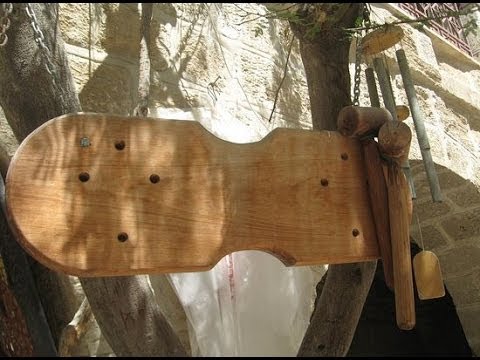
semantron pic

I never tire of watching this video and thought I’d share it with you. I love traditions from different countries and religions. I find them fascinating. Perhaps you do, too? I hope so!

Pictured above is a wooden board called a semantron used in Eastern Orthodox Christian monasteries where monks use mallets to bang against the wood, making a cool sound that is used as a call to prayer (like bells are used at churches). Here’s a history of the use of the semantron via Wikipedia:

The portable semantron is made of a long, well-planed piece of timber, usually heart of maple (but also beech), from 12 feet (3.7 m) and upwards in length, by 1 12 feet (46 cm) broad, and 9 inches (23 cm) in thickness.[2] Of Levantine and Egyptian origin, its use flourished in Greece and on Mount Athos before spreading among Eastern Orthodox in what are now Bulgaria, Romania, Moldova, Serbia, Montenegro, Bosnia and Herzegovina and the Republic of Macedonia. It both predates and substitutes for bells (first introduced to the East in 865 by the Venetians, who gave a dozen to Michael III),[3] being used to call worshipers to prayer. 

In the portable wooden form, at the centre of the instrument’s length, each edge is slightly scooped out to allow the player to grasp it by the left hand, while he or she holds a small wooden (or sometimes iron) mallet in the right, with which to strike it in various parts and at various angles, eliciting loud, somewhat musical sounds (κροῦσμα, krousma).[2]

Although simple, the instrument nonetheless produces a strong resonance and a variety of different intonations, depending on the thickness of the place struck and the intensity of the force used, so that quite subtle results can be obtained.[5] A metal semantron, smaller than those of wood, is usually hung near the entrance of the catholicon (the monastery’s main church).[6] In the traditional monastic ritual, before each service the assigned player takes a wooden semantron and, standing before the west end of the catholicon, strikes on it three hard and distinct blows with the mallet. He then proceeds round the outside of the church, turning to the four quarters and playing on the instrument by striking blows of varying force on different parts of the wood at uneven intervals, always winding up the “tune” with three blows similar to those at the beginning.[3]

The video is three minutes in length.  I hope you enjoy it!

(Romanian monk hitting the semantron with wooden mallets for a call to prayer courtesy youtube)


~*~*~*~