
Critiques, Show, Don’t Tell, Oh My!

Editing an English language document

Recently, I’ve re-entered the critiquing world in all its fictional fun and grueling work.  It truly is a lot of work.  I admire editors for the painstaking mental labor they endure.  Having said that, I’m thrilled to be back in this creative universe.

I’m in the last week of my IDS Wellness college course, followed by a week off.  Then I start my last course in Advanced Creative Writing.  After that, my bachelor’s degree in Creative Writing and English!

Time is slowly opening up to me, edging toward mornings free to dedicate my thoughts and energies to story creating and revising,

Every time I read and critique fellow writers’ works in my online critique group, I learn something, usually more than one thing.  I noticed the past week, I’ve improved my feedback skills.  Yea!

What I find fun and fascinating is when I’ve finished my critique, I go back into the work and read over other critters’ feedback and see how they caught things I missed and vice versa.  It’s incredible to read both negative and positive comments on the paragraph–one finding the descriptions or scene awkward or not needed, while another finds it fantastic.

I did learn through two and a half years of participating in this group that when you have more than one person pointing out something in your chapter that doesn’t make sense, isn’t realistic, etc., you heed those because it’s a good chance more readers than not will have the same troubles with that.

I am half way through a book called Understanding Show, Don’t Tell (And Really Getting It) by Janice Hardy.  How many times are we writers told to show the scenes, the character’s actions, behavior, etc.?  Avoid adverbs.  Don’t use filter words like felt, saw, knew, looked, and decided.  Don’t use passive “to be” verbs like was and is being.
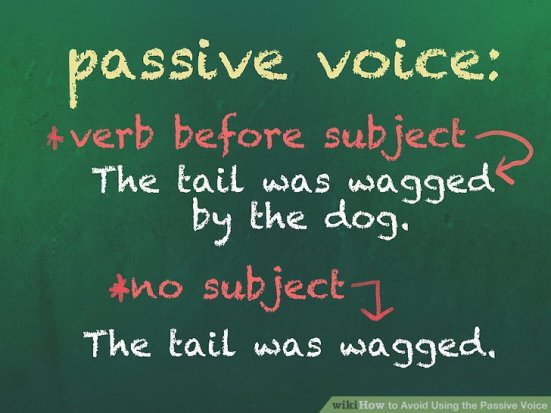
passive voice ex

(Passive voice example)

The amount of telling and showing varies a bit depending on the point of view in which you’re writing.  I’ll share an example from the book, which I really appreciate.  I love visual aids since I’m a visual learner.  This excerpt is written in third person through the usual told manner:

Bob screamed in pain when the zombie clawed his leg.  He struggled to get away, and realized he had seconds to shake loose before the thing got its hooks into him and went straight for his brain.  Zombies needed brains to survive or they turned to dust and bones in just under thirty days.  He didn’t have thirty seconds let along thirty days.

A few red flag tell words mentioned in this paragraph, Hardy points out:  in and when.  We are told when the zombie clawed Bob’s leg, but we don’t really get to see it.  In is used to explain how Bob screams and the reason why he screamed.  There’s explaining the life of zombies too.  The latter is referred to as an infodump.

Therefore, Hardy removes the red flag words, infodump, and Bob’s responses, etc.  Here’s the result:

The zombie clawed Bob’s leg.  He screamed.  He struggled, but he had seconds to shake loose before the thing got its hooks into him and went straight for his brains.

How’s that?  Better?  Hmm.  Hardy says it is.  But she also acknowledges it’s boring and needs interesting details.  Here is the finalized version:

The zombie tore through his pants, sinking its broken fingernails into his calf.  Fire and knives raced up his leg and Bob screamed.  He kicked at it with his free foot, but it held tight.

“Let go, you sonuva–“

He kept kicking, but each heartbeat brought it–and its infected teeth–closer.  Sure, maybe he wasn’t using his brain this instant, but he wasn’t about to let this dagger get it.  Or him.

Improvement, no?  I love seeing the before (telling) and after (showing).  It’s kind of like hair styles or home makeovers.

As I said earlier, I’m half way through this book and enjoying it.  I just wanted to share an example on telling verses showing with excerpts from Hardy’s book in the hopes it helps you, my fellow writers, as much as it has for me.

More to come on this in future posts.


~*~*~*~


Works Cited
Hardy, Janice.  Understanding Show, Don’t Tell (And Really Getting It).  Fiction University Press.

The Hardest Thing In Life

silhouette of woman facing sunset

There are many difficulties and challenges in life.  Generally speaking, they are usually these:

Financial.  Loss of jobs, debt, etc.

Emotional.  The ups and downs in relationships with family and friends, bullies and adversaries.

Physical.  Illnesses.

Death.  The loss of a loved one.

School.  Working hard to get good grades and finish a degree.

Job.  Stressors in the workplace.

But, for me, none of those temporary hardships and painful experiences is as challenging or as tough as living the Christian life.

It’s a lifestyle that is worked on daily.  One of constant striving to repent, changing my thinking and actions.  It can get very exhausting and frustrating.

Being a Christian, living the life of a Christian, isn’t just believing in God and reading the Bible.  Sure, that’s necessary and included, but it requires more from us.

Cooperating with God’s grace so that we are transformed. 

Image result for public domain pictures of walking path toward the sun

There’s a saying by St. Athanasius that says “God became man so man can become like God” (paraphrased but the gist is correct).

In order to become like God, (called theosis in Greek explained here), there are tools and practices that help us get there.

In the Eastern Orthodox Christian faith, these tools and practices are:

Prayer, fasting, almsgiving, Confession, attending Church services, reading the Bible, books about the Saints, and Other spiritual material, and spiritual mindfulness/warfare.

Image result for public domain pictures of Greek Orthodox Christian Jesus Prayer Lord Jesus Christ Son of God have mercy on me a sinner

All of these practices are like exercises for an athlete training for the Olympics.  With God’s help, we are training our minds, bodies, and souls, in preparation for encountering Him when we depart this life and hopefully enter into His Kingdom.

St. Paul talks about this race we must run until the finish (the end of our earthly lives).  God says that we are saved when we endure until the end.

This transformation of our minds, hearts, and bodies is a life-long journey.

All of this effort is exhausting at times, especially the mental battles via spiritual warfare.  You’re fighting with the enemy’s temptations, and your own ego/pride.

Incidentally, you have to die to live.

We died and rose with Christ in the fount at our baptism.  But being a Christian means I am to do this daily.

We as Christians, are to be continually changing, growing spiritually and holy in Christ God.

This means we are not supposed to be stagnate.

We are not supposed to be the same person we were a year ago, a month ago, a week ago, a day ago.  By our cooperating with God, He is transforming us into holy beings.

Without God, we can do none of this.

In a culture that is all about ME and the EGO, it is a very difficult activity to repent daily and make the effort to cooperate with God’s grace.

It’s much easier to stay the way we are, which isn’t fully human.

Staying as we are is not how God initially made us to be in the beginning before the Fall.

Christ, the Second Person of the Holy Trinity, made this transformation of union with God and holiness possible through his incarnation, crucifixion and resurrection, reconciling us to God the Father.

Yet, at times, I wonder why I’m doing this because I don’t see my progress. Why am I not changing?  It feels at times like I’m idling, just sitting there in my own sinful mud puddle, flailing about.

feeling-the-effects-of-chronci-stress

A few weeks ago, pondering all of this, I could understand why people become atheists.

The Christian life is tough.

You feel like running in a hamster wheel getting nowhere a lot of the times.  I teeter between hating myself and self-love/arrogance/conceit.

This perpetual battle drains you of any energy or will to want to continue.

But you know you can’t quit.

You want to be with God, you want to love Him, you want to love others.

You can’t quit because you know Him.

monk contemplating with prayer rope

There are still occasions where I’m still trying to fix myself without turning towards Him.  He is in the background instead of the foreground.

“We ourselves cannot get rid of any of our faults. He takes them away from us, one by one.” – Mother Gavrilia

I am corrupted by the culture in which I live, where I want results quickly, if not immediately, and I know intellectually that’s not how it works in the spiritual life, the life of a Christian.

“God works in eternity. Not in the hurry of our temporary life. Everything will happen as and when He wants.” – Mother Gavrilia

But this awareness needs to travel from head to heart to soul.

I get encouragement, love, and guidance from my spiritual father and love and understanding from fellow Orthodox and various Christian friends struggling along with me.  I follow the Orthodox Christian practices listed above.

If it weren’t for the Church, I’d be twisting in the wind with no roots or steady moral compass.

I know this because I was there decades ago before I was a practicing Orthodox Christian.

However, this ongoing inner struggle is a balancing act, of moderation, as always.  And for me, moderation in anything has been difficult most of my life until the past decade or so.

I was the All or Nothing sort.

I would pursue something hard and obsessively, or I’d just quit/drop the activity.  As a result, I’ve had to reign myself in when going overboard and pull myself up when apathetic or despondent.

But discovering this tendency and monitoring myself has only been possible through God’s enlightening my mind and heart, and His help.

God's mercy quote by St. Isaac the Syrian.jpg

Christians find passages in the Scriptures and sayings by the Saints that give them hope and encouragement.

Mother Gavrilia, a nun who died in the early 1990s, is a not-yet-declared Saint, in my opinion.

I read the book about her life many years ago, and it was life-changing.  She changed my whole worldview.  I quoted her twice already in this blog post.

Here’s one of my favorites:

“God often does not desire the act but the intention. It is enough that He sees you are willing to do His command.” – Mother Gavrilia

She is saying making an effort to follow God’s Commandments daily is all He expects from us.

I cherish these words.  It washes away the frustration and weariness of my daily struggles.

“When you know Him, you want to be with Him, be like Him, learn to love Him, all people, and all of His creation.” – Me.