A Christmas Household of Many Different Tongues

Christmas scene of front door and tree


It was Christmas Day, 1980, at our home at Rhein Main Air Base, Germany, when a handful of my mother’s friends from all over came to visit and stay a couple of nights.  I was eleven years old at the time and brimming with excitement over the gifts from Santa and my parents.  But it only grew in fun and warmth through these wonderful people who stayed with us.  Below are the people who stayed with us around Christmas.

Bill:  A World War II veteran and friend of my mother’s (and eventually my father) before they married.

Marilyn:  A sweet woman from Belgium (lives in Greece) (her father was from Belgium and mother from Greece) who speaks French and Greek and only a few English words here and there.

Frida:  An energetic woman from Switzerland who speaks German and French and English.

Chantal:  Daughter of Frida who speaks German and French.

Anthoula & family:  A family from Greece that speaks Greek and German and lived in Germany when we were there.

*FYI: My mother is from Greece and speaks Greek and English.

Everyone got along splendidly.  The languages of French, German, Greek, and English  were like a symphony to my ears.  It stoked a special joy and magic to the Holy Day.  I only speak English and did my best to communicate with our guests.  They were all very kind to me, and all of them felt like part of our family.  So, you can imagine the conversations going on between Marilyn and my mother in Greek, Marilyn and Frida and Chantal in French, Frida and Chantal and Anthoula and her family in German, and Bill and my family in English.  My sister and I tried to chat with Marilyn (early 20s) and Chantal (approximately late teens/early 20s) as best as we could.  Gestures helped out a lot.  And I remember Marilyn spoke a few words in English that were enough for me to grasp what she was talking about.

foreign languages heart

As the large dining room table filled up with delicious Christmas foods, I was in the kitchen watching my mom running in and out of the kitchen to the dining room table to set out the dishes.  She looked frantic because, with the except of the turkey (mom had no idea about how to cook turkeys being Greek!) cooked up by my dad (which was always delicious), she did all the rest of the cooking and most of the preparing and serving!  Anyway, I don’t remember my question, but I asked her something, and she looked down at me with one of the dishes of food in her hand and responded to me in Greek!  I said something like, “Mom, I don’t understand what you said.”  Haha!  She then spoke to me in English.  🙂  With all the different languages floating inside the house, it was only natural that at least once, someone would lose track of to whom they were speaking.

BEST. CHRISTMAS. EVER.
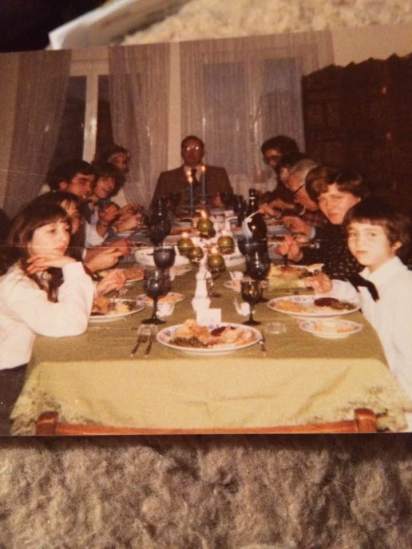
Best Christmas 1980 in Germany

(Our gathering at the table for Christmas dinner. I’m on the left closest to the camera.)

What was your best Christmas memory?

~*~*~*~


The Most Excellent and Insightful Advice for Writers in Creating a Story

A few weeks back, I happened upon this wonderful TEDx talk that blew me away.  The author gave step by step descriptions and instructions on how to write a story.  He brought us viewers into the imagined world of his characters.  We writers believe we know how to do this already, but we never stop learning, and I learned a great deal from this presentation.  In fact, it was the most superb, insightful, and profoundly helpful talk I’ve ever heard or seen on creating a story.  I am sharing it in the hopes that all my fellow writers will find much use in it and gain further knowledge in the art of writing.

(courtesy of and credited to TEDx Talks shared on youtube)

His tips on setting helped me tremendously in writing my latest story I began December 7.  I was thrilled to be able to apply it gently into the beginning scene of this newest work of mine, for which I am not sure whether it will be a short story, novella, or novel.  It will be fun to see where my characters and storyline lead me.

Incidentally, a book I’ll be reading for my fiction writing workshop class that starts early next month is written by Mr. Dufresne.  It’s called Lie That Tells a Truth:  A Guide to Writing Fiction.  How awesome is that?

Please share your comments below on what you thought and took away from this presentation!

~*~*~*~

(Since I was only able to find this on youtube, I was not able to embed it directly from TED.com.)


The Written Word Comes to Life

stardust blue

There are times in your life where something beautiful and unexpected happens, and you’re left in awe as your heart swells with joy and pride for this blessed experience.

When I started back to school in 2014, I’d found the major of my dreams from my childhood that I did not know existed. It presented me with the real possibility of becoming a professional writer. While taking so many fascinating courses thus far online through Southern New Hampshire University, there were three core courses for my major in English Creative Writing from which to choose:

  • Fiction writing workshop
  • Nonfiction writing workshop
  • Poetry workshop
  • Playwriting workshop

Considering I had been writing fiction and had felt most comfortable in that realm, it was the easiest choice for me. Nonfiction was more difficult, but I learned more in that class than I did in my Introduction to Creative Writing course the year before. But I will be taking the fiction writing workshop next term that starts in early January, and will see how it compares to the others. Knowing poetry wasn’t a talent I possessed, nor did I completely comprehend all poems, I chose the playwriting workshop. I had no knowledge or experience in playwriting, but I figured it would be easier to compose than poetry.

I completed the playwriting workshop last term (each term is eight weeks long), and it surprised me and intrigued me very much. I’d learned so much about this art. I found writing plays that depended primarily on dialogue at its core came easier and more natural to me than writing a setting in a novel. Many of the very short plays I wrote for this class were born out of my stream of consciousness.

3d rendering of human  brain on technology background

Rewinding in time to two years ago, in my Introduction to Creative Writing course, I produced a screenplay (the first I’d ever done) for the week’s assignment. It was a play about…well…nothing. And it grew out of a stream of consciousness.   Nevertheless, my fellow classmates and professor loved it and laughed while reading it. This play is called “Falling Up Stairs.”

Fast forward to last term (September-October), when I wrote, again, from a stream of consciousness, my play, “The Tricker’s Treat.”

In mid to late October, I corresponded with a local theater director via my mother-in-law, who acted there on average, two times a year. Through my husband’s and mother-in-law’s help—husband told his mom about my plays, and she passed this on to the director—the director had told me she would be happy to read over my plays. I was nervous at first…the thought of anyone at that level reading my silly plays…but I managed to get past my fears and sent them to her.

With only a few minor changes (one being changing my screenplay, “Falling Up Stairs,” into a play for live theater), she offered her small theater venue and actors to informally read my plays so I could hear how the words I’d written would be animated with tone and expression and flow.

I couldn’t believe it.

This path of writing began to bloom before my eyes, like a new colorful world opening up to me.

Last night, this came to fruition. Hearing the written words of the dialogue between my created characters in my plays come to life was something nearly inexplicable. It was a euphoric moment that lifted my soul and kindled joy in my heart.

I’m still writing fiction stories and enjoy the cozy feeling of being immersed in my created characters’ worlds, but after last night, the longing to see my plays actually acted on the stage with props and costumes–the whole kit and caboodle–grew exponentially. I don’t know what will happen now, but I’m eternally grateful to Laurie, the director, and her actors for the opportunity they gave me to see my play come to life.

The actors and me from the play reading!

(The actors and me (in the center))

~*~*~*~