Do you have a hard time getting back into your writing after you’ve been on vacation? Do you get totally and happily lost in trekking in the peaceful, scenic, and rugged landscape of the Rocky Mountains for two weeks?
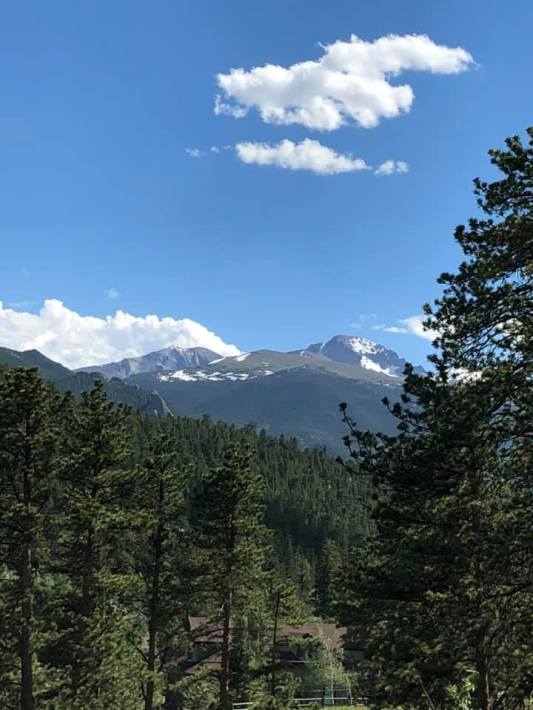
(Long’s Peak seen from our adorable cabin)
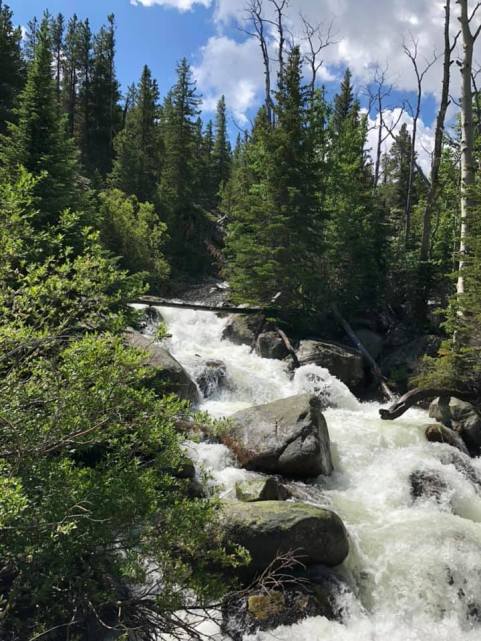
(One of the trails we trekked in Rocky Mountain National Park)
Maybe hung out at an absolutely gorgeous lake?
(Hubby and I)
Okay, maybe you spent your holiday on the beach or zip-lining through the rainforests of Brazil.
In any case, when my family left for our vacation to Colorado (once again. Our last vacation there was June 2017), I’d left my computer at home but brought along a small notebook in case I wanted to jot anything down regarding the experiences I encountered on my trip. And I did. I also wrote a page and a half of a story I’d written notes on a few months ago. The latter was done on the train ride back to Chicago before we picked up our car that had been sitting in the parking garage and headed home.
But still, my mind, body, and spirit absorbed the beautiful surroundings of Colorado Springs where we caught up with dear friends, but most especially, Estes Park and Rocky Mountain National Park. We walked four trails while there, and it was exhilarating.
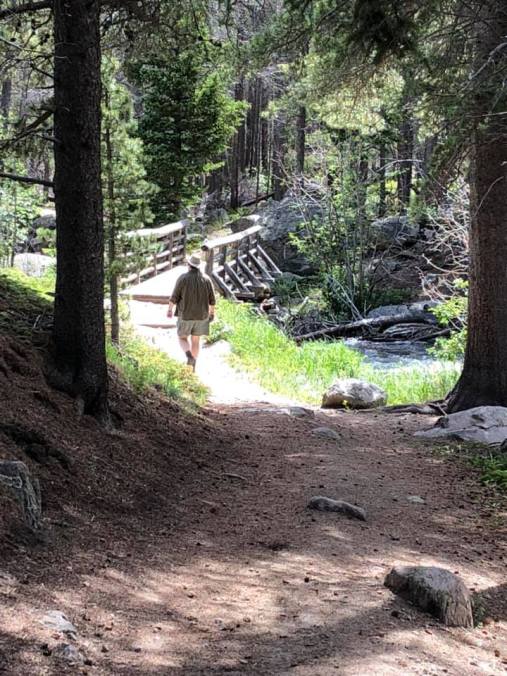
(Hubby walking ahead of me on our second hike, just me and him)
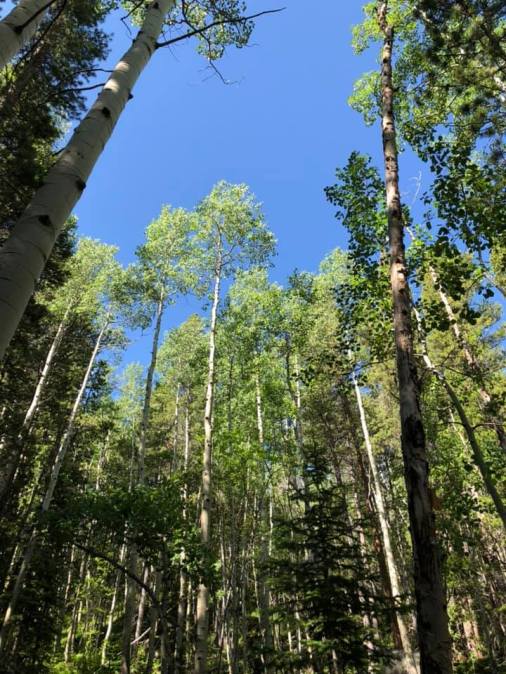
(Canopy of pines and aspens)
(Mid to lower section of Alberta Falls in RMNP)
(Small bridge on one of the trails on which our boys joined us)
And had visitors right outside our cabin.
(A doe about 30 feet from our cabin)
(Buck right near our cabin, as well)
For a little while those first couple of days back home, I worried I’d not want to finish my WIP, but by the third day home, I was finally able to focus and re-immerse myself in my story and others’ stories via my online critique group.
I think what helped get me interested again in my story was submitting the next chapters and reading the ones already in the queue. My characters and the storyline drew me back in. Whew. Thank God!
So, it’s back to the story-creating world for me, while keeping the memories of my favorite place, Colorado, always in my heart, for we want to return to Colorado in three years, after our youngest has finished high school.
When you return from a well-needed and relaxing vacation, how do you get your mind and fingers back into your writing?
Overall, I believe many things happening to the environment are our doing. When we do good things for life on the planet, good things happen. When we do bad things, there are consequences, consequences of our own doing.
Only we are to blame for taking more than we need (greed). We think since we were given charge over all living beings and the planet, we decide who/what lives or dies and how to treat the Earth (pride). We can destroy animals’ habitats as we like and not face the repercussions.
We do this in a myriad of ways: wars, over farming, over fishing, poaching, mowing down of rain forests, polluting the air, water, and soil with toxic chemicals like Round Up’s glyphosate and other deadly poisons like neonicotinoids that have been causing massive deaths of honey bees.
Then there are oil spills and tossing plastics in our oceans, rivers, waterways as if these are our personal trashcans. And it ticks me off because one of my pet peeves is LITTERING. Why anyone would think a body of water is a dumping ground for his or her own trash is beyond me. It’s careless, lazy, and cruel.
On October 29, the World Wildlife Fund released their newest data on the loss of animals. Between 1970 and 2014, we’ve lost 60% of our wildlife. These include “mammals, birds, reptiles, and amphibians” (Davis and Walsh).
What is the cause of this tragic loss? Us. Not the Earth doing its thing. Us.
In the article from the WWF, it states, “The top threats to species identified in the report are directly linked to human activities, including habitat loss and degradation and overexploitation of wildlife.”
Perhaps this isn’t news to you. You’ve known about what’s happening with animals all over the globe. And you are one of many people who are trying to do what you can to support the lives of God’s creatures. Kudos. We do try to do our part.
I knew of recent animals that had gone extinct, like the black rhino (heartbreaking) in 2011, and the announcement that bumblebees are now on the endangered species list. But I had no idea 60% of wildlife had been wiped out in the last 40 years. Devastating.
WWF’s executive director of science and conservation, Mike Barrett, said in a Guardian article, ““We are sleepwalking towards the edge of a cliff. If there was a 60% decline in the human population, that would be equivalent to emptying North America, South America, Africa, Europe, China and Oceania. That is the scale of what we have done.”
That’s a pretty devastating message.
Recently, I saw a beautiful ad that Iceland banned as being too political. Below is the video via you tube. It’s not too political. It’s TRUTH.
The truth is shown in that little minute and a half ad. The truth that there are only 7500 orangutans left in this world, losing on average a thousand a year. This ad needs to be out there for people to see.
Check your food products. If they have PALM OIL listed, consider not purchasing it. The orangutans’ habitat is being destroyed for palm oil. These poor animals have lost their food and homes. It’s killing them off. So please read the ingredients on the foods you get to make sure you’re not supporting their extinction.
Two more pieces of data from the Living Planet Report for 2018 that was echoed in the ad above: “Species population declines are especially pronounced in the tropics, with South and Central America suffering the most dramatic decline, an 89% loss compared to 1970” and “Freshwater species numbers have also declined dramatically, with the Freshwater Index showing an 83% decline since 1970.”
What have we done to help keep God’s creatures alive and well? The WWF said that the creation of the US Endangered Species put in place in 1973, has helped 99% of the listed endangered species to be saved from extinction.
What else can we do to help? Wildlife and biodiversity issues have to stay as one of our top concerns.
Little things my family does is we don’t use straws at home or at restaurants because of the plastic problem in our oceans and other waterways. We try and buy recyclable and biodegradable items. We don’t use harmful pesticides on our yard. We don’t litter anywhere.
My family donates to certain organizations, but we don’t specify which ones because in our Orthodox Christian faith, we aren’t supposed to announce what we give for the good of others, but do so privately.
All of God’s creation matter on this Earth. He assigned us to take care of this planet, and we need to step up and do that. He’s counting on us.
“Love all creation, the whole of it and every grain of sand within it. Love every leaf, every ray of God’s light. Love the animals, love the plants, love everything. If you love everything, you will perceive the divine mystery in things.” – Starets Zosima from the novel, The Brothers Karamazov





 Modest Musings