
Recently, I’ve re-entered the critiquing world in all its fictional fun and grueling work. It truly is a lot of work. I admire editors for the painstaking mental labor they endure. Having said that, I’m thrilled to be back in this creative universe.
I’m in the last week of my IDS Wellness college course, followed by a week off. Then I start my last course in Advanced Creative Writing. After that, my bachelor’s degree in Creative Writing and English!
Time is slowly opening up to me, edging toward mornings free to dedicate my thoughts and energies to story creating and revising,
Every time I read and critique fellow writers’ works in my online critique group, I learn something, usually more than one thing. I noticed the past week, I’ve improved my feedback skills. Yea!
What I find fun and fascinating is when I’ve finished my critique, I go back into the work and read over other critters’ feedback and see how they caught things I missed and vice versa. It’s incredible to read both negative and positive comments on the paragraph–one finding the descriptions or scene awkward or not needed, while another finds it fantastic.
I did learn through two and a half years of participating in this group that when you have more than one person pointing out something in your chapter that doesn’t make sense, isn’t realistic, etc., you heed those because it’s a good chance more readers than not will have the same troubles with that.
I am half way through a book called Understanding Show, Don’t Tell (And Really Getting It) by Janice Hardy. How many times are we writers told to show the scenes, the character’s actions, behavior, etc.? Avoid adverbs. Don’t use filter words like felt, saw, knew, looked, and decided. Don’t use passive “to be” verbs like was and is being.
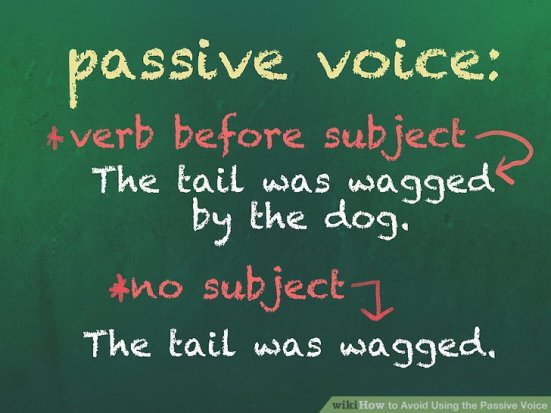
(Passive voice example)
The amount of telling and showing varies a bit depending on the point of view in which you’re writing. I’ll share an example from the book, which I really appreciate. I love visual aids since I’m a visual learner. This excerpt is written in third person through the usual told manner:
Bob screamed in pain when the zombie clawed his leg. He struggled to get away, and realized he had seconds to shake loose before the thing got its hooks into him and went straight for his brain. Zombies needed brains to survive or they turned to dust and bones in just under thirty days. He didn’t have thirty seconds let along thirty days.
A few red flag tell words mentioned in this paragraph, Hardy points out: in and when. We are told when the zombie clawed Bob’s leg, but we don’t really get to see it. In is used to explain how Bob screams and the reason why he screamed. There’s explaining the life of zombies too. The latter is referred to as an infodump.
Therefore, Hardy removes the red flag words, infodump, and Bob’s responses, etc. Here’s the result:
The zombie clawed Bob’s leg. He screamed. He struggled, but he had seconds to shake loose before the thing got its hooks into him and went straight for his brains.
How’s that? Better? Hmm. Hardy says it is. But she also acknowledges it’s boring and needs interesting details. Here is the finalized version:
The zombie tore through his pants, sinking its broken fingernails into his calf. Fire and knives raced up his leg and Bob screamed. He kicked at it with his free foot, but it held tight.
“Let go, you sonuva–“
He kept kicking, but each heartbeat brought it–and its infected teeth–closer. Sure, maybe he wasn’t using his brain this instant, but he wasn’t about to let this dagger get it. Or him.
Improvement, no? I love seeing the before (telling) and after (showing). It’s kind of like hair styles or home makeovers.
As I said earlier, I’m half way through this book and enjoying it. I just wanted to share an example on telling verses showing with excerpts from Hardy’s book in the hopes it helps you, my fellow writers, as much as it has for me.
More to come on this in future posts.
~*~*~*~
Works Cited
Hardy, Janice. Understanding Show, Don’t Tell (And Really Getting It). Fiction University Press.



 Modest Musings