Finish What You’ve Started

spiral notebook and pen

For the past three days, I’ve inched away from my notebook and pencil after writing up my latest chapter a few days ago.  It seems I’ve fallen into that familiar rut where you sit there thinking about your story for which you’re a quarter or half way through it, wondering if it’s really any good.  You look over the chapters and the storyline and wonder if it really is interesting enough to readers.  Would they even read up to chapter eight or nine or ten?  Where has this story gone?  And you find your fingers and ideas bound up in an invisible chain of nothingness filled with your inner critic telling you it’s going nowhere and what’s the point?  You can’t get your fingers to write what you’ve thought about writing the past week, the last month, as you’d been creating this story that started off so easily and with such grandeur and pizazz in hopes of something fabulous taking root and blossoming into an incredible, earth-shattering novel.

In my case, I’ve jotted down plenty of notes on where I want my work in progress (WIP) to go, but I’m feeling a bit like an old game system on its last flicker of electrical usefulness, or a pinball machine that’s tilted into a quiet repose.
writing's hard gif

In author, John Dufresne’s book, Lies That Tell a Truth, for which I’ve mentioned has been one of our reading materials for my current course in fiction writing, he talks about this sputtering along midway through your story, just before you end up running on vapors and quit.  He describes what we writers, I’m sure, have all done once or twice in our histories of writing novels/novellas, etc.  He says, “Perhaps you discover that you’re afraid to fail.  After all, you’ve failed at this before.  Your desk drawer is crammed with half-written stories, isn’t it?”  We writers can probably relate well to his comment.  I’ve had a few upstarts that crashed and burned and were forgotten in old, dusty notebooks sitting in stacks somewhere in the little bookcase in my bedroom.
stack of old notebooks

Dufresne says our real problem is wanting to write our first draft very well, or even, dare we admit, perfectly.  He says, “Every work of art is a failure.  No story is ever what it could or should have been.  You aren’t perfect, never will be.  Neither is your writing.  Get over it.” OUCH.  Ah, but you can read the truth in his words, can’t you?  And then the key to this mess comes out in his next words.  “Perfectionism is the voice of the oppressor.  It’s Mom or Dad or your professor or your critical self telling you you’re not good enough.  And the only way to silence this discouraging voice is to write.”  And that doesn’t mean writing it very well the first time.  Just writing it!  Dufresne says, “A good first draft is a poor first draft.”  Allow me to quote that again:  “A good first draft is a poor first draft.”  Oh, I think it may some time soon sink all the way into my gray matter.  Yes, let’s hope before my next feeble attempt at writing another chapter.

John Dufresne says another encouraging line:  “You’ve simply transcribed thoughts on paper.  This is taking dictation, not creation.  Expecting too much from an early draft is the most common mistake beginning writers make, and it leads to frustration and disappointment.”  But I thought I wasn’t a beginning writer, didn’t you?  I mean, I’ve been back at this since the fall of 2014.
tom hanks trying to write

And here’s the sharp sting of truth to the heart for me (maybe for you, too?):  “Or maybe you’ve lost faith in your material or confidence in yourself” (Dufresne).  Well, yeah.  I can relate to that….I mean, that’s me sporadically in creating my stories.

But Dufresne tells us, “You will experience that same uncertainty and uneasiness in the writing of every story.  This is how writing happens.  You bring that anxiety to the blank page.”  So, we are to relax and let whatever sprouts from ours head reach our fingers and move pen on the paper, or fingers on the keyboard.

writing

So, this blog post is about encouraging us writers to realize the first draft is crap and it doesn’t matter how it’s organized or written.  JUST WRITE.  And with this, I will sit down with pencil and notebook and scribble across the pages mediocre words that may give birth to a few stellar ones, creating a scene in which the characters are doing something that may or may not be more exciting than counting the brown blades of winter grass in my backyard.


~*~*~*~


Works cited
Dufresne, John.  Lies That Tell a Truth:  A Guide to Writing Fiction.  New York:  W. W. Norton & Company, Inc., 2003.


Pen/Pencil Vs. Keyboard

notebook and computer

It has been my practice from the time I first started writing stories in my early teens to coming back to writing in 2014 to write with a pencil in a spiral notebook.  Hold on… there was one novel I wrote in my early twenties that was directly typed into the computer, but that was the only one.  Otherwise it’s been pencil to notebook paper, and it always seems to work well and better for me.

But I’ve been asked why do I write out my stories twice–once on paper and then on the computer?  Why not just skip the first step and type straight on the glowing Word page?

So, I tried that with my last novella and my work in progress.  It took me this long to realize why I hadn’t done it in this manner for the most part.  I had many questions  that weren’t what my friends were asking.  These questions were, “Why am I having such a hard time formulating what I want to write in these sentences?  Why do I sit there pausing, searching for words to come to my head to create a simple sentence?”

At first, I thought it was the changing from writing in first person to third person.  But my novella was written in first person, so that, obviously, isn’t it.  Is my inner editor/critic interfering with my flow, expecting me to put down sentences perfectly correct the first time around?  No, I don’t think so.  It’s the problem of just typing them via the keyboard and watching them pop up on the white page on the computer screen.  It’s very sterile and uncreative to me.

empty white page on computer

I decided to look up information on the differences between writing out your story with a pen or pencil and typing it on the keyboard of your computer.  There were several articles on this.  One was from The Guardian.  There were a few explanations from authors that really cinched writing longhand for me (which I went back to a couple nights ago, and didn’t have any problems with what to say or with the point of view I was using).

Lee Rourke, the author of the article, is a writer with the pen first.  He explains, “Not only is longhand a much more portable way to write, it’s also much more individual.”  His writing process is like mine, in that he composes all his thoughts onto physical paper first and then transfers it to the computer.  In addition, he says, “There are far too many distractions when writing directly onto the screen. The internet being the main culprit.”

Rourke’s description of what it feels like to write longhand is what I experience.  He says, “In longhand, the hand moves freely across the page in a way no amount of computer jiggery-pokery can muster.”

Writing longhand mutes distractions and puts me in the creative realm where flow of language, imagery, and sentence structure comes much more naturally.

There is the subject of pace when writing, and from my own experience, my writing flows on paper and has little road blocks, but when I type, it’s as if I’m turning the key in my car’s ignition, and it coughs several times before rumbling to life, and the process continues with speed bumps interrupting and jostling my thought process and ability to write.  Writing is slower but more constant for me.

Author, Alex Preston mentioned in the article, discovered this pacing issue between writing longhand and typing on the computer, saying, “It’s important to find a tool that matches the pace of the writing. I composed my first book in a computerised blur; for the second, I wanted to be more scrupulous, more thoughtful. This is the pace of longhand. Writing with the fetish objects – the Uni-ball pen, the Rhodia notebooks –and watching the imprint of pen on page reminds us that writing is a craft. If everything is done on keyboards and fibre-optic wires, we may as well be writing shopping lists or investment reports.”

It’s true that composing my stories longhand feels more artistic, a real craft, as Preston said.  Perhaps, because the ideas flow on the page better and more beautifully has something to do with having a pencil in your hand rather than your fingers on a keyboard.

woman writing in notebook

It’s a known fact that students produce more ideas and retain better what they are learning through writing notes rather than typing them.  I believe this can apply to writing stories as well.

In a 2017 Huffington Post article, learning specialist, Patricia Ann Wade, says, “Writing entails using the hand and fingers to form letters … the sequential finger movements activate multiple regions of the brain associated with processing and remembering information.”

This article also brings up taking more time to write something via longhand is actually a good thing overall.  Wade adds the reason why slowing the pace matters is because, writing longhand, “requires more mental energy and engages more areas of the brain than pressing keys on a computer keyboard.”

Yes, and here is where my writing longhand is an affirmation for my ability to write more creatively.  The article goes on to say that writing with pen and paper “sparks creativity” (Pearson).

Finally, The Guardian author, Lee Rourke, finishes this subject of creativity by saying, “For me, writing longhand is an utterly personal task where the outer world is closed off, just my thoughts and the movement of my hand across the page to keep me company. The whole process keeps me in touch with the craft of writing. It’s a deep-felt, uninterrupted connection between thought and language which technology seems to short circuit once I begin to use it.”

All of this information hits home for me and confirms the benefits of writing with my pencil on paper.  I will continue this process from now on (shouldn’t have ever left it!), and will be happier for it.

Share below your thoughts on what works best for you in your writing.


Works Cited
Rourke, Lee.  “Why creative writing is better with a pen.”  The Guardian, 3 November 2011.  https://www.theguardian.com/books/2011/nov/03/creative-writing-better-pen-longhand
Pearson, Catherine.  “The Benefits Of Writing With Gold Old Fashioned Pen and Paper.”  Huffington Post, 6 December 2017.  https://www.huffingtonpost.com/2014/09/12/writing-on-paper_n_5797506.html


How to Keep Writing When You’ve Run Out of Steam in Your Work in Progress

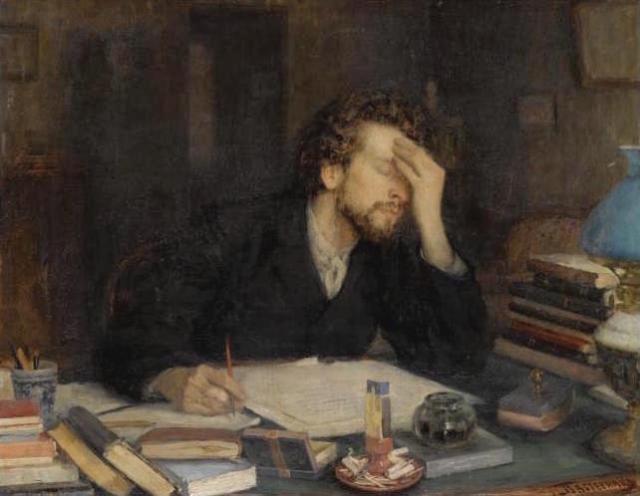
painting of author stuck

There’s the topic of daily writing that is discussed and wrote about often to give us writers encouragement.  This is important because the more you write and read, the better your writing becomes.  But there is another aspect of writing that I’ve run into many times in the past but hadn’t thought about it until yesterday.  It was brought up in a Facebook writing group in which I’m a member.  This pertains to how to continue writing your work in progress without losing steam.

What happens when you write a few chapters and all of a sudden your mind goes blank, even though you know where you want your story to go.  Thinking about it and executing it are two different animals.  My present work in progress is a complex story in my view, as I am writing it from three different characters’ perspectives and they all tie into the main plot that strings their lives together.  Also, I’m writing in third person point of view.  I thought I wrote only in third person point of view in my teens and early twenties, but I didn’t have the knowledge of what that actually meant until my fiction writing course at SNHU and my online critique group over the past couple of years, so my stories were probably more omniscient points of view.  The fiction writing course, which I’m in right now, has helped me to understand it, but I am still in the process of practicing and trying to produce it.

writing scrabble blocks

On to the subject at hand–losing steam while in the midst of writing your novel, novella, or even your short story.  First, I want to add one more piece of information, which won’t really be novel (pun intended) to us writers, but I’m going there anyway!  Creating a story and writing it is a lot more difficult than I thought years ago.  Once you learn the elements of character, plot, setting/place, and structure, you realize it takes a lot more effort and technique and skill to write than you ever thought.  So, as you trudge forward in your chapters, you unexpectedly hit road bumps.  Those road bumps are your creative juices and ideas sputtering to a stop.  What do you do?

What I used to do and still do that sometimes works just on its own is reread the chapter I just wrote to stimulate the thoughts and continuation of the story and where I want it to go.  But I’ve incorporated something else that I believe really helps keep me on the greased tracks of continued creative writing.  I write pages of notes.  I’ve gotten into the habit of doing that.  It was discussed often in John Dufresne’s book I’m reading for my fiction writing workshop class that I mentioned I’m presently in.  So, just yesterday after writing a lot the day before, I hit that road block.  My mind was jumbled with the characters, the plot, like cut-out words from newspaper articles all haphazardly shuffled together in a disorganized heap.  How do I write the next chapter? Who is the next chapter about?  Am I continuing with the same character, or do I move on to the other one?  It needs to move the plot along.  What am I doing?

spiral notebook and pen

I begin writing more notes that turn out to be around four pages in my trusty spiral notebook.  Notes on what the next chapter will be about and who’s in it.  This expands to connected characters and what they are doing and why.  Questions appear in my scribblings, and I need to have answers for the story to make sense and to move forward, so I offer different responses and see which one sticks…which ones are most plausible and most believable.  Sometimes research is needed in this depending on the subject matter.  In any case, the jotting of notes continues until all those words about the characters, their actions, how they move the plot along, and the questions are answered satisfactorily, gives me enough ammunition to create my next chapter.  I will use this strategy/technique for each chapter if the flow of the next sequence of events isn’t happening or the gas tank of creativity is empty.

If you run into these road blocks in your writing, what do you do?  Was my process helpful to you?  Have you tried that already?  Please share your thoughts, fellow writers. 🙂


~*~*~*~