
Critiques, Show, Don’t Tell, Oh My!

Editing an English language document

Recently, I’ve re-entered the critiquing world in all its fictional fun and grueling work.  It truly is a lot of work.  I admire editors for the painstaking mental labor they endure.  Having said that, I’m thrilled to be back in this creative universe.

I’m in the last week of my IDS Wellness college course, followed by a week off.  Then I start my last course in Advanced Creative Writing.  After that, my bachelor’s degree in Creative Writing and English!

Time is slowly opening up to me, edging toward mornings free to dedicate my thoughts and energies to story creating and revising,

Every time I read and critique fellow writers’ works in my online critique group, I learn something, usually more than one thing.  I noticed the past week, I’ve improved my feedback skills.  Yea!

What I find fun and fascinating is when I’ve finished my critique, I go back into the work and read over other critters’ feedback and see how they caught things I missed and vice versa.  It’s incredible to read both negative and positive comments on the paragraph–one finding the descriptions or scene awkward or not needed, while another finds it fantastic.

I did learn through two and a half years of participating in this group that when you have more than one person pointing out something in your chapter that doesn’t make sense, isn’t realistic, etc., you heed those because it’s a good chance more readers than not will have the same troubles with that.

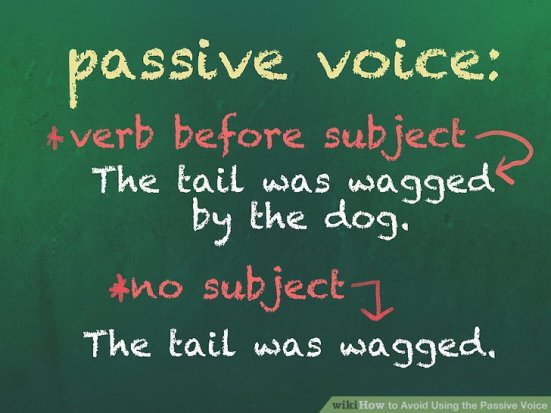
I am half way through a book called Understanding Show, Don’t Tell (And Really Getting It) by Janice Hardy.  How many times are we writers told to show the scenes, the character’s actions, behavior, etc.?  Avoid adverbs.  Don’t use filter words like felt, saw, knew, looked, and decided.  Don’t use passive “to be” verbs like was and is being.
passive voice ex

(Passive voice example)

The amount of telling and showing varies a bit depending on the point of view in which you’re writing.  I’ll share an example from the book, which I really appreciate.  I love visual aids since I’m a visual learner.  This excerpt is written in third person through the usual told manner:

Bob screamed in pain when the zombie clawed his leg.  He struggled to get away, and realized he had seconds to shake loose before the thing got its hooks into him and went straight for his brain.  Zombies needed brains to survive or they turned to dust and bones in just under thirty days.  He didn’t have thirty seconds let along thirty days.

A few red flag tell words mentioned in this paragraph, Hardy points out:  in and when.  We are told when the zombie clawed Bob’s leg, but we don’t really get to see it.  In is used to explain how Bob screams and the reason why he screamed.  There’s explaining the life of zombies too.  The latter is referred to as an infodump.

Therefore, Hardy removes the red flag words, infodump, and Bob’s responses, etc.  Here’s the result:

The zombie clawed Bob’s leg.  He screamed.  He struggled, but he had seconds to shake loose before the thing got its hooks into him and went straight for his brains.

How’s that?  Better?  Hmm.  Hardy says it is.  But she also acknowledges it’s boring and needs interesting details.  Here is the finalized version:

The zombie tore through his pants, sinking its broken fingernails into his calf.  Fire and knives raced up his leg and Bob screamed.  He kicked at it with his free foot, but it held tight.

“Let go, you sonuva–“

He kept kicking, but each heartbeat brought it–and its infected teeth–closer.  Sure, maybe he wasn’t using his brain this instant, but he wasn’t about to let this dagger get it.  Or him.

Improvement, no?  I love seeing the before (telling) and after (showing).  It’s kind of like hair styles or home makeovers.

As I said earlier, I’m half way through this book and enjoying it.  I just wanted to share an example on telling verses showing with excerpts from Hardy’s book in the hopes it helps you, my fellow writers, as much as it has for me.

More to come on this in future posts.


~*~*~*~


Works Cited
Hardy, Janice.  Understanding Show, Don’t Tell (And Really Getting It).  Fiction University Press.

Steadying Your Creative Flame

candle flame


What’s all this effort for?

When you look at what you wrote and it’s a bore.

You’ve lost the creative spark

That drew you out of the dark.

You’d created so many tales

That you believed kept you on the scrawling rails.

But that was three years ago,

When your passion was again aglow.

Now the embers of your exhausted endeavor,

Are giving off the last flick of light ever.

Confusion, fear, and sadness cloud your head,

At the thought that your life passion is dead.

What was it all for?

To come to a place you abhor?

No.

Rather, you realize the time has come,

To take a needed respite

For your mind to be relit

In the days and weeks ahead,

Because you refuse to believe your craft is dead.


How Creative Writing Can Boost Your Intelligence (Guest Blog Post)

This is a reblog of my fellow blogger, Nicholas C. Rossis’ guest blog post.  I thought it was important to share.  Credit goes to Nicholas and guest blogger Sally Keys.


This is a guest post by Sally Keys. You may remember her from her guest post, Creating The Time And Space You Need To Write Your Best Work. Sally is a professional freelance writer with many years experience across many different areas. She made the move to freelancing from a stressful corporate job and loves the work-life balance it offers her. When not at work, she enjoys reading, hiking, spending time with her family, and traveling as much as possible.

How Creative Writing Can Boost Your Intelligence

Globally, the average IQ has increased by 20 points over the last 100 years. Many reasons are given for this and all, no doubt, play a part. The fact is that we live in a very different world to the one of 100 years ago. By examining these differences and comparing them to research into intelligence, we can determine ways to boost our own IQs. Creative writing can play a major part in this but only if you are pushing your writing standards to the limit.

What Is Different About Today?

Globalisation has led to multiculturalism becoming the norm. Diethas improved dramatically and, along with basic medication, we have all but eradicated many of the illnesses that struck us down in childhood. Film, television, and mass production of books have all played a part in increasing our exposure to new ideas. Computers for communication, leisure, and research all provide a range of inputs that simply did not exist in the past. New stimuli are known to stimulate the prefrontal cortex (an area of the brain linked to intelligence) and our increased globalization and technological development make novelty a regular occurrence (despite how counterintuitive that may sound). Diet and healthcare help our brains develop further (especially at an early age) and free us from having to fight infections or deal with malnourishment.

What Has This To Do With Writing?

There is some evidence that 5 simple steps can help to boost your intelligence. Each of these can be achieved through creative writing if you approach it properly.

The first, seeking novelty, has been mentioned already. By writing about unfamiliar topics, doing research into another country, trying new foods and so on you are pushing yourself to experience the new.

You are also achieving step 2, which is to challenge yourself. Increase your challenge (and introduce more novelty) by stepping out of your comfort zone. Write a chapter in iambic pentameter or in verse, try a different voice for narration, or find any of a million different ways to push yourself. You could challenge yourself further by taking IQ tests. By taking tests before actively pushing yourself when writing, you could experiment and take the tests again at the end to see if you’ve improved.

The next step is the one most obviously linked to writing – think creatively. The simple act of writing fiction is sufficient stimulus to cognitively challenge your brain, but if you want to boost it, you need to think outside of the box. Take your creativity to the next level by remembering to seek novelty and by challenging yourself. Whilst our novelty-rich modern world has boosted our intelligence as a species, there is something to be said for doing things the hard way. Old-fashioned methods often bring their own cognitive challenges, especially as modern methods become more familiar.

Which leads us to the fourth tip; to do things the hard way. Write your first drafts long-hand. Turn off the grammar and spell checkers when you write it up and edit manually. Do some of your research from books instead of the internet. Taking the longer, slower route brings with it new challenges that cause new stimulation.

The final tip takes us back to one of the ways in which the modern world is different to the old, but it also turns it on its head. We live in multicultural societies and interact with people from across the globe, but do we really know people as well as we used to? The concept of communities seems to have gotten lost along the way. As a writer, the final stage of your work is to share it. If you aren’t taking this step, then you are missing out on the 5th tip, to network. Sharing ideas with others who have faced similar challenges and getting to know them both in person and through their work, will help you increase your intelligence – and improve your writing.