Miyazaki’s Masterpieces Center on the Human Condition

miyazaki movies collage

Have you ever seen any of Studio Ghibli’s animated movies? In particular, Hayao Miyazaki’s animated movies through Studio Ghibli? I know that many of you probably have, but if you haven’t, this blogpost is for you (and for fans of these movies!).  They are drawn in the anime style and are fantastic.  My family has a stack of them sitting in our DVD bookcase.  What makes the movies so superb is their depth, their artwork, and their focus on the human condition.  Below, I go into detail about two specific movies of Miyazaki’s that portrays the characters, their relationships, and good and evil through the lens of the human condition.

In Disney movies, there is a strong distinction between the heroes and the villains, especially the earlier animated ones.  I would go so far as to say many of the villains in Disney movies are two-dimensional, fail to show remorse most of the time, and lack the full makeup of human beings–good and bad qualities.  But with such movies as Spirited Away, the human condition and the more rounded personalities of the characters are present and great to watch.  

Spirited Away

This movie is long, engrossing, and deep.  So deep that you forget you’re watching an animated feature (this is the case for all Miyazaki’s films).  Chihiro, a young, 10-year-old girl is riding with her parents in their car heading for their new house in a new city.  She possesses a bratty mentality who is not happy about moving, which is typical for children who like to stay where they grew up, for the most part (says the daughter of an Air Force officer who moved every two to four years. Haha).  Anyway, her parents and she end up going through a type of stone tunnel that opens up to green hills and a little village with a bunch of shops.  Her parents get caught up in the smell and devouring of delicious food, and their gluttony takes over, transforming them into huge pigs.  Chihiro is left alone, desperate to help her parents.  Later, she becomes an employee at a bathhouse run by a nasty witch who steals people’s names.  Still, aspects of good show through this witch, which makes her more “human” and interesting.  

A teenaged boy, Haku, aids Chihiro using his special powers, as he’s also a white dragon.  And then there’s No Face.  This character doesn’t speak, and appears and disappears in and around the bathhouse where Chihiro works.  He followers Chihiro and tries to give her handfuls of gold, but she isn’t interested.  All those that do take the gold blocks are eaten by No Face.  He becomes gluttonous, and can’t stop eating.  He’s miserable, and he sees Chihiro as the person to save him from this.  Instead of kicking him to the curb for his destructive behavior, she eventually helps him, and his passion is squelched. Also, the witch softens towards the end of the story.  

Through helping others, learning to be independent and resourceful, Chihiro matures and loses the brattiness and ungratefulness that had been part of her at the beginning of the story.  There’s the element of redemption in this that I love–that people aren’t all bad or good, and that they repent and change.  All of these elements in this Japanese movie show Christian aspects but are globally understood because it’s part of humanity and its ability to transform through the love of others that shines the light of Christ, from my perspective.  If you haven’t seen this epic film, I highly recommend it.  Although it’s a “children’s movie,” (I wouldn’t say very young children), it’s for adults, too.

Howl’s Moving Castle

This movie is enchanting.  It, too, is long and engrossing.  Again, you forget this is animated. Main character, Sophie, is a young woman who works with her sisters in her since deceased father’s hat shop until she encounters Howl, the Wizard, and then The Witch of the Waste.  The latter casts a spell on Sophie, turning her into an old woman.  Sophie did not consider herself beautiful, and so, although she isn’t happy she’s been turned wrinkly, it’s the struggle with her aching body that causes her the most difficulty.  She finds herself inHowl’s magic, moving castle and works for him as a cleaning lady.  Throughout this is a war going on in the country where she and the others live.  

Howl suffers from vanity.  He is particular about his hair color, his clothes, and how he looks.  If something comes between him and his appearance, he crumbles, and this happens in one of the scenes.  Black forms of demons slither out and around him while he’s melting in the chair.  Why?  Because he’s allowed his vanity to overtake him, causing him the danger of being destroyed.  But Sophie is there to talk to him and help him.  

Ultimately, Sophie’s compassion toward Howl, the Witch, and other characters brings about remorse and repentance for those characters that were doing evil.  Sophie does not have a high regard for herself and believes herself to be unattractive.  But she grows through dealing with the curse of being old.  I don’t believe she cared that she was old because she didn’t think she was beautiful anyway, so she didn’t lose anything in appearance.  But she learns through helping others, and these people’s respect for her, that she is truly worth something and she learns to like herself.  In return, Howl tells her she’s beautiful and helps her get back home.  If you haven’t seen this one, please do.

Whenever watching these movies, everything around you melts away, and you’re sucked into the storyline, the characters, and the beautiful artistic scenes.

There are plenty of other spectacular Hiyazaki movies that are just as deep, and some a little lighter in content.  Below is a list of the DVDs we own that are all fantastic and enjoyable.

Princess Mononoke (my oldest son’s favorite, and very profound)

Kiki’s Delivery Service

My Neighbor Totoro

Nausicaä of the Valley of the Wind (profound)

From Up On Poppy Hill (my favorite lighter film)

Castle in the Sky

Whisper of the Heart

The Secret World of Arrietty

Porco Rosso

Incidentally, if you’re in to real tear-jerkers, watch this Studio Ghibli movie called Grave of the Fireflies.  It’s a twenty-tissue film, and one I doubt I’ll be able to watch again, but it was incredible.

Take a look at this video that explains Miyazaki’s theme of the human condition in his works.


~*~*~*~


A Guardian Angel’s Warning

Orthodox guardian angel for women


In the summer of 1993, Deanna drove her gray hatchback around the unknown neighborhood for a third time, seeking out a friend’s house.  After the past three years of a tumultuous and painful relationship with Kyle, she desperately desired a man who would fiercely love her back. She wanted to take a chance with her good friend, Patrick.  They had been fellow classmates in their sociology class at the local community college four years before and had kept in touch.  She knew he liked her more than just as a friend, so she believed her efforts to pursue Patrick would be worthwhile, as she struggled to unshackle herself from the dead end that was Kyle, the golf enthusiast.

The gray cloudy sky veiled the afternoon sun, as Deanna rolled down the same street for the fourth time.  Panic and worry settled in her chest as she faced the realization she didn’t know which house was Patrick’s.

As her hopes fell, the car rumbled to a stop in front of a modest, two-story house.  She checked her watch and found it was already after four o’clock. Anxiousness took hold of her, and the thought of calling Patrick flooded her mind.  The insistence grew so strong that she turned off the engine and exited the vehicle.

Walking up to the porch, ideas of what she’d say to Patrick floated through her mind.  Since she’d lost the chance to surprise him at his house, she’d have to surprise him with a call.  She knocked on the door with anticipation of the soon-to-be conversation.

A minute later, the door slowly opened, and a middle-aged man in a bathrobe eyed her with a mixture of irritation and curiosity.

“Hi, can I borrow your phone?” she asked with an impatient smile.

He hesitated for a moment, still staring at her, but then said, “Just a minute,” and retreated from the doorway, leaving the door cracked.

Eagerness and excitement bubbled inside Deanna as the imagined conversation with Patrick danced in her head.

Suddenly, a voice neither specifically male nor female squelched the talking in her head.

“What are you doing?”

Deanna froze, hearing this unexpected and unfamiliar voice.

“Leave the porch, get in your car, and get out of there.”  The tone was firm but not cruel.

Fear laced through her stomach as the realization of nearly entering a complete stranger’s home shook her.

Deanna bolted from the front of the house, got in her car, and fumbled for her keys, trying to shove the car key into the ignition.  As the vehicle hummed to life, she glanced at the house, where the man stood there still in his robe, behind the screen door, peering at her with a stony expression.

Heart pounding, Deanna flicked a wave in his direction and sped off.


(This story is based on my true life experience, with change in names for privacy)


~*~*~*~


Writer’s Block “is a fabrication”

writer's block wads of paper and pen


On Monday, January 8, my fiction writing workshop class at my online university starts up, and I’m reading two books:  The Lie that Tells the Truth by John Dufresne, and 100 Years of the Best American Short Stories by Lorrie Moore and Heidi Pitlor.  I’ve already read one short story assigned for this week in the latter book, and I’m half way through the second chapter of Dufresne’s book assigned to us.  As I suspected, Dufresne’s book is excellent.  He writes with such clarity, wit, and animation, which is really fabulous for a book that’s published for teaching writing techniques to fiction writing students and beginner writers (but I think it’s valuable information for even experienced writers).  

john dufresne book the lie that tells the truth

In the first chapter assigned for us to read, he talks about getting in a routine of writing at least fifteen minutes each day in whatever place is your writing space.  If you get stuck, scan the things around your room, like a photograph of somebody or something, a colorful bird perched outside your window, or Mardi Gras beads, for example, and write about it.  You have still gotten in your writing for the day, and it wasn’t wasted because one of those items you wrote about may be useful in a future book.

In the second assigned chapter we are reading for the first week of this course that is eight weeks long (called a term, as are all undergraduate online classes at SNHU), he talks about writer’s block that clears up any ambiguity or belief in it.  Here’s an excerpt from the book on this (that I partially used in my blog title for this piece):

“Understand that if you didn’t write today, it’s because you didn’t want to. You didn’t have the perseverance or the courage to sit there. You lacked the will and the passion. Maybe you don’t enjoy it enough–we always find time to do the things we love. Your choice not to write–and it is a choice–had nothing to do with what has been called writer’s block. Writer’s block is a fabrication, an excuse that allows you to ignore the problem you’re having with your story, which means, of course, that you cannot solve the problem. But it does let you off the hook, doesn’t it? You can tell your friends, I have this strange and debilitating neurological paralysis that affects only writers and it’s untreatable. I just need to let it run its course. Saying you’ve come down with block gives something else the control over your behavior and conveniently absolves you from responsibility.

You must not accept or embrace this expedient but ludicrous notion that you can be blocked from writing. Writing is a job, like being a secretary is a job. And if you have a job, you go to work every day, or you lose the job.”

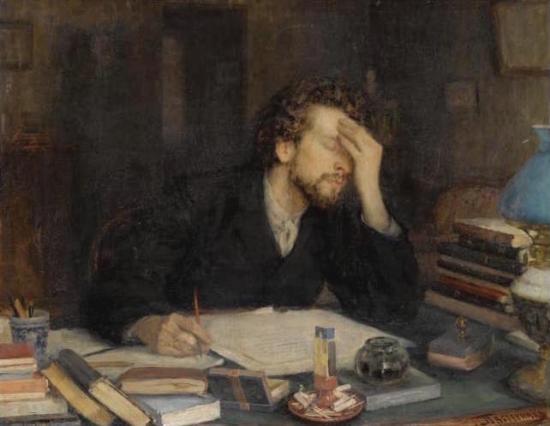
painting of author stuck

I don’t know about you, but this really opened my eyes.  After all, I thought I had “writer’s block” for nearly 18 years, as I’ve mentioned in a few of my blog posts.  But pondering those years, I was just busy and allowed all the things around me to take me away from my writing, and in most of those circumstances, they were legitimate reasons why.   Considering I was taking care of my youngest son’s special needs when he was a baby, toddler, and early grade school age, he needed to be my first priority.  It was only right he came before any thoughts of taking up writing again that I’d not touched in eight years by that time.  

But what I took away from Dufresne’s words, other than the fact that writer’s block isn’t real, is that writing is a choice and a job.  This is so important, and I am asking myself why hadn’t I considered this before?  It hadn’t even crossed my mind.  Why did I think of writing as more of a pastime or hobby?  Do published authors think what they’re doing is just a pastime or hobby?  I highly doubt it.  It’s what they do, their job. They put their hearts and souls, sweat and tears into their novels and short stories.  Therefore, what Dufresne says makes perfect sense, and these words need to be heeded and remembered always for us writers.  In fact, it would be good to jot this down in our notebooks and perhaps type them up in bolded, large print and hang it up near our writing space as a constant reminder whenever we are feeling stuck or distracted or lazy.  

In the weeks to come, I may write more blog posts on what John Dufresne has to teach us (he does teach at a college in Florida) on the techniques and art of writing.  Until then, keep on keeping on with the pen to the paper or hands on the keyboard and eyes on the  MS Word document filling up with your thoughts in black and white.

~*~*~*~