The Importance of Your Creative Work Space

desk and windows

I’m sharing a post by fellow blogger, Nicholas Rossis, who shared a guest post about your work space and how it can help and improve your creative writing.  Until today, I’d been sitting on my bed writing, and well, that wasn’t really the best place to be a creative writer.  So, these tips helped me to change that, and I’m now sitting in my living room/library at my desk, and I already feel better having the space to type and write and  the fortunate treat of being able to look out the picture window that I believe will help to inspire me to create many imaginative characters, settings, and stories (God willing!).

I hope this shared post is beneficial to your writing.

This is a guest post by Jade Anderson is an experienced In-house Editor at Upskilled. With a background in online marketing, Jade runs some successful websites of her own. Her passion for the education industry and content is displayed through the quality of work she offers.

6 Tips for Making a Workspace Conducive to Writing

No matter what type of content you’re writing, whether it’s fiction, investigative journalism, feature pieces or academic articles, the environment that you write in has a big impact on how well you put that piece together. Writing takes skill, for sure, but where you write can affect how you write because if there are distractions in your workplace, your writing is likely to reflect that. As a writer, your workspace should be inspiring and comfortable in equal measure. It should be somewhere you can focus and reflect. Here are five tips for creating the perfect writing workspace.

2. Make Sure You Have Privacy

One criterion for success when it comes to writing is consistency. Often, this means writing something every day. But it also means trying to work in the space every time you write. In order to find a space where you are going to be able to be productive most days, you need to consider the level of privacy you will have. Choose a space where you’re able to be alone with your projects and your thoughts without being distracted by background noise or other people. This can simply mean working in a room in your house that has a door or finding an area where there is little to no foot traffic. Having a private, dedicated area that is yours allows you to have a distraction-free workspace.

3. Consider Your Desk And Chair

How comfortable your desk and chair are, are important factors that affect how productive you are. If you feel cramped or uncomfortable, you’re far more likely to get distracted and want to stop working. Chances are, you’ll be sitting and typing for long stretches of time, so you need a space that is ergonomic. Make sure that your desk and chair are at the right height so you don’t have to strain or hunch to work on your computer. You need a chair that will support your back and encourage good posture. As for your desk, it must provide enough space for everything you need.

4. Declutter

It is hard to work amongst clutter. Physical clutter can cause mental clutter, leaving us feeling distracted and unfocused. Getting rid of unnecessary mess and creating a clutter-free space is one of the key steps in creating an environment conducive to writing. While decluttering can take some time and hard work, it pays off. Set aside a day to declutter the space you wish to work in and decide what items you will throw out, what you’ll donate, and what you’ll keep. If you have furniture, files or belongings that you want to keep but don’t necessarily need right now, consider putting these things into storage. Using community storage is an affordable and convenient option should you find yourself in this situation.

5. Make It Yours

Your workspace is a space for you. You want it to reflect your personality and to be a place where you feel comfortable and at home. While you shouldn’t fill it with personal belongings that may be distracting or cause clutter, you should put some effort into personalizing the area. This can be with artwork, photos or other decorative features that you feel express your personality. As a writer, you may wish to personalize your space by filling it with your favorite books or quotes from your favorite authors!

6. Go For Natural Light

Regardless of your industry, natural light has been proven to impact productivity. The sun boosts your mood, gives you energy, and can stimulate creativity. For these reasons, natural light is particularly important for writers. If you’re working from home, it might be difficult to find a room with natural light to work in. However, even if you can work in front of a window or in a room with a skylight, this is better than nothing. Adequate light is important no matter what time of the day. If you’re working into the evenings, ensure that you have artificial lighting so you can read and write without straining your eyes.

7. Have What You Need On Hand

In order to work productively in your workspace, you should have everything you need to work on hand and ready to go. In the digital age, this might mean having all your tech accessories, chargers, and screens neatly arranged by your desk so they are easily accessible at all times. For writers, having two screens can be particularly useful. This allows you to have multiple windows open if you are researching and writing at the same time. If you still like the traditional pen-to-paper method when you’re figuring out your ideas, ensure you have plenty of supplies at hand in your desk drawers or on your desk.


~*~*~*~


When Art & Math Unite

colored fractal

In 2015 through my online college, I took a required general education math course on math concepts for which I chose thinking I could maybe get through that seeing how horribly I did in math in my high school years.  That most math above the basics was something to avoid and something appearing too foreign like a lost prehistoric language with strange and cryptic symbols.

Ahem…All you math geniuses out there, please humor me and follow me through this post.

How naive I was to think math concepts would be easier.  So many of these concepts I’d never heard of before, but by week two, I was to choose one for my final 10-page paper on this concept.

This discovery caused me great anxiety, and I wrung my hands and shed tears of fear and panic allowing these scary unfamiliar math theories and formulas to balloon up to a major overwhelming hurdle over which I didn’t believe I could jump.

I beseeched my advisor that perhaps it had been a mistake to take this class, and really, I needed to go back to square one and take a basic algebra class first before my brain could wrap itself around any of these heady applications.

But alas, I’d missed the window to withdrawal from the course and with a gulp and shaky body, I braced myself for the onslaught of cryptic, confusing, symbolic hell.

By week two, I was introduced to the Fibonacci sequence, and immediately, my mind was blown.  The same numbers (0, 1, 1, 2, 3, 5, 8, 13, 21, 34, …) found on pinecones were found on other objects in nature, such as flower petals and the nautilus. Yes, I’m sure you all already knew this, but for me, this was all new and fascinating!

Cool video by Khan Academy on the Fibonacci Sequence:

(credit to Khan Academy)

There was a dark, cobwebbed, spongy crevice in my brain that opened up like the detachable hood off of a convertible, and God’s universe glistened bright and infinitely vast before me.  The mathematical number sequence and how it joined with nature screamed the hands of God, for nothing perfect in this world can be accidental or just be.  Something perfect has to be created by Someone Perfect–God.

Suddenly, math had taken on a totally different view for me, and I liked it.

Reading over and looking up the meaning of the list of math concepts in which we students were to choose from, I finally chose the knot theory because it sounded less scary and perhaps even something my simple, elementary math brain could comprehend.

So, for the next few weeks, in between weekly assignments, I read the history of knot theory, its formulas, how it’s used in life, and watched videos of professors teaching the knot theory by scribbling many different knots on the chalk board and explaining the negative and positive integers used in them.  Frankly, I enjoyed watching those lectures!

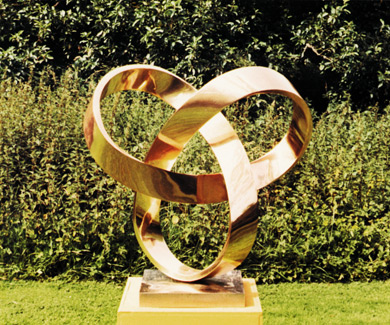
While researching how the knot theory is used in life, such as in our DNA and mountain climbing, I was pleasantly surprised to find it in art, and not just any art, art by sculptor, John Robinson.

immortality sculpture

The first one shown above titled Immortality, sculpted in 1982, resembles a trefoil knot.  The meaning behind this great work of art is profound and beautiful.  He created this trefoil to represent the three generations of his family, he being the oldest of the three.  It shows the continuous movement and connection through time, becoming infinite.  Robinson said, “I believe that Immortality is made up of one’s memories of the past, as well as those one leaves behind.  I see this Symbolic Sculpture not only as a continuous journey, but also the scroll of which all life’s experiences (DNA) is recorded.”

rhythm of life pic

In the second picture, his sculpture, Rhythm of Life,  was also done in 1982. When creating this piece, he had wrapped a ribbon around an inner tire tube.  The last wrap was the fourth time around, and it returned to its original starting point.  Ronnie Brown, an English mathematician, had explained that this happens in Torus knots in math.  Robinson said, “I created the sculpture about the time that the miracle of DNA had just been discovered, and for me, this delightful flowing ribbon summed up the continuity of Genes.  I found I could balance the 18-inch maquette on a single point.”

Through this math course that was called The Heart of Math, I truly learned there was a lot of heart to it, and a lot of soul and beauty.  It may have taken decades for me to have found an appreciation for math via this class, but I’m just grateful I did discover it.


Works Cited
Symbolic Sculpture:  The Collected Works of John Robinson.  (n.d.).  Rhythm of Life.  Symbolic Sculpture:  The Collected Works of John Robinson.  Retrieved from
http://www.bradshawfoundation.com/jr/rhythm_of_life.php


Steadying Your Creative Flame

candle flame


What’s all this effort for?

When you look at what you wrote and it’s a bore.

You’ve lost the creative spark

That drew you out of the dark.

You’d created so many tales

That you believed kept you on the scrawling rails.

But that was three years ago,

When your passion was again aglow.

Now the embers of your exhausted endeavor,

Are giving off the last flick of light ever.

Confusion, fear, and sadness cloud your head,

At the thought that your life passion is dead.

What was it all for?

To come to a place you abhor?

No.

Rather, you realize the time has come,

To take a needed respite

For your mind to be relit

In the days and weeks ahead,

Because you refuse to believe your craft is dead.