
The Hardest Thing In Life

silhouette of woman facing sunset

There are many difficulties and challenges in life.  Generally speaking, they are usually these:

Financial.  Loss of jobs, debt, etc.

Emotional.  The ups and downs in relationships with family and friends, bullies and adversaries.

Physical.  Illnesses.

Death.  The loss of a loved one.

School.  Working hard to get good grades and finish a degree.

Job.  Stressors in the workplace.

But, for me, none of those temporary hardships and painful experiences is as challenging or as tough as living the Christian life.

It’s a lifestyle that is worked on daily.  One of constant striving to repent, changing my thinking and actions.  It can get very exhausting and frustrating.

Being a Christian, living the life of a Christian, isn’t just believing in God and reading the Bible.  Sure, that’s necessary and included, but it requires more from us.

Cooperating with God’s grace so that we are transformed. 

Image result for public domain pictures of walking path toward the sun

There’s a saying by St. Athanasius that says “God became man so man can become like God” (paraphrased but the gist is correct).

In order to become like God, (called theosis in Greek explained here), there are tools and practices that help us get there.

In the Eastern Orthodox Christian faith, these tools and practices are:

Prayer, fasting, almsgiving, Confession, attending Church services, reading the Bible, books about the Saints, and Other spiritual material, and spiritual mindfulness/warfare.

Image result for public domain pictures of Greek Orthodox Christian Jesus Prayer Lord Jesus Christ Son of God have mercy on me a sinner

All of these practices are like exercises for an athlete training for the Olympics.  With God’s help, we are training our minds, bodies, and souls, in preparation for encountering Him when we depart this life and hopefully enter into His Kingdom.

St. Paul talks about this race we must run until the finish (the end of our earthly lives).  God says that we are saved when we endure until the end.

This transformation of our minds, hearts, and bodies is a life-long journey.

All of this effort is exhausting at times, especially the mental battles via spiritual warfare.  You’re fighting with the enemy’s temptations, and your own ego/pride.

Incidentally, you have to die to live.

We died and rose with Christ in the fount at our baptism.  But being a Christian means I am to do this daily.

We as Christians, are to be continually changing, growing spiritually and holy in Christ God.

This means we are not supposed to be stagnate.

We are not supposed to be the same person we were a year ago, a month ago, a week ago, a day ago.  By our cooperating with God, He is transforming us into holy beings.

Without God, we can do none of this.

In a culture that is all about ME and the EGO, it is a very difficult activity to repent daily and make the effort to cooperate with God’s grace.

It’s much easier to stay the way we are, which isn’t fully human.

Staying as we are is not how God initially made us to be in the beginning before the Fall.

Christ, the Second Person of the Holy Trinity, made this transformation of union with God and holiness possible through his incarnation, crucifixion and resurrection, reconciling us to God the Father.

Yet, at times, I wonder why I’m doing this because I don’t see my progress. Why am I not changing?  It feels at times like I’m idling, just sitting there in my own sinful mud puddle, flailing about.

feeling-the-effects-of-chronci-stress

A few weeks ago, pondering all of this, I could understand why people become atheists.

The Christian life is tough.

You feel like running in a hamster wheel getting nowhere a lot of the times.  I teeter between hating myself and self-love/arrogance/conceit.

This perpetual battle drains you of any energy or will to want to continue.

But you know you can’t quit.

You want to be with God, you want to love Him, you want to love others.

You can’t quit because you know Him.

monk contemplating with prayer rope

There are still occasions where I’m still trying to fix myself without turning towards Him.  He is in the background instead of the foreground.

“We ourselves cannot get rid of any of our faults. He takes them away from us, one by one.” – Mother Gavrilia

I am corrupted by the culture in which I live, where I want results quickly, if not immediately, and I know intellectually that’s not how it works in the spiritual life, the life of a Christian.

“God works in eternity. Not in the hurry of our temporary life. Everything will happen as and when He wants.” – Mother Gavrilia

But this awareness needs to travel from head to heart to soul.

I get encouragement, love, and guidance from my spiritual father and love and understanding from fellow Orthodox and various Christian friends struggling along with me.  I follow the Orthodox Christian practices listed above.

If it weren’t for the Church, I’d be twisting in the wind with no roots or steady moral compass.

I know this because I was there decades ago before I was a practicing Orthodox Christian.

However, this ongoing inner struggle is a balancing act, of moderation, as always.  And for me, moderation in anything has been difficult most of my life until the past decade or so.

I was the All or Nothing sort.

I would pursue something hard and obsessively, or I’d just quit/drop the activity.  As a result, I’ve had to reign myself in when going overboard and pull myself up when apathetic or despondent.

But discovering this tendency and monitoring myself has only been possible through God’s enlightening my mind and heart, and His help.

God's mercy quote by St. Isaac the Syrian.jpg

Christians find passages in the Scriptures and sayings by the Saints that give them hope and encouragement.

Mother Gavrilia, a nun who died in the early 1990s, is a not-yet-declared Saint, in my opinion.

I read the book about her life many years ago, and it was life-changing.  She changed my whole worldview.  I quoted her twice already in this blog post.

Here’s one of my favorites:

“God often does not desire the act but the intention. It is enough that He sees you are willing to do His command.” – Mother Gavrilia

She is saying making an effort to follow God’s Commandments daily is all He expects from us.

I cherish these words.  It washes away the frustration and weariness of my daily struggles.

“When you know Him, you want to be with Him, be like Him, learn to love Him, all people, and all of His creation.” – Me.



Anxiety Bores Impatience

silhouette of woman for anxiety blog post

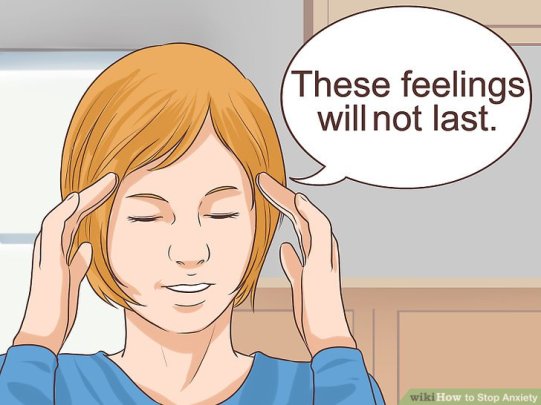
When I was twenty-two, I was diagnosed with general anxiety with periodic panic attacks.

Anxiety and panic, for me, are two different things.  Panic attacks hit me in my head first, causing dizziness, followed by quickened heart rate, some perspiring, fear, and the like.  With anxiety, it starts in the chest and causes helplessness, an impending sense of doom, as well as quickened heart rate.

Everyone who suffers from anxiety or panic attacks may share in some of the symptoms, but experiences them a bit differently and also has different triggers that set them off.

Mine is TIME.

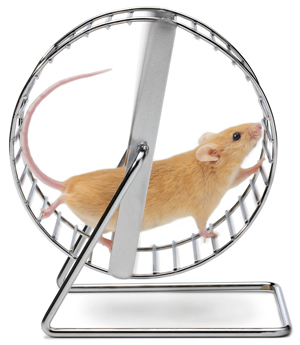
I remember in my early twenties explaining this visual of my trigger of time as a rodent running on a wheel, getting nowhere while time and the world churned ahead without me.  I desperately wanted to catch up but was helpless to in the moments of panic attacks.

mouse on wheel

When I had my first panic attack at age twenty, it felt like my head was going to spin right off my body, my heart raced, and I feared loss of mind and control.  And as panic sufferers know, we become worried about it happening again, which perpetuates the panic feelings.

Eventually, after having a handful of full-blown panic attacks, I learned to be aware of when one was coming on, and talking to myself (in my head, not out loud) about it in a reasonable manner.

talking out of anxiety and panic

At that time in my early twenties, for four years, I was on an anti-anxiety medication for my anxiety and a tranquilizer for panic attacks.  Both medications did the job of curbing my anxiety and panic attacks.  After getting off the medication, my system seemed improved.

Since this time (over twenty years ago), I’ve faired pretty well, but since the onslaught of peri-menopause, my anxiety and panic attacks have been kicked up a notch, causing some disruption in my life.

At the end of June, I did some stupid things because of my anxiety, like mistakenly canceling my debit card.

I looked over my husband’s and my checking account and discovered a debit card purchase for a DVD from an unknown company.  Worried and panic-stricken thinking  somebody had gotten my card number, I went online and disputed the purchase.  Immediately after I did that, my card was canceled.

It was at that moment I remembered the amount of the purchase and realized I did purchase this DVD.  It was just that the company name didn’t match the place I ordered from.

silencing inner critic

Peri-menopausal fog brain mixed with anxiety is a recipe for chaos.

I called the bank the next day, and a new card was sent out for two-day delivery.

If I’d just waited and thought calmly for about five more minutes, I’m positive I would have remembered the amount and the place from which I purchased the DVD.

This was the day Whole Foods opened in my area, and I wanted to be there for the opening (I know, that alone is nuts).  Obviously I didn’t have my debit card, but I did have my checkbook.  That was a mistake because they didn’t take checks, so I had to run home and fetch my credit card that I’ve been desperately trying to pay down.

I could have just waited until the next day when my new debit card arrived and gone to Whole Foods then and not gone through all of this.  But NO, I was anxious to go RIGHT NOW!  If I didn’t go then, think of all the things I’d miss seeing on Opening Day!

scolding myself

Every time my anxiety hits, I become impatient and pushy.  After the incident, I’d hate my actions and how I irritated my family members.  Imagine this anxious impatience…it feels like a tornado of confusion, frustration, fear, and anger sweeping through you.  At least it does for me.

depressed-silhouette-woman

After experiencing this impatience three days in a row, I broke down in tears of frustration and anger, really strongly disliking myself for my stupid actions and idiocy.

Where did my brain go?

The next few days and weeks I sat analyzing my actions and behavior. I finally saw this pattern of impatience and that it was actually tied to my anxiety.

It only took me 28 years to figure this out.

gif of duh or rolling eyes

In any case, this was a breakthrough for me, a relief.  I’d finally figured out what I was doing and why I was doing it.

But how was I going to stop doing it?

Anxiety pounces on me unexpectedly a lot of the time.  The behavior and havoc almost always play out before I am aware of it.

Friends who suffer from anxiety and/or panic attacks, how do you experience them?  How do you deal with them?

Being a person who tries to follow Christ, making an effort to be Christ-like daily, even though I fail most of the time, my anxiety causes me to forget to ask Him for help when I’m going through this.  Too many times, I try to control these attacks all on my own.

give your burden at the Lord's feet

This is the crux of my problem.

But I suppose I had to discover what I was doing before I could reach this point.

So, now that I know this, I am making the effort and becoming more aware to ask God to help me through these instances of impatience and anxiety.

I’m not really a fan of praying for patience, because…well…then your patience is tested, and I fail 99% of the time.

BUT…

In reality, it’s through those tests of my patience, that I am provided the chances to be patient and make it become more of a habit, and therefore, become more of who I want to be, which is a better, calmer, loving person with a closer relationship to Christ.

In the past few weeks, I’ve been able to apply patience to at least three occasions, by talking to myself, as a type of mental coach, and through God’s help.

Here’s to a new path toward a less anxiety-ridden life.

mountain path towards light

~*~*~*~


When Art & Math Unite

colored fractal

In 2015 through my online college, I took a required general education math course on math concepts for which I chose thinking I could maybe get through that seeing how horribly I did in math in my high school years.  That most math above the basics was something to avoid and something appearing too foreign like a lost prehistoric language with strange and cryptic symbols.

Ahem…All you math geniuses out there, please humor me and follow me through this post.

How naive I was to think math concepts would be easier.  So many of these concepts I’d never heard of before, but by week two, I was to choose one for my final 10-page paper on this concept.

This discovery caused me great anxiety, and I wrung my hands and shed tears of fear and panic allowing these scary unfamiliar math theories and formulas to balloon up to a major overwhelming hurdle over which I didn’t believe I could jump.

I beseeched my advisor that perhaps it had been a mistake to take this class, and really, I needed to go back to square one and take a basic algebra class first before my brain could wrap itself around any of these heady applications.

But alas, I’d missed the window to withdrawal from the course and with a gulp and shaky body, I braced myself for the onslaught of cryptic, confusing, symbolic hell.

By week two, I was introduced to the Fibonacci sequence, and immediately, my mind was blown.  The same numbers (0, 1, 1, 2, 3, 5, 8, 13, 21, 34, …) found on pinecones were found on other objects in nature, such as flower petals and the nautilus. Yes, I’m sure you all already knew this, but for me, this was all new and fascinating!

Cool video by Khan Academy on the Fibonacci Sequence:

(credit to Khan Academy)

There was a dark, cobwebbed, spongy crevice in my brain that opened up like the detachable hood off of a convertible, and God’s universe glistened bright and infinitely vast before me.  The mathematical number sequence and how it joined with nature screamed the hands of God, for nothing perfect in this world can be accidental or just be.  Something perfect has to be created by Someone Perfect–God.

Suddenly, math had taken on a totally different view for me, and I liked it.

Reading over and looking up the meaning of the list of math concepts in which we students were to choose from, I finally chose the knot theory because it sounded less scary and perhaps even something my simple, elementary math brain could comprehend.

So, for the next few weeks, in between weekly assignments, I read the history of knot theory, its formulas, how it’s used in life, and watched videos of professors teaching the knot theory by scribbling many different knots on the chalk board and explaining the negative and positive integers used in them.  Frankly, I enjoyed watching those lectures!

While researching how the knot theory is used in life, such as in our DNA and mountain climbing, I was pleasantly surprised to find it in art, and not just any art, art by sculptor, John Robinson.

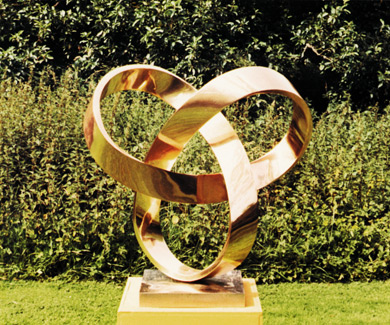
immortality sculpture

The first one shown above titled Immortality, sculpted in 1982, resembles a trefoil knot.  The meaning behind this great work of art is profound and beautiful.  He created this trefoil to represent the three generations of his family, he being the oldest of the three.  It shows the continuous movement and connection through time, becoming infinite.  Robinson said, “I believe that Immortality is made up of one’s memories of the past, as well as those one leaves behind.  I see this Symbolic Sculpture not only as a continuous journey, but also the scroll of which all life’s experiences (DNA) is recorded.”

rhythm of life pic

In the second picture, his sculpture, Rhythm of Life,  was also done in 1982. When creating this piece, he had wrapped a ribbon around an inner tire tube.  The last wrap was the fourth time around, and it returned to its original starting point.  Ronnie Brown, an English mathematician, had explained that this happens in Torus knots in math.  Robinson said, “I created the sculpture about the time that the miracle of DNA had just been discovered, and for me, this delightful flowing ribbon summed up the continuity of Genes.  I found I could balance the 18-inch maquette on a single point.”

Through this math course that was called The Heart of Math, I truly learned there was a lot of heart to it, and a lot of soul and beauty.  It may have taken decades for me to have found an appreciation for math via this class, but I’m just grateful I did discover it.


Works Cited
Symbolic Sculpture:  The Collected Works of John Robinson.  (n.d.).  Rhythm of Life.  Symbolic Sculpture:  The Collected Works of John Robinson.  Retrieved from
http://www.bradshawfoundation.com/jr/rhythm_of_life.php