When Art & Math Unite

colored fractal

In 2015 through my online college, I took a required general education math course on math concepts for which I chose thinking I could maybe get through that seeing how horribly I did in math in my high school years.  That most math above the basics was something to avoid and something appearing too foreign like a lost prehistoric language with strange and cryptic symbols.

Ahem…All you math geniuses out there, please humor me and follow me through this post.

How naive I was to think math concepts would be easier.  So many of these concepts I’d never heard of before, but by week two, I was to choose one for my final 10-page paper on this concept.

This discovery caused me great anxiety, and I wrung my hands and shed tears of fear and panic allowing these scary unfamiliar math theories and formulas to balloon up to a major overwhelming hurdle over which I didn’t believe I could jump.

I beseeched my advisor that perhaps it had been a mistake to take this class, and really, I needed to go back to square one and take a basic algebra class first before my brain could wrap itself around any of these heady applications.

But alas, I’d missed the window to withdrawal from the course and with a gulp and shaky body, I braced myself for the onslaught of cryptic, confusing, symbolic hell.

By week two, I was introduced to the Fibonacci sequence, and immediately, my mind was blown.  The same numbers (0, 1, 1, 2, 3, 5, 8, 13, 21, 34, …) found on pinecones were found on other objects in nature, such as flower petals and the nautilus. Yes, I’m sure you all already knew this, but for me, this was all new and fascinating!

Cool video by Khan Academy on the Fibonacci Sequence:

(credit to Khan Academy)

There was a dark, cobwebbed, spongy crevice in my brain that opened up like the detachable hood off of a convertible, and God’s universe glistened bright and infinitely vast before me.  The mathematical number sequence and how it joined with nature screamed the hands of God, for nothing perfect in this world can be accidental or just be.  Something perfect has to be created by Someone Perfect–God.

Suddenly, math had taken on a totally different view for me, and I liked it.

Reading over and looking up the meaning of the list of math concepts in which we students were to choose from, I finally chose the knot theory because it sounded less scary and perhaps even something my simple, elementary math brain could comprehend.

So, for the next few weeks, in between weekly assignments, I read the history of knot theory, its formulas, how it’s used in life, and watched videos of professors teaching the knot theory by scribbling many different knots on the chalk board and explaining the negative and positive integers used in them.  Frankly, I enjoyed watching those lectures!

While researching how the knot theory is used in life, such as in our DNA and mountain climbing, I was pleasantly surprised to find it in art, and not just any art, art by sculptor, John Robinson.
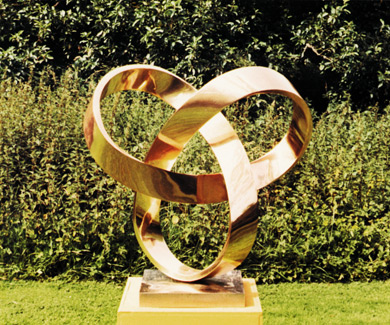
immortality sculpture

The first one shown above titled Immortality, sculpted in 1982, resembles a trefoil knot.  The meaning behind this great work of art is profound and beautiful.  He created this trefoil to represent the three generations of his family, he being the oldest of the three.  It shows the continuous movement and connection through time, becoming infinite.  Robinson said, “I believe that Immortality is made up of one’s memories of the past, as well as those one leaves behind.  I see this Symbolic Sculpture not only as a continuous journey, but also the scroll of which all life’s experiences (DNA) is recorded.”

rhythm of life pic

In the second picture, his sculpture, Rhythm of Life,  was also done in 1982. When creating this piece, he had wrapped a ribbon around an inner tire tube.  The last wrap was the fourth time around, and it returned to its original starting point.  Ronnie Brown, an English mathematician, had explained that this happens in Torus knots in math.  Robinson said, “I created the sculpture about the time that the miracle of DNA had just been discovered, and for me, this delightful flowing ribbon summed up the continuity of Genes.  I found I could balance the 18-inch maquette on a single point.”

Through this math course that was called The Heart of Math, I truly learned there was a lot of heart to it, and a lot of soul and beauty.  It may have taken decades for me to have found an appreciation for math via this class, but I’m just grateful I did discover it.


Works Cited
Symbolic Sculpture:  The Collected Works of John Robinson.  (n.d.).  Rhythm of Life.  Symbolic Sculpture:  The Collected Works of John Robinson.  Retrieved from
http://www.bradshawfoundation.com/jr/rhythm_of_life.php


Steadying Your Creative Flame

candle flame


What’s all this effort for?

When you look at what you wrote and it’s a bore.

You’ve lost the creative spark

That drew you out of the dark.

You’d created so many tales

That you believed kept you on the scrawling rails.

But that was three years ago,

When your passion was again aglow.

Now the embers of your exhausted endeavor,

Are giving off the last flick of light ever.

Confusion, fear, and sadness cloud your head,

At the thought that your life passion is dead.

What was it all for?

To come to a place you abhor?

No.

Rather, you realize the time has come,

To take a needed respite

For your mind to be relit

In the days and weeks ahead,

Because you refuse to believe your craft is dead.


My Muse, My Inspiration

muse of wonderment and writing

I’ve discovered my muse. Her writings inspire me and give me mental motivation in my ability to write these days.  Not only that, she writes about topics and relationships that I have great interest in and have wanted to write about.  The muse is author Jodi Picoult.  You may have read at least one or two of her books if you like women’s fiction.  I wonder if she realizes what an inspiration she is to fellow writers.

The last novel I read of hers was the best.  It’s called House Rules.  If you haven’t read it, I highly recommend it. Loved it!

house rules novel cover

Synopsis:

When your son can’t look you in the eye . . . does that mean he’s guilty?

Jacob Hunt is a teen with Asperger’s syndrome. He’s hopeless at reading social cues or expressing himself well to others, though he is brilliant in many ways. But he has a special focus on one subject—forensic analysis. A police scanner in his room clues him in to crime scenes, and he’s always showing up and telling the cops what to do. And he’s usually right.

But when Jacob’s small hometown is rocked by a terrible murder, law enforcement comes to him. Jacob’s behaviors are hallmark Asperger’s, but they look a lot like guilt to the local police. Suddenly the Hunt family, who only want to fit in, are directly in the spotlight. For Jacob’s mother, Emma, it’s a brutal reminder of the intolerance and misunderstanding that always threaten her family. For his brother, Theo, it’s another indication why nothing is normal because of Jacob.

Any time I read her works, ideas flow from my mind onto the paper freely without constraints, and the writing isn’t half bad.  In fact, it often comes out beautifully!  Kudos that I’ve found my muse, my inspiration for aiding me in my creative writing endeavor.

champagne glasses

But when I’m not reading her, when I’m reading other authors’ books, my creative writing isn’t as rich.

I have heard that depending on the type of writing style and its brilliance or less brilliant form, voice, structure, character development, and flow of whatever authors you read can and will affect how good and creative your own writing will be.  Should I continue reading others’ books and settle for a mediocre spark of creativity? Perhaps I’m learning something else from these authors’ writings than from my muse’s writings, that can help my writing techniques in some way.  I just haven’t discovered what that is yet.  If and when I do, I’ll write a blog post on it.

Therefore, I won’t stop reading other authors’ works that I like.  After all, I do know that my first novel was written before I’d read anything by Picoult, so I know I can accomplish this.  I just need to stay motivated and continue to practice my writing and continue reading the genre in which I am interested and in which I write.  That’s part of being a writer.

idea writing

Incidentally, as I’d written this, new ideas popped into my head on additional dialogue and descriptions (in which I’d turned into written revisions) to my first novel, Passage of Promise.  I’ve been revising and deepening its protagonist, antagonist, and supporting characters’ relationships for the past week so that I can send it back to my editor in a couple weeks to re-edit and give any other suggestions.

Wow.  Who would have thought a blog post on writing abilities via one’s muse and the concerns about lesser creative abilities when not reading their works would lead to ideas sprouting like pea shoots in my head.  I think the creative writing of my muse lingers in my mind like the sweet smell of incense from Orthodox Church services I attend that cling to my clothes and hair, and keeps God in my thoughts for the week.

So, what are the solutions to this struggle of the muse and the lesser inspired readings to aid me in my writing?  Well, I will…

  1. Continue reading works from Picoult.
  2. Take daily walks. They give me peace, spur creative ideas, and nostalgic memories.
  3. Write, if not daily, every other day (I try, people).
  4. Do other creative activities. I’ve read they help spark ideas for your writing.
  5. Try not to worry about losing my writing abilities.  I’ve got to stay steadfast and believe in my writing.  And truly, writing is in me (has been since my childhood) and part of who I am.

Who’s your writing muse that helps inspire you?


~*~*~*~