Forgotten Peace

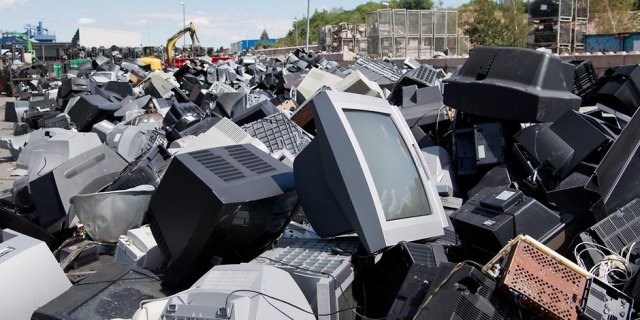
dark, collapse of world pic


Forgotten Peace


After the attack in September,

At the beginning of the century, remember,


Rage, sorrow, shock gripped all,

Our leaders swore vengeance that fall.


A hunt for the guilty and countries harboring them,

All this discovered within hours of the mayhem.


All aircraft grounded that day,

But the bin Laden family jetted away.


Our troops sent to Afghanistan,

Tracking bin Laden and Taliban,


Followed by invasion, war in Iraq,

later realized WMD story not fact.


Destroyed, lost lives and land,

By our leaders’ hands.


Yet Saudi Arabia, country where terrorists were harbored?

Overlooked, excused, forgotten, ignored.


Years later, Libya’s harsh leader killed,

The fledgling democracy, gold currency stilled,


Replaced by sex slavery and despair,

For which our leaders don’t care.


In Syria, we armed the same September killers,

Morphing into “moderate rebels” for army fillers.


Now, we’re arming Saudi Arabia, got their back,

The producer of the September attack,


Bombing, murdering hundreds of civilians,

Many of which are children.


Seventeen years of killing, destruction, obliteration.

For what? We ask in contemplation.


Profits, Resources,

Through our forces.


If our government cared and respected life,

it wouldn’t be invading, causing bloody strife.


Using billions of dollars on bombs, weapons, war,

In lieu of healthcare, jobs, green energy to soar.


PEACE is no longer a word or actions.

Only GREED, POWER, and FACTIONS.


~*~*~*~


*I’m far from a poet.  I don’t usually write poetry but felt compelled to write this.


Too Many Gadgets, Too Little Memory

electronic stuff

We bought a new car in March.  We hadn’t bought a new car since 2005, and before that, 1999.  So, you can imagine how bewildered we were….correction, I was…my husband took it all in without so much as a blink….when the car salesman introduced us to all the gadgets on our new car and how they worked.

To be honest, I was intimidated by it all.  The alert beeps for your blind spot, for warning me when any exterior part of my car was close to touching another car or any other object or person, the annoying humming sound that vibrated me into panic mode if I wandered an inch over the dividing lines on the highway, and all the lit up little icons on the dashboard and little screen.

It was overwhelming at first, but once I drove the car the first time, I relaxed a bit, even if I didn’t know how everything worked outside your regular immediate buttons and such.

It got me thinking about the technological advances over the years and decades since I was a child.  I grew up during my elementary school years with my parents purchasing one of the first VHS recorders.  My growing up years was also the time when TV remote controls came out and cordless telephones.

Related image

Pong, the first video game I remember came out, followed by Atari, for which my parents bought.  Who could forget playing those video games with those ancient joysticks that caused hand and thumb pain within a couple hours?  Good old Atari games like Astroids, Centipede, Pac-Man, Maze Craze, Space Invaders, Frogger, and Pit Fall.
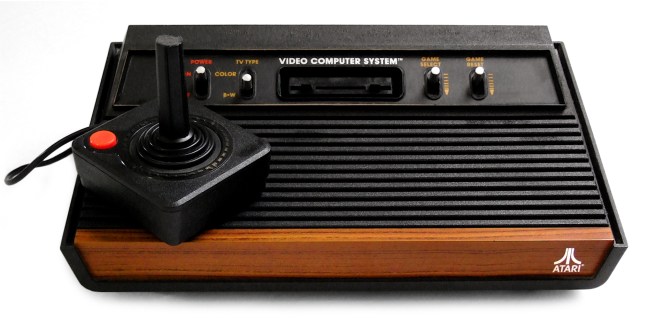
atari video console

In the music realm, boom boxes were in, that were a combination of radio and tape cassette player, with a mic jack and two speakers.  And the Walkman became popular shortly after, I think.
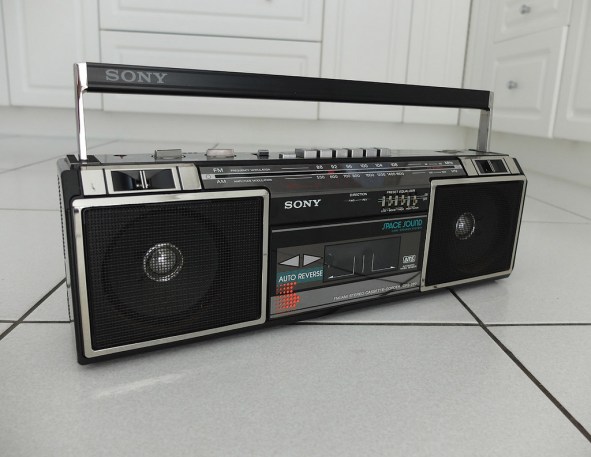
boom box

Dad’s Commodore 64 with its permanent blue screen sat on his desk in my teen years.  When I was sixteen, I used that computer to type up my first novel.
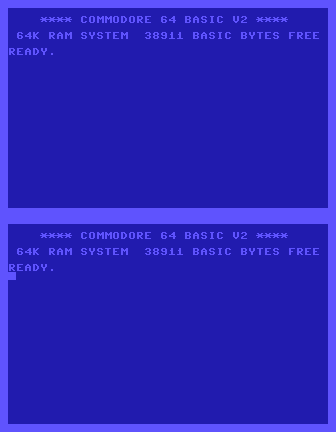
commodore 64 computer screen

I remember when my parents bought me a cell phone around 1993 for me to have in case my car broke down.  It was bulky and weighed a ton.
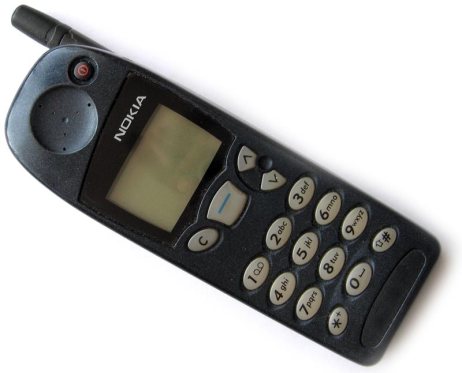
Related image

And I distinctly remember my first caller ID.  None of my friends or family had one at that time.  It was so cool being able to see who called at that time because I lived in my apartment then and could tell when a guy I liked called, but he didn’t know I knew.  Haha!

Image result for public domain pictures of the first caller IDs from 1993

And then came the CDs, DVDs, desk top computers, etc.  All of those new gadgets were pretty cool.  They didn’t make us too lazy.  But I’d have to say, that’s changed.

I’ve been watching many TED Talks on our addiction to our computers and phones, and also, the gadgets that think for us, like our car’s lights shutting on and off on their own, the doors locking and unlocking on their own, warning lights and beeping sounds to alert us to a danger of a car too close to ours, and the like.

Our cell phones keeping our appointments, waking us up for work in the morning, storing all of our friends and family members’ phone numbers, telling us how many calories the meal is that’s sitting in front of us at lunch or dinner.  You know what I’m talking about.

These are all very convenient, easy, and helpful.  But they also make us lazy and lose our ability to remember/memorize things, such as an appointment date or a friend’s phone number.

I don’t even know my family member’s cell numbers, except my husband’s.  I don’t know my sister’s or my mother’s by heart.  That is truly pathetic.  When I was a teen up through my thirties, I could dial a number no more than twice, and it would be stuck in my memory from then on.  Because I don’t have to remember these numbers since they’re stored in my phone, they aren’t memorized.

Now, I realize when one gets older, a little help in the memory department is needed, but our brain’s memory can be boosted by walking or doing jigsaw puzzles, for example.

So, I ignore focusing solely on the camera on the small screen in my car and physically look behind me when backing up, and make sure I still look toward the blind spot before moving into another lane.  I manually lock my car doors when I get into my car most especially in parking lots.  I think it’s the safe thing to do for us women going grocery shopping and other places by ourselves.

I don’t think we can rely so much on computers.  They do malfunction at times, have glitches, and can be hacked.  Obviously, you can guess I’m not one of those people who is anxiously awaiting buying or traveling in a driverless car.  I think I’ll skip that, thank you very much!

In my psychology course I took a couple of years ago at my university, I learned the twenty-first century sedentary lifestyle is not normal or healthy for the human body and mind.  We are meant to move and move around often, and use our minds critically.  If we’re not careful, we’ll become like the folks in the Pixar movie, WALL-E.  Was that not a glimpse into the future, or what?

WALL-E pic 2

We have to find ways to exercise these days.  Join a gym.  Join an exercise class.  Buy exercise equipment.  Pencil in jogging several times a week.  When in the generations before this age, people walked or rode their bikes to work, worked outside, walked to stores, opened their cars’ hatchbacks, manually rolled up and down their cars’ windows, lifted their garage doors, and got up to turn off their TVs.

Since being a sloth is too familiar to me, I struggle to get up the energy, and it’s even harder because of my time spent on the computer for too many hours a day.  It is my goal to keep doing things that jog my memory, such as walking and doing jigsaw puzzles, and doing what I said above with regards to my car.  I even started doing tai chi two weeks ago.  It brings me stress relief and serenity.  Do you do anything to keep your mind working and body in motion to counter today’s sedentary lifestyle?


~*~*~*~


A Slave & Poet

phillis wheatley pic

Have you ever heard of the remarkable woman, Phillis Wheatley?  I hadn’t until I read a little blurb in my university course’s textbook on American Art.  I finished this course last week.  There had been a lot of heavy reading and writing, but chock full of rich and beautiful artwork and information.

Phillis was born about 1753 in Senegal/Gambia, West Africa.  She was kidnapped around age eight and transported on a slave ship to the United States.  The captain of the ship discovered little Phillis was a fragile girl not suited for hard labor when they’d stopped at the first two ports of call, the West Indian and Southern colonies while crossing the Atlantic Ocean.  The captain believed her to be terminally ill.  Landing in Boston, Massachusetts, the captain wanted at least some financial compensation before Phillis’ death.  He got his wish.  A prominent Boston tailor purchased Phillis for her to be his wife’s domestic servant (Poetry Foundation).

Although frail, Phillis’ health did improve a bit, disproving the sea captain’s belief that she was terminally ill.

The Wheatleys found Phillis to be precocious, so they taught her how to read and write.  Soon, the young, intelligent girl was engrossed in various subjects, such as astronomy, history, the Bible, and classic British, Greek, and Latin literature.  But Phillis desired to learn more and stated so in her poem called “To the University of Cambridge in New England,” that was most likely her first poem written but wasn’t published until 1773 (Poetry Foundation).

Phillis wrote a poetic elegy for the Reverend George Whitefield that brought her international recognition.  It was published as a pamphlet in 1771 with Ebenezer Pemberton’s funeral sermons for Whitefield in London that was distributed in Boston, Philadelphia, and Newport (Poetry Foundation).

In February 1772 at age 18, Phillis had collected twenty-eight of her poems and with the help of Mrs. Wheatley, ran ads in Boston periodicals for sponsors.  But the colonists refused to support her because she was an African.  Frustrated by this, Phillis and the Wheatleys looked to London.  Phillis sent the Whitefield poem to Countess of Huntingdon, Selina Hastings, who was a parishioner of Reverend Whitefield.  A backer of abolitionist and evangelical causes, the countess connected bookseller Archibald Bell with Wheatley to prepare for a book of her poems (Poetry Foundation).

Suffering from asthma, Phillis traveled to London with the Wheatley’s son, Nathaniel, and was welcomed by several English dignitaries and also Benjamin Franklin.  Her collection of poems, Poems of Various Subjects, Religious and Moral, was published in 1773 (Poetry Foundation).

Phillis Wheatley’s work was the first book of poetry by an African American published in that period (Poetry Foundation)!

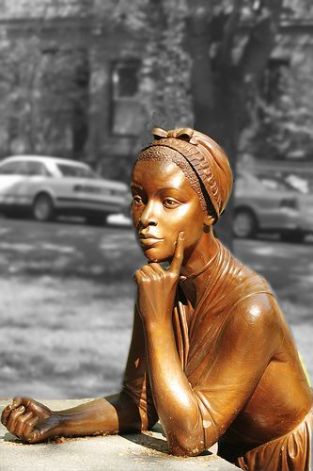
phillis wheatley sculpture

Phillis did write a few poems against slavery.  Below is an excerpt from a poetic eulogy to General David Wooster in which she spoke strongly about the wrongs of slavery (Poetry Foundation).

But how, presumptuous shall we hope to find
Divine acceptance with th’ Almighty mind—
While yet (O deed Ungenerous!) they disgrace
And hold in bondage Afric’s blameless race?
Let Virtue reign—And thou accord our prayers
Be victory our’s, and generous freedom theirs.

On Phillis’ trip back to America, Mrs. Wheatley had fallen very ill.  Phillis was made a free woman approximately three months before Mrs. Wheatley’s death on March 3, 1774.  She married and spent the rest of her life in financial hardship but still managed to continue writing her poems until she fell ill and died in 1784.

Thankfully, Phillis Wheatley’s memory and poems live on.

Here’s one of her most famous poems (a short one) titled Being Brought From Africa to America:

‘Twas mercy brought me from my Pagan land,
Taught my benighted soul to understand
That there’s a God, that there’s a Saviour too:
Once I redemption neither sought nor knew.
Some view our sable race with scornful eye,
“Their colour is a diabolic die.”
Remember, Christians, Negro’s, black as Cain,
May be refin’d, and join th’ angelic train.

I enjoyed learning about this famous, amazing African American female slave who rose in respect and accolades because of her beautiful writing and being the first African American in modern times to have her work published, that was admired by such prominent Americans as George Washington, Benjamin Franklin, and John Hancock (Poetry Foundation).


~*~*~*~


Works Cited
Poetry Foundation.  “Phillis Wheatley:  1753-1784.”  https://www.poetryfoundation.org/poets/phillis-wheatley