This is a 2016 essay of mine on the Analysis of
“Hermes and the Infant Dionysius” and “Madonna in the Meadow”
Praxiteles was born circa 390 B.C., and died circa 332 B.C. He was considered the greatest sculptor in Greece and was known as the “sculptor of grace” for his use of softer forms and displaying the Greek gods as humanlike and gentle instead of indignant and distant. His work, “Hermes with the Infant Dionysus” is the only known work of art done by him that has survived. The statue made of marble, which was Praxiteles’ choice of medium, shows softness in lines and form and humanistic style (“Hermes and the Infant Dionysos”).
The sculpture portrays Hermes carrying baby Dionysus to the nymphs in the mountains. The mythological story tells us that Zeus had an affair with a mortal woman named Semele. Once he showed himself to her, she burned to death by the warm radiance he possessed as a god. Dionysus was produced from their love, and Zeus’ wife, Hera, found out and wanted to kill the infant and anything else that reminded her of his affair. With that, Zeus called on his messenger, Hermes, to take Dionysus and deliver him to the nymphs that live in the mountains for his safety and to raise him. This sculpture captures the playful moment of Hermes with baby Dionysus on their journey to the nymphs. Dionysus grew up and became the god of wine, festivity, and theater (“Hermes and the Infant Dionysos”).
The statue was most assuredly commissioned for the sanctuary, and it was, indeed, housed in the Temple of Hera at Olympia. In 1877, German archeologists discovered the sculpture in that temple.
Praxiteles’ work, “Hermes with the Infant Dionysus,” truly reflects the late Classical style of that era, as well as represents the Greek pagan religion at the time where many temples to the various gods and goddesses housed statues like Praxiteles’ beautiful sculptures.
The inclusion of children/babies in Greek art is evident of Late Classical sculpture. Praxiteles promoted a new decree of proportions, which displayed a naturalistic, thinner, softer, taller, and more intimate sculpture style that had never been seen before. His sculpting design is more secular and worldly than depicting the divine. It signifies social changes and predominance of secular and touching representations from then on (“Hermes and the Infant Dionysos”).
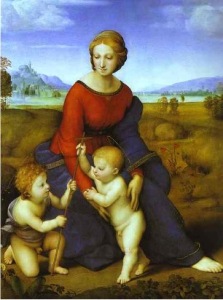
Raphael’s oil painting on wood, “Madonna in the Meadow” was created and completed between the years of 1505 and 1507. Raphael, whose full name was Raffaello Sanzio or Santi, was born in Duchy of Urbino, Italy, on April 6, 1483, and died April 6, 1520. His parents, Margia di Battista Ciarla, died in 1491, and his father, Giovanni Santi, first taught him to paint, not too long before his death. Giovanni had also exposed Raphael to humanist philosophy at the court. The city in which Raphael had lived, Urbino, was a cultural center under the rule of Duke Federico da Montefeltro.
Most of Raphael’s basic learning of the arts was while living in Urbino. His talent was exceptional at barely 17 years old. In circa 1495, Raphael went to Perugia and began his work through commissions by the Church between 1501 and 1503, through his connection to and learning from a great artist and master from Urbino named Pietro Perugino. Perugino’s excellent style influenced Raphael, and later, also Leonardo da Vinci and Michelangelo’s amazing works. He was one of their students (“Raphael”).
Raphael worked on his many paintings of the Madonna between 1505 and 1507. In his painting, “Madonna in the Meadow,” it shows the Virgin Mary sitting on a large stone gently grasping baby Jesus and watching he and baby St. John the Baptist, who was just six months older than Jesus. The colors used in Christian art are of great importance. For example, the Virgin is dressed in red and blue clothing. The red signifies her mortality or humanity and the blue, her holiness. Raphael’s use of chiaroscuro in the painting was an influence of da Vinci, as well as by his sfumato – the use of very fine, soft shading in lieu of line/characterized forms and features. He used aerial perspective to give the appearance that the landscape was far away. Raphael created unique figures with round, tender faces that were not complex, but expressed basic human feeling. His technique also elevated them to precision and peacefulness. He strived to create a more personable style to make a popular and accessible form of visual connection (“Raphael”).
Raphael’s painting, “Madonna in the Meadow,” reflects the Renaissance period in which he lived. There is the Classical aspect of the work reminiscent of ancient Greco-Roman Classical art, and there is the humanistic aspect of the Renaissance era, which stressed the excellence and integrity of the human being. Christianity was still prevalent at the time, despite the troubles in the Catholic Church, the beginnings of the Protestant Reformation, and the ushering in of more reason than religious thinking.
These two artworks have many similarities. They share mystical and mythological representations.
Praxiteles’ “Hermes with the Infant Dionysus” depicts two Greek gods of Greek mythology, which was the religion of the Greeks throughout the ancient and Classical Greek periods. Raphael’s “Madonna in the Meadow” displays the blessed, holy Virgin and her son, Jesus Christ, reflecting the religion of Christianity’s true God incarnate.
The forms are sculpted and painted in soft, beautiful lines and classical beauty. With Hermes’ weight bearing on his right leg and his left leg gently touching the ground, his sinuous body curves in an S shape. This lack of equilibrium in the statue was a new form at that time, which was called the “Praxitelean curve” (“Hermes and the Infant Dionysos”).
There are smooth and graceful curves in Raphael’s oil painting through the soft curves of the Madonna’s shoulders against the gentle curves of the landforms behind her. Both pieces of art contain children in them of great importance. Infant Dionysus is the offspring of a god, Zeus, and a mortal, Semele, and likewise, Christ is the offspring of God, the Holy Spirit, and mortal, Mary.
Baby St. John the Baptist is a messenger from God. His purpose on earth was to pave the way for Jesus Christ’s entrance into the world and his future ministry. Hermes is a messenger from the god, Zeus, and in this case, he is delivering Zeus’ son, Dionysus, to the nymphs for his safety and care.
Another similarity between the two mediums is displaying the human body nude and also donning robes or cloaks. Both art periods honored the human body and considered it beautiful. The oil painting and sculpture share the depiction of a protective, gentle adult caring for a child. In the Classical Greek tradition, the naked body portrayed moral virtue and heroism (Mount). In Raphael’s era of the Renaissance, the naked human body was also considered beautiful and revered (Sorabella).
There are differences in the two artworks. Praxiteles’ work is a sculpture made of marble, whereas Raphael’s work is an oil painting on wood. “Hermes with the Infant Dionysus” depicts two Greek gods from Greek mythology, which are demigods – they produce children and have relations with mortals/humans producing children. They share human emotions, especially jealousy and anger (“Hermes”), but this is not so for the Christian God, who does not have such emotions as jealousy.
In Praxiteles’ sculpture, Hermes’ body is off-balance, shaped in an S curve that makes it asymmetrical, which Praxiteles brought to the Late Classical Greek art (“Hermes with the Infant Dionysus”). In Raphael’s painting, there is a pyramidal blueprint with the position of the three subjects that gives it a sense of quality, tranquility, and symmetry that was commonly employed by Renaissance artists (“Raphael”). In the painting, “Madonna in the Meadow,” the viewer is able to see the scenic background of the meadow through its aerial perspective and two-dimensional form, but a background isn’t shown in “Hermes with the Infant Dionysus” largely because it is sculpted in the round, which means that it is not attached to a background and can be seen from any angle.
In conclusion, Praxiteles’ “Hermes with the Infant Dionysus” and Raphael’s “Madonna in the Meadow” share the Classical style of both their eras and portray the mystical and gentle beauty in their lines and forms, and therefore complement each other.
~*~*~*~
Works Cited
“Hermes with the Infant Dionysus.” Museum of Antiquities. n.d. Web. 3 March 2016.
http://www.usask.ca/antiquities/our-collection-/greek/classical-greek/sculpture/hermes-with-the-infant-dionysus/index.php
“Raphael.” Artsy. 2016. Web. 3 March 2016. https://www.artsy.net/artwork/raphael-
madonna-on-the-meadow
“Hermes and the Infant Dionysos.” Museum of Art and Archeology. 2016. Web. 3 March
2016. https://maa.missouri.edu/?q=collection/hermes-and-infant-dionysos
“Raphael: Italian Painter and Architect.” Encyclopedia Britannica. 2015. Web. 3 March 2016.
http://www.britannica.com/biography/Raphael-Italian-painter-and-architect
Mount, Harry. “Why Are Greek Statues Always NAKED?” Daily Mail. 2015. Web. 3 March
2016. http://www.dailymail.co.uk/news/article-3010353/Why-Greek-statues-NAKED-
extraordinary-answer-s-laid-bare-magnificent-risque-exhibition-British-Museum.html
Sorabella, Jean. “The Nude in the Middle Ages and the Renaissance.” The Metropolitan
Museum of Art. 2008. Web. 3 March 2016.
https://www.metmuseum.org/toah/hd/numr/hd_numr.htm
“Hermes.” GreekGods.org. 2016. Web. 3 March 2016. http://www.greek-gods.org/olympian-
gods/hermes.php



 Modest Musings