
Critiques, Show, Don’t Tell, Oh My!

Editing an English language document

Recently, I’ve re-entered the critiquing world in all its fictional fun and grueling work.  It truly is a lot of work.  I admire editors for the painstaking mental labor they endure.  Having said that, I’m thrilled to be back in this creative universe.

I’m in the last week of my IDS Wellness college course, followed by a week off.  Then I start my last course in Advanced Creative Writing.  After that, my bachelor’s degree in Creative Writing and English!

Time is slowly opening up to me, edging toward mornings free to dedicate my thoughts and energies to story creating and revising,

Every time I read and critique fellow writers’ works in my online critique group, I learn something, usually more than one thing.  I noticed the past week, I’ve improved my feedback skills.  Yea!

What I find fun and fascinating is when I’ve finished my critique, I go back into the work and read over other critters’ feedback and see how they caught things I missed and vice versa.  It’s incredible to read both negative and positive comments on the paragraph–one finding the descriptions or scene awkward or not needed, while another finds it fantastic.

I did learn through two and a half years of participating in this group that when you have more than one person pointing out something in your chapter that doesn’t make sense, isn’t realistic, etc., you heed those because it’s a good chance more readers than not will have the same troubles with that.

I am half way through a book called Understanding Show, Don’t Tell (And Really Getting It) by Janice Hardy.  How many times are we writers told to show the scenes, the character’s actions, behavior, etc.?  Avoid adverbs.  Don’t use filter words like felt, saw, knew, looked, and decided.  Don’t use passive “to be” verbs like was and is being.
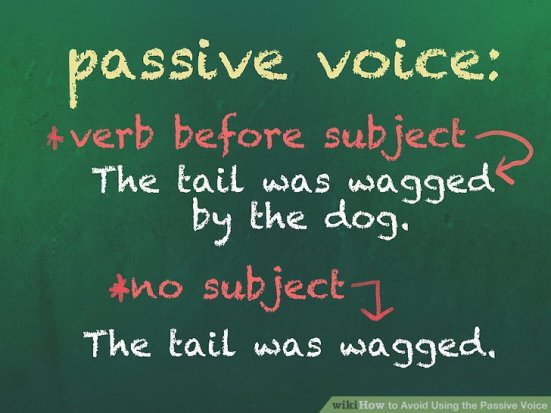
passive voice ex

(Passive voice example)

The amount of telling and showing varies a bit depending on the point of view in which you’re writing.  I’ll share an example from the book, which I really appreciate.  I love visual aids since I’m a visual learner.  This excerpt is written in third person through the usual told manner:

Bob screamed in pain when the zombie clawed his leg.  He struggled to get away, and realized he had seconds to shake loose before the thing got its hooks into him and went straight for his brain.  Zombies needed brains to survive or they turned to dust and bones in just under thirty days.  He didn’t have thirty seconds let along thirty days.

A few red flag tell words mentioned in this paragraph, Hardy points out:  in and when.  We are told when the zombie clawed Bob’s leg, but we don’t really get to see it.  In is used to explain how Bob screams and the reason why he screamed.  There’s explaining the life of zombies too.  The latter is referred to as an infodump.

Therefore, Hardy removes the red flag words, infodump, and Bob’s responses, etc.  Here’s the result:

The zombie clawed Bob’s leg.  He screamed.  He struggled, but he had seconds to shake loose before the thing got its hooks into him and went straight for his brains.

How’s that?  Better?  Hmm.  Hardy says it is.  But she also acknowledges it’s boring and needs interesting details.  Here is the finalized version:

The zombie tore through his pants, sinking its broken fingernails into his calf.  Fire and knives raced up his leg and Bob screamed.  He kicked at it with his free foot, but it held tight.

“Let go, you sonuva–“

He kept kicking, but each heartbeat brought it–and its infected teeth–closer.  Sure, maybe he wasn’t using his brain this instant, but he wasn’t about to let this dagger get it.  Or him.

Improvement, no?  I love seeing the before (telling) and after (showing).  It’s kind of like hair styles or home makeovers.

As I said earlier, I’m half way through this book and enjoying it.  I just wanted to share an example on telling verses showing with excerpts from Hardy’s book in the hopes it helps you, my fellow writers, as much as it has for me.

More to come on this in future posts.


~*~*~*~


Works Cited
Hardy, Janice.  Understanding Show, Don’t Tell (And Really Getting It).  Fiction University Press.

Anxiety Bores Impatience

silhouette of woman for anxiety blog post

When I was twenty-two, I was diagnosed with general anxiety with periodic panic attacks.

Anxiety and panic, for me, are two different things.  Panic attacks hit me in my head first, causing dizziness, followed by quickened heart rate, some perspiring, fear, and the like.  With anxiety, it starts in the chest and causes helplessness, an impending sense of doom, as well as quickened heart rate.

Everyone who suffers from anxiety or panic attacks may share in some of the symptoms, but experiences them a bit differently and also has different triggers that set them off.

Mine is TIME.

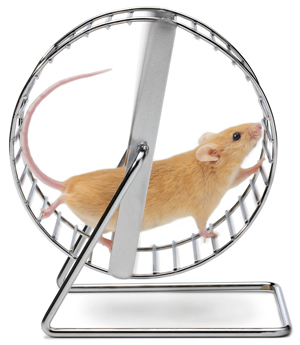
I remember in my early twenties explaining this visual of my trigger of time as a rodent running on a wheel, getting nowhere while time and the world churned ahead without me.  I desperately wanted to catch up but was helpless to in the moments of panic attacks.

mouse on wheel

When I had my first panic attack at age twenty, it felt like my head was going to spin right off my body, my heart raced, and I feared loss of mind and control.  And as panic sufferers know, we become worried about it happening again, which perpetuates the panic feelings.

Eventually, after having a handful of full-blown panic attacks, I learned to be aware of when one was coming on, and talking to myself (in my head, not out loud) about it in a reasonable manner.

talking out of anxiety and panic

At that time in my early twenties, for four years, I was on an anti-anxiety medication for my anxiety and a tranquilizer for panic attacks.  Both medications did the job of curbing my anxiety and panic attacks.  After getting off the medication, my system seemed improved.

Since this time (over twenty years ago), I’ve faired pretty well, but since the onslaught of peri-menopause, my anxiety and panic attacks have been kicked up a notch, causing some disruption in my life.

At the end of June, I did some stupid things because of my anxiety, like mistakenly canceling my debit card.

I looked over my husband’s and my checking account and discovered a debit card purchase for a DVD from an unknown company.  Worried and panic-stricken thinking  somebody had gotten my card number, I went online and disputed the purchase.  Immediately after I did that, my card was canceled.

It was at that moment I remembered the amount of the purchase and realized I did purchase this DVD.  It was just that the company name didn’t match the place I ordered from.

silencing inner critic

Peri-menopausal fog brain mixed with anxiety is a recipe for chaos.

I called the bank the next day, and a new card was sent out for two-day delivery.

If I’d just waited and thought calmly for about five more minutes, I’m positive I would have remembered the amount and the place from which I purchased the DVD.

This was the day Whole Foods opened in my area, and I wanted to be there for the opening (I know, that alone is nuts).  Obviously I didn’t have my debit card, but I did have my checkbook.  That was a mistake because they didn’t take checks, so I had to run home and fetch my credit card that I’ve been desperately trying to pay down.

I could have just waited until the next day when my new debit card arrived and gone to Whole Foods then and not gone through all of this.  But NO, I was anxious to go RIGHT NOW!  If I didn’t go then, think of all the things I’d miss seeing on Opening Day!

scolding myself

Every time my anxiety hits, I become impatient and pushy.  After the incident, I’d hate my actions and how I irritated my family members.  Imagine this anxious impatience…it feels like a tornado of confusion, frustration, fear, and anger sweeping through you.  At least it does for me.

depressed-silhouette-woman

After experiencing this impatience three days in a row, I broke down in tears of frustration and anger, really strongly disliking myself for my stupid actions and idiocy.

Where did my brain go?

The next few days and weeks I sat analyzing my actions and behavior. I finally saw this pattern of impatience and that it was actually tied to my anxiety.

It only took me 28 years to figure this out.

gif of duh or rolling eyes

In any case, this was a breakthrough for me, a relief.  I’d finally figured out what I was doing and why I was doing it.

But how was I going to stop doing it?

Anxiety pounces on me unexpectedly a lot of the time.  The behavior and havoc almost always play out before I am aware of it.

Friends who suffer from anxiety and/or panic attacks, how do you experience them?  How do you deal with them?

Being a person who tries to follow Christ, making an effort to be Christ-like daily, even though I fail most of the time, my anxiety causes me to forget to ask Him for help when I’m going through this.  Too many times, I try to control these attacks all on my own.

give your burden at the Lord's feet

This is the crux of my problem.

But I suppose I had to discover what I was doing before I could reach this point.

So, now that I know this, I am making the effort and becoming more aware to ask God to help me through these instances of impatience and anxiety.

I’m not really a fan of praying for patience, because…well…then your patience is tested, and I fail 99% of the time.

BUT…

In reality, it’s through those tests of my patience, that I am provided the chances to be patient and make it become more of a habit, and therefore, become more of who I want to be, which is a better, calmer, loving person with a closer relationship to Christ.

In the past few weeks, I’ve been able to apply patience to at least three occasions, by talking to myself, as a type of mental coach, and through God’s help.

Here’s to a new path toward a less anxiety-ridden life.

mountain path towards light

~*~*~*~