
Breaking from Writing and the Consequences

writing exhaustion pic

What if I stop writing for a while?  What if taking this hiatus is not because I have no choice but precisely because I do?

About a month ago, I’d reached writing and creativity exhaustion, so much so that even when I’d forced myself to write at least a few sentences or a paragraph, nothing but stale, dry, lifeless words settled on the page.

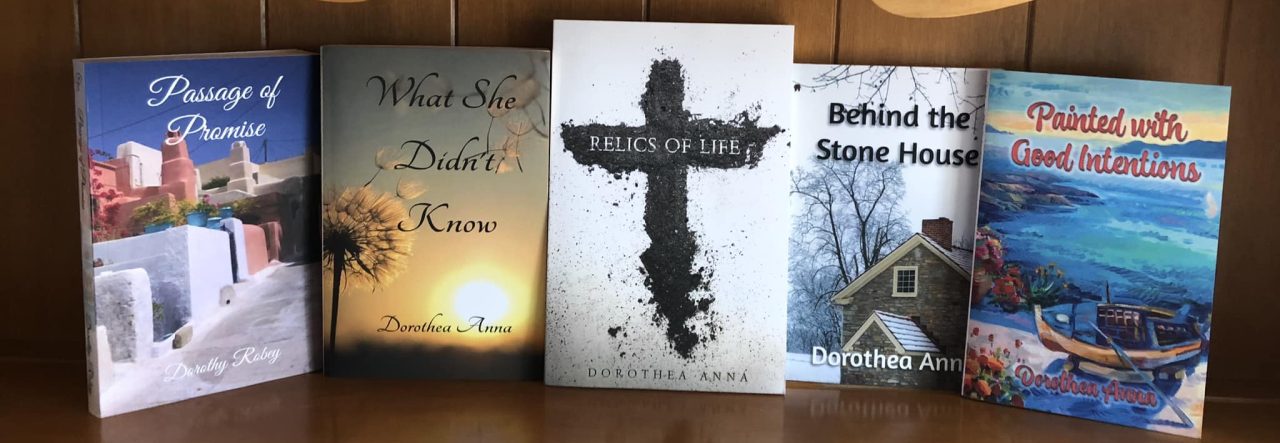
You see, at this time, I’d finished my current revisions and my editor had done her thing in supplying me with superb proofreading, editing, and suggestions for my characters and plot for my novel, Passage of Promise.

But at the same time, I’d entered my subsequent university course in fascinating American Art.  It was one of the required general education exploration courses available for me to choose. My courses are eight weeks long.  By mid term, the college load was like swimming in an ever deepening pool, and the massive reading assignments and associated linked reading material were pulling me under.

drowning underwater pool

Overwhelmed by keeping up with my novel’s plot additions, blog posts, essays, and colossal pages to peruse and jot down notes, it was time for me to slide one of these on the shelf.

Permanently? you ask.  I sure hope not.

When you struggle with general anxiety and menopausal symptoms that trigger it (along with blood sugar issues), your brain can only take in so many mental activities at a time.  I’d reached my limit.

When this happened, I closed up my manuscript on Word, and dread hit me as I remembered the eighteen-year hiatus from writing that was broken in September 2014…not so long ago.  Was I going to end up disconnected from my writing another eighteen years?

This concern prompted me to look up information on authors/writers taking breaks.  I found a couple of articles that gave me a great sense of relief.

What I learned is breaks are not only acceptable, but necessary to regenerate your creative juices and thought processes.  And we writers make the choice on how long that break will be.  It could be a day, a week, a month, or months.

I know this is alarming and sounds close to anathema considering how often we hear and read in the writing world the mantra stressing writing at least something daily.

But please keep reading.

Via a Writer’s Edit article, it says, “If you are at the point where you are forcing a story, take this as a sign to take a break from it.”  This gave me a chance to exhale.

cartoon girl sitting in hammock

(credit:  GetDrawings.com)

The author of that article also stressed not losing the joy of writing.  Well, I’d forgotten the joy of writing.  It had become the equivalent of cramming for final exams since it was juxtaposed with my college course load.

However, another reassuring perspective came from The Writing Cooperative’s author, Ryan J. Pelton’s article on this subject, stating, “You are not weak, uncommitted, and not a true writer if you take breaks.  You will not forget how to write.”  I could sit back calmly with this tidbit.

These breaks can be used for relaxing and cleaning out your brain, for continued reading for pleasure, and an upcoming chance for new, fresh characters and storylines to surface that can be noted for later.

My plan at this time is to pick up on my novel and other writing projects after I graduate from my university at the end of October.  Then I will be free to pursue my writing without college assignment pressures.  This is my tentative schedule, and each of us makes our own.

So, if you’re feeling burnt out, or you have nothing left, take a much needed break that is as long as you choose, and look forward to sparkling, vivid tales in the very near future.


~*~*~*~


Works Cited
Writer’s Edit.  “Why Taking Writing Breaks Is Important.” writersedit.com.  https://writersedit.com/fiction-writing/taking-writing-breaks-important/
Pelton, Ryan J.  “Put Down the Pen and Step Away (rest for writers).”  The Writing Cooperative.  https://writingcooperative.com/put-down-the-pen-and-step-away-rest-for-writers-44a98971db4b


A Slave & Poet

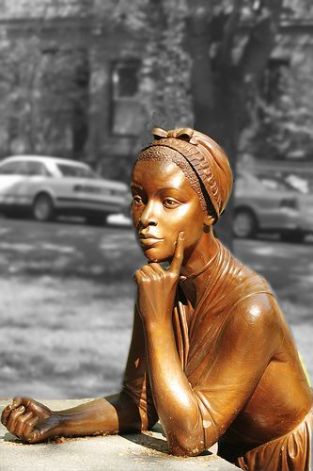
phillis wheatley pic

Have you ever heard of the remarkable woman, Phillis Wheatley?  I hadn’t until I read a little blurb in my university course’s textbook on American Art.  I finished this course last week.  There had been a lot of heavy reading and writing, but chock full of rich and beautiful artwork and information.

Phillis was born about 1753 in Senegal/Gambia, West Africa.  She was kidnapped around age eight and transported on a slave ship to the United States.  The captain of the ship discovered little Phillis was a fragile girl not suited for hard labor when they’d stopped at the first two ports of call, the West Indian and Southern colonies while crossing the Atlantic Ocean.  The captain believed her to be terminally ill.  Landing in Boston, Massachusetts, the captain wanted at least some financial compensation before Phillis’ death.  He got his wish.  A prominent Boston tailor purchased Phillis for her to be his wife’s domestic servant (Poetry Foundation).

Although frail, Phillis’ health did improve a bit, disproving the sea captain’s belief that she was terminally ill.

The Wheatleys found Phillis to be precocious, so they taught her how to read and write.  Soon, the young, intelligent girl was engrossed in various subjects, such as astronomy, history, the Bible, and classic British, Greek, and Latin literature.  But Phillis desired to learn more and stated so in her poem called “To the University of Cambridge in New England,” that was most likely her first poem written but wasn’t published until 1773 (Poetry Foundation).

Phillis wrote a poetic elegy for the Reverend George Whitefield that brought her international recognition.  It was published as a pamphlet in 1771 with Ebenezer Pemberton’s funeral sermons for Whitefield in London that was distributed in Boston, Philadelphia, and Newport (Poetry Foundation).

In February 1772 at age 18, Phillis had collected twenty-eight of her poems and with the help of Mrs. Wheatley, ran ads in Boston periodicals for sponsors.  But the colonists refused to support her because she was an African.  Frustrated by this, Phillis and the Wheatleys looked to London.  Phillis sent the Whitefield poem to Countess of Huntingdon, Selina Hastings, who was a parishioner of Reverend Whitefield.  A backer of abolitionist and evangelical causes, the countess connected bookseller Archibald Bell with Wheatley to prepare for a book of her poems (Poetry Foundation).

Suffering from asthma, Phillis traveled to London with the Wheatley’s son, Nathaniel, and was welcomed by several English dignitaries and also Benjamin Franklin.  Her collection of poems, Poems of Various Subjects, Religious and Moral, was published in 1773 (Poetry Foundation).

Phillis Wheatley’s work was the first book of poetry by an African American published in that period (Poetry Foundation)!

phillis wheatley sculpture

Phillis did write a few poems against slavery.  Below is an excerpt from a poetic eulogy to General David Wooster in which she spoke strongly about the wrongs of slavery (Poetry Foundation).

But how, presumptuous shall we hope to find
Divine acceptance with th’ Almighty mind—
While yet (O deed Ungenerous!) they disgrace
And hold in bondage Afric’s blameless race?
Let Virtue reign—And thou accord our prayers
Be victory our’s, and generous freedom theirs.

On Phillis’ trip back to America, Mrs. Wheatley had fallen very ill.  Phillis was made a free woman approximately three months before Mrs. Wheatley’s death on March 3, 1774.  She married and spent the rest of her life in financial hardship but still managed to continue writing her poems until she fell ill and died in 1784.

Thankfully, Phillis Wheatley’s memory and poems live on.

Here’s one of her most famous poems (a short one) titled Being Brought From Africa to America:

‘Twas mercy brought me from my Pagan land,
Taught my benighted soul to understand
That there’s a God, that there’s a Saviour too:
Once I redemption neither sought nor knew.
Some view our sable race with scornful eye,
“Their colour is a diabolic die.”
Remember, Christians, Negro’s, black as Cain,
May be refin’d, and join th’ angelic train.

I enjoyed learning about this famous, amazing African American female slave who rose in respect and accolades because of her beautiful writing and being the first African American in modern times to have her work published, that was admired by such prominent Americans as George Washington, Benjamin Franklin, and John Hancock (Poetry Foundation).


~*~*~*~


Works Cited
Poetry Foundation.  “Phillis Wheatley:  1753-1784.”  https://www.poetryfoundation.org/poets/phillis-wheatley


When Art & Math Unite

colored fractal

In 2015 through my online college, I took a required general education math course on math concepts for which I chose thinking I could maybe get through that seeing how horribly I did in math in my high school years.  That most math above the basics was something to avoid and something appearing too foreign like a lost prehistoric language with strange and cryptic symbols.

Ahem…All you math geniuses out there, please humor me and follow me through this post.

How naive I was to think math concepts would be easier.  So many of these concepts I’d never heard of before, but by week two, I was to choose one for my final 10-page paper on this concept.

This discovery caused me great anxiety, and I wrung my hands and shed tears of fear and panic allowing these scary unfamiliar math theories and formulas to balloon up to a major overwhelming hurdle over which I didn’t believe I could jump.

I beseeched my advisor that perhaps it had been a mistake to take this class, and really, I needed to go back to square one and take a basic algebra class first before my brain could wrap itself around any of these heady applications.

But alas, I’d missed the window to withdrawal from the course and with a gulp and shaky body, I braced myself for the onslaught of cryptic, confusing, symbolic hell.

By week two, I was introduced to the Fibonacci sequence, and immediately, my mind was blown.  The same numbers (0, 1, 1, 2, 3, 5, 8, 13, 21, 34, …) found on pinecones were found on other objects in nature, such as flower petals and the nautilus. Yes, I’m sure you all already knew this, but for me, this was all new and fascinating!

Cool video by Khan Academy on the Fibonacci Sequence:

(credit to Khan Academy)

There was a dark, cobwebbed, spongy crevice in my brain that opened up like the detachable hood off of a convertible, and God’s universe glistened bright and infinitely vast before me.  The mathematical number sequence and how it joined with nature screamed the hands of God, for nothing perfect in this world can be accidental or just be.  Something perfect has to be created by Someone Perfect–God.

Suddenly, math had taken on a totally different view for me, and I liked it.

Reading over and looking up the meaning of the list of math concepts in which we students were to choose from, I finally chose the knot theory because it sounded less scary and perhaps even something my simple, elementary math brain could comprehend.

So, for the next few weeks, in between weekly assignments, I read the history of knot theory, its formulas, how it’s used in life, and watched videos of professors teaching the knot theory by scribbling many different knots on the chalk board and explaining the negative and positive integers used in them.  Frankly, I enjoyed watching those lectures!

While researching how the knot theory is used in life, such as in our DNA and mountain climbing, I was pleasantly surprised to find it in art, and not just any art, art by sculptor, John Robinson.

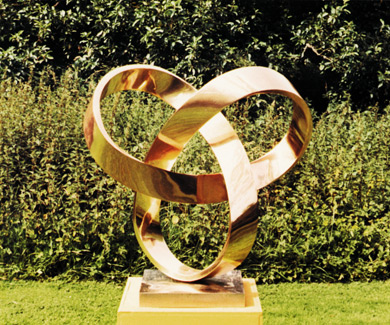
immortality sculpture

The first one shown above titled Immortality, sculpted in 1982, resembles a trefoil knot.  The meaning behind this great work of art is profound and beautiful.  He created this trefoil to represent the three generations of his family, he being the oldest of the three.  It shows the continuous movement and connection through time, becoming infinite.  Robinson said, “I believe that Immortality is made up of one’s memories of the past, as well as those one leaves behind.  I see this Symbolic Sculpture not only as a continuous journey, but also the scroll of which all life’s experiences (DNA) is recorded.”

rhythm of life pic

In the second picture, his sculpture, Rhythm of Life,  was also done in 1982. When creating this piece, he had wrapped a ribbon around an inner tire tube.  The last wrap was the fourth time around, and it returned to its original starting point.  Ronnie Brown, an English mathematician, had explained that this happens in Torus knots in math.  Robinson said, “I created the sculpture about the time that the miracle of DNA had just been discovered, and for me, this delightful flowing ribbon summed up the continuity of Genes.  I found I could balance the 18-inch maquette on a single point.”

Through this math course that was called The Heart of Math, I truly learned there was a lot of heart to it, and a lot of soul and beauty.  It may have taken decades for me to have found an appreciation for math via this class, but I’m just grateful I did discover it.


Works Cited
Symbolic Sculpture:  The Collected Works of John Robinson.  (n.d.).  Rhythm of Life.  Symbolic Sculpture:  The Collected Works of John Robinson.  Retrieved from
http://www.bradshawfoundation.com/jr/rhythm_of_life.php