Literary Humanness

books and flowers

The literary package—reading, writing, and analyzing literature—is quite crucial in the life of not only a writer, but also a reader and a student studying to become a good fiction writer (or creative non-fiction, screenwriter, etc.).  When we authors write our creative fiction works, it is a sole project in which we delve into our own minds filled with images, ideas, strings of words and sentences, and the bellowing of our carved-out characters.  But in essence, once our work is out there in print and ebook, we connect with the readers, and ultimately humanity.

In writing my stories, I’ve always been drawn to human emotions, the human condition, and the light of hope, to which I weave into my creative works.  Creating fictional characters’ journeys in dealing with real life issues, their relationships with others, and how they get through conflicts and come to discovery and resolution, is something every human being can relate to because we’ve all gone through difficulties, joys, and sorrows in our lives.
renoir dance pic

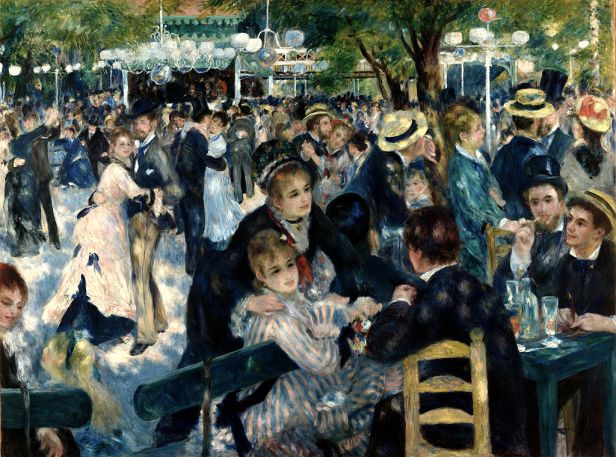
(Renoir’s Dance at Le Moulin de la Galette)

I don’t have a high self-esteem or much confidence in myself, even with the recent accomplishments in my writing this year. I still wonder if my writing is good enough.  But with all the things I’ve learned, it has only taught me I still have more to learn and that it is an ongoing process that will probably continue throughout the rest of my writing life.

Analyzing and reading the classic and modern stories I’ve read in World Literature, Fiction Writing Workshop, Intro to Creative Writing, Shakespeare, Romantic Literature, Nonfiction Writing Workshop, and most recently, British Literature, have helped me in structuring my novels in the proper manner for the character arc, and appreciate a deeper understanding of the characters.  Delving deeper into the characters revealed the utter humanness of them, their flawed selves, broken and fragile, and I think how brilliant the authors were in creating such compelling characters and their stories.  For example, the most recent paper I wrote was on Mary Shelley’s novel, Frankenstein. The character of Victor Frankenstein depicts clearly the brokenness of human beings.  And through Frankenstein’s and other fictional characters’ choices they make, cause either joy or sorrow and success or ruin for them.

frankenstein outside darkness

Literature also helps us to understand people who have different perspectives than our own, by stepping into these characters’ minds, lives, cultures, watching them deal with their bad habits, and struggles with relating to others.

Having relationships with others makes us truly human. And I believe that’s really the central struggle and most difficult endeavor for many human beings (me for sure!  Introvert here) in this life.  Generally speaking, it’s easier for us to have relationships with and love our pets than other people.  But it is through communion with other people that we become whole.

It is my hope that my writing touches the hearts of my readers (hopefully I’ll have some when my books are published!) and that they feel inspired and satisfied when they are done reading my works.

In wrapping up this blog post, I wish and pray for continued striving and success for all of us writers because writing is one hundred times harder than we thought when we first started out in the craft.


~*~*~*~


Writer Vs. Inner Critic

silencing inner critic

Sweating with anxiety, I stepped into the familiar and dangerous ring of my mind, ready with padded gloves on.  My inner critic had a fast voice that knew how to bob and weave through my brain, punching out negative remarks in all the recesses of my gray matter.  It managed to paralyze the use of my left hand (yes, I’m a leftie), and rendered my pencil useless, until it had me flat out on the cushiony floor of the right side of my brain, gasping for creativity, ideas, any words at all.  But none would formulate in my brain before I was hit by another, “That’s not good enough.”  And this melee continued for several days.

This massive struggle was all over a first draft’s middle chapters.  Oh, those dreaded scenes.  What could be worse than trying to carry on your story twenty chapters in when everything you write looks like and feels like total crap?  The beginning started with such gusto and imagination and flair.  But now, like the plummeting of a meteor to earth, the haunting middle chapters had crushed my creative endeavor.  The last fizzle of ingenuity faded into the realm of unconsciousness.

open written notebook on desk

I came to just before the count of ten and rolled onto my side, huffing as I tried to lift myself.  My body slowly obeyed, as I worked hard to produce words.  The inner critic had the energy of ten people. As soon as I had gotten to my hands and knees, it rammed into me with a triple dose of “Your writing sucks.”  I lurched and collapsed onto my side.

But I wasn’t giving up.

With new clear determination, I decided to read over the pages I’d managed to write before this battle.  The words connected, weaved together in a coherent manner.  I grabbed the pencil next to my body, scrambled to my feet, and with a sharp inhale and swing of my hand wielding the pencil, I erased the words of the inner critic.  The inner critic’s voice attempted again to try and embed more of its toxic language into my brain.  But this time, with gained strength and confidence, I shouted, “Hey!  This is a first draft!” and kicked its foul castigations out of my head.

kicking something away

It scurried away, whimpering and mumbling, but I knew it would be back soon, too soon.  I would have to keep vigilant.  I hung my gloves on the wall of my brain, and with my right hand, grabbed a towel and wiped the sweat from my brow, and with my left hand that still had the pencil in its grasp, I started writing the next chapter, one that would not haunt me but would submit to my writing freely.  At least I hoped so.


~*~*~*~


Guest Blog Post on Dialogue

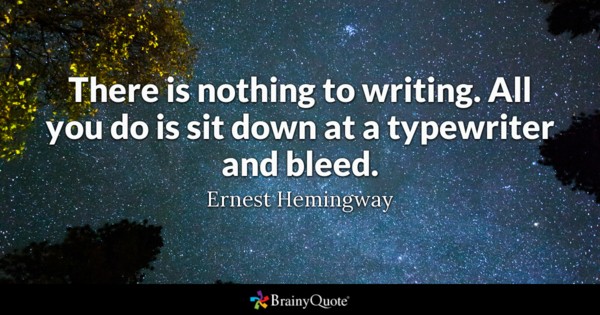
Writing the past few days has been quite painful.  Not emotionally or physically, but creatively.  Nothing good is formulating in my head to my fingers to the pencil onto the paper.  The text is wooden, mechanical.  Heck, reading a car manual is probably more exciting than what I’ve put together lately.  I think the culprit is my inner critic butting into my creativity and writing abilities.  Oy!  So, while I’m feeling like what Hemingway says,

hemingway quote 1

I’m sharing a blog post from WOW! Women On Writing Blog. A piece by Sue Bradford called, “Dialogue: 5 Tips for Dazzling Dialogue,” because we can all use a little help, I think, in writing dialogue and all things pertaining to writing fiction.

As I work through the pre-writing on my mystery and get closer to actually writing, I’ve been paying a lot of attention to fiction. Truth be told, mostly, I’m obsessing because I’m getting really worried about writing dialogue for my characters. Because of that, I’ve taken a brief class on dialogue and been doing a…

via Dialogue: 5 Tips for Dazzling Dialogue — WOW! Women On Writing Blog


**I wrote the above post in the middle of last week but am posting it today.  My writing has improved a bit since then, as I continue to work on shedding my loud inner critic who doesn’t belong anywhere near me while I’m scrawling down my WIP’s first draft.


~*~*~*~