Austen and Shelley:  Humanity’s Universal Connection and Its Struggle with Alienation and Loss in the Romantic Era

My University Essay, October 11, 2015

During the Romantic Era, the upper class of English society was a patriarchal one in which women had to rely on male family members or their husbands for them to have security, food, and shelter.  In Lady Susan, Austen presents Lady Susan as a widow seeking a weak man to marry, so she can carry out her destructive actions.   Her deceptive and flirtatious personality wreaks havoc on her family and friends, which alienates her from others.  

Shelley’s main character, Lionel Verney, in her work, The Last Man, is an orphan and a widower.  His family died years before, and the companions for whom he sailed with in the storm at sea, drowned, their boat destroyed in the crashing waves.  

Both Lionel and Lady Susan experience alienation and loss in their relationships, but the latter purposefully distances herself from others through her manipulative actions, whereas Lionel’s connection to his family and friends is torn from him through a deadly disease and the powers of Nature. 
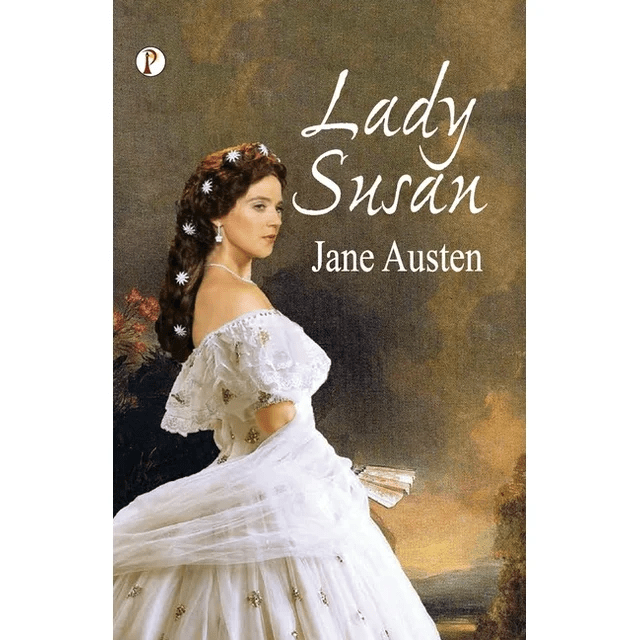
Lady Susan’s disregard for people’s feelings and their intimate and familial relationships shows her inability to have healthy relationships in either family or romantic love because she does not display a capability to love, but only to manipulate and deceive.  This is evident from the beginning of the story in which Lady Susan, while staying at her friends, the Manwaring’s house, manages to interfere with the courting of Maria Manwaring and Sir James Martin, as well as cause a rift between Mr. and Mrs. Manwaring, because of Mr. Manwaring’s interest in Lady Susan, and Lady Susan’s finding him “uncommonly pleasing” (Austen 481).  This interference she causes with Mr. Martin and Maria Manwaring, she claims is to match up Mr. Martin with her daughter, Frederica.  Her lack of compassion and maternal love for Frederica is evidenced in her calling her, “the greatest simpleton on earth,” (Austen 481) and “born to be the torment of my life” (Austen 481).  

Lady Susan informs her friend, Alicia, with regards to the Manwarings, “The females of the family are united against me” (Austen 481), which is due to her flirtations with Mr. Manwaring and Mr. Martin.  She has no consideration or compassion for her friend, Mrs. Manwaring, or for her daughter, Maria Manwaring.  Breaking up a friendship does not concern or upset Lady Susan, because she is ruled by her appetite for deception and power over the men she flirts with and the family members for which she feigns love and affection.

Catherine Vernon, Lady Susan’s sister-in-law, mentions to her mother that Lady Susan didn’t want her to marry Charles, the brother of her deceased husband, and believes Charles to be too lenient toward the lady.  Catherine says, “Her behaviour to him, independent of her general character, has been so inexcusably artful and ungenerous since our marriage was first in agitation, that no one less amiable and mild than himself could have overlooked it at all” (Austen 484).  

Additionally, Catherine warns her brother, Sir Reginald DeCourcy, of the powers of Lady Susan through her beauty and clever language, and says, “I’m sorry it is so, for what is this but deceit?” (Austen 484) Lady Susan reiterates her interference in Charles and Catherine’s initial engagement, saying to her friend, Alicia, “To be sure, when we consider that I did take some pains to prevent my brother-in-law’s marrying her, this want of cordiality is not very surprising” (Austen 483).  This pattern of driving a wedge between both married and courting relationships is prevalent throughout the story. 

Having been warned of Lady Susan’s destructive and deceptive behavior by his sister, Catherine, Sir Reginald initially heeds her warning, but it is forgotten once he meets her in person; he becomes captivated by her.  Conversely, Lady Susan enjoys garnering his attention and upsetting her sister-in-law, but she decides she is not interest in marrying Sir Reginald, which was suggested by her friend, Alicia, telling her, “I cannot easily resolve on anything so serious as Marriage; especially as I am not at present in want of money, & might perhaps, till the old Gentleman’s death, be very little benefited by the match” (Austen 487).  She recognizes Sir Reginald’s abilities to question her behavior toward her daughter and does not feel he will be compliant enough for her.

Lady Susan is interested in her desires first and foremost, with little consideration for the needs or wants of others. Literary critic, Michiko Soya, reiterates this point by saying, “She gives first priority to the pleasure of deceit, and as a result, she eventually becomes the object of love,” (Soya) as seen in Reginald’s falling in love with her.  

Lady Susan’s scheming and flirting give her power over her victims, but only for a while – until she is found out.  Sir Reginald eventually discovers the true nature of Lady Susan through the Manwarings, and he sends her a letter stating, “The spell is removed” (Austen 506).  Lady Susan does not pursue him, but only answers his two letters, closing their relationship, with a feeling of indifference toward his pain in the fact that he loved her.  

She continues to try and push on her daughter the match with Sir James, but her daughter is vehemently against it, and eventually, Lady Susan marries him herself, because she has exhausted all avenues of marriage possibilities by causing one man to cut off their relationship and the other to do the same because her schemes were exposed.  True, loving, and mutually respectful relationships are seemingly foreign to her, as she does not pursue this at any time.  Instead of embracing her family, friends, and male suitors, she distances herself from them through her desire for power, flirtation, and deception.

In Shelley’s work, The Last Man, main character, Lionel Verney, having been an orphan, already experiencing loss and alienation early in his life, grows up in childhood poverty for which he blames the king, who was supposed to have been a friend of his father’s, was indifferent to him.  He grew up with bitterness and resentment for the rich, the monarchy, and nearly everyone, but he changes when he finds love.  Yet, when he and his companions are caught up in a storm at sea, not only is he a widower, having lost his wife years before and survived his children, he is left vulnerable and at the mercy of Nature in his struggle to survive the rocky tempest. Determined to beat Nature, he said, “I breasted the surges, and flung them from me as I would the opposing front and sharpened claws of a lion about to enfang my bosom.  When I had been beaten down by one wave, I rode on another, while I felt bitter pride curl my lip” (Shelley 886).  

When the Plague stains humanity with its poison, and Lionel’s sailing companions perish at sea in the storm, he is left alone with no connection to humanity in the flesh for the third and last time in his life.  Lionel feels the rain joins him in his mourning, for which he states, “even the eternal skies weep” (Shelley 886).  His grief is heavy as he reflects on his companions who have perished, saying, “I shall never see them more. The ocean has robbed me of them – stolen their hearts of love from their breasts, and given over to corruption what was dearer to me than light, or life, or hope” (Shelley 889).  He thinks about his wife and children, saying, “I had not forgotten the sweet partner of my youth, mother of my children, my adored Idris” (Shelley 889).  He saw her in his youngest son, Evenlyn, and when he died, he “lost what most dearly recalled her to me” (Shelley 889).  He then kept her memory through seeing her in her brother, Adrian, who died, along with Clara, in the storm.  With profound sorrow, he says, “They were all to me – the sums of my benighted soul, repose in my weariness, slumber in my sleepless woe.  Ill, most ill, with disjointed words, bare and weak, have I expressed the feeling with which I clung to them” (Shelley 889).  

Lionel treasures his family and friends, and love penetrates his heart for them, as critic, Betty Bennett says, “…through love, which is true power; and he metamorphoses into an educated, sensitive, human-sized heroic figure…” (Bennett).

He wanders the empty cities of Italy and enters many houses where he tries to find some relation to humanity. Desperate for companionship with the living, he tries to befriend a goat family, but after the male goat charges him, he instinctively wants to hurt the animal for this, but doesn’t have the heart to do so. As they scurry off through the woods to seek protection from him, he cries, “I, my heart bleeding and torn, rushed down the hill, and by the violence of bodily exertion sought to escape from my miserable self” (Shelley 893).  He envied the animals with their dens and burrows and nests of families.

Believing the Plague carried out its obliteration of humanity in England and France first and Italy last, he says, “Reason methought was on my side; and the chances were by no means contemptible that there should exist in some part of Italy a survivor like myself – of a wasted, depopulated land” (Shelley 891).  While searching for people, he comes upon white paint and decides that he will write with that paint: “Verney, the last of the race of Englishmen, had taken up his abode in Rome.” This minute act brought about some comfort for him, and he added in his painted message, “Friend, come!  I wait for thee!” (Shelley 891) Hope is ever present inside him.

In entering a saloon, he did not recognize himself reflected in the mirror on the wall.  His meek existence left him in tattered clothes, and much growth of hair on his face and on his head.  But with the spark of hope in him that there may be some surviving people somewhere, he cleaned himself up a bit.  He found writing utensils and papers in the study of an author of the house he came upon, and decided, “I also will write a book” (Shelley 897) and said, “I will write and leave in this most ancient city, the ‘world’s sole monument,’ a record of these things.  I will leave a monument of the existence of Verney, the Last Man” (Shelley 897).  

After a year, Lionel still endured, saying, “…loneliness is my familiar, sorrow my inseparable companion” (Shelley 897).  He cries, “Without love, without sympathy, without communion with any, how could I meet the morning sun, and with it trace its oft repeated journey to the evening shade?” (Shelley 895) But he does find a companion in the form of a shepherd dog that “left his fold to follow me, and from that day has never neglected to watch by and attend on me, showing boisterous gratitude whenever I caressed or talked to him” (Shelley 897).  He decides to depart on one of the boats tied to the pier, and to take books, supplies, and his dog with him to sail wherever it takes him in which he says, “restless despair and fierce desire of change lead me on” (Shelley 898), so that he feels he has a purpose in the remaining years of his life, always with a perseverance, strength, and hope for what lies ahead.  Literary critic, Timothy Ruppert, says as much when he argues The Last Man means, “…a prophecy of hope justified by the regenerative power of the human imagination” (Ruppert).

Through Austen’s portrayal of Lady Susan and Shelley’s depiction of Lionel Verney, both characters have relations with family and friends, but both find themselves cut off from them and their communities. Lady Susan produces ostracization from others through her selfish and conniving behavior, while Lionel lost his connection to his family and friends as well as all humanity through the circumstances of death, in which he had no control. Austen and Shelley teach us through their characters’ experiences with desolation, loneliness, and destructive behaviors, that human unity and kinship in our lives is vital to our health and wellbeing.

Works Cited

Austen, Jane.  Lady Susan.  The Broadview Anthology of British Literature:  The Age of 

Romanticism.  2nd ed.  Broadview Press, 2010.  Print.

Shelley, Mary.  The Last Man.  The Broadview Anthology of British Literature:  The Age

            of Romanticism.  2nd ed.  Broadview Press, 2010.  Print.

Soya, Michiko.  “Lady Susan:  A Game of Capturing the Last Word from Lady Susan to

            Jane Austen and Then”  Jane Austen Society of North America.  Winter 2003.

Web.  15 October 2015.  http://www.jasna.org/persuasions/on-line/vol24no1/soya.html

Bennett, Betty.  “Radical Imaginings:  Mary Shelley’s The Last Man.”  Romantic Circles.

            Summer 1995.  Web.  15 October 2015. 

https://www.rc.umd.edu/editions/mws/lastman/bennett.htm

Ruppert, Timothy. “TIME AND THE SIBYL IN MARY SHELLEY’S THE LAST MAN.” Studies in the Novel 41.2 (2009): 141-56.  Web.  18 October 2015.

http://search.proquest.com.ezproxy.snhu.edu/docview/212636355/fulltext?accountid=3783

Two Gods, Two Mediums

This is a 2016 essay of mine on the Analysis of

“Hermes and the Infant Dionysius” and “Madonna in the Meadow”

Praxiteles was born circa 390 B.C., and died circa 332 B.C.  He was considered the greatest sculptor in Greece and was known as the “sculptor of grace” for his use of softer forms and displaying the Greek gods as humanlike and gentle instead of indignant and distant.  His work, “Hermes with the Infant Dionysus” is the only known work of art done by him that has survived.  The statue made of marble, which was Praxiteles’ choice of medium, shows softness in lines and form and humanistic style (“Hermes and the Infant Dionysos”).    

The sculpture portrays Hermes carrying baby Dionysus to the nymphs in the mountains.  The mythological story tells us that Zeus had an affair with a mortal woman named Semele.  Once he showed himself to her, she burned to death by the warm radiance he possessed as a god.  Dionysus was produced from their love, and Zeus’ wife, Hera, found out and wanted to kill the infant and anything else that reminded her of his affair.  With that, Zeus called on his messenger, Hermes, to take Dionysus and deliver him to the nymphs that live in the mountains for his safety and to raise him.  This sculpture captures the playful moment of Hermes with baby Dionysus on their journey to the nymphs.  Dionysus grew up and became the god of wine, festivity, and theater (“Hermes and the Infant Dionysos”).

The statue was most assuredly commissioned for the sanctuary, and it was, indeed, housed in the Temple of Hera at Olympia.  In 1877, German archeologists discovered the sculpture in that temple.  

Praxiteles’ work, “Hermes with the Infant Dionysus,” truly reflects the late Classical style of that era, as well as represents the Greek pagan religion at the time where many temples to the various gods and goddesses housed statues like Praxiteles’ beautiful sculptures.  

The inclusion of children/babies in Greek art is evident of Late Classical sculpture.  Praxiteles promoted a new decree of proportions, which displayed a naturalistic, thinner, softer, taller, and more intimate sculpture style that had never been seen before.  His sculpting design is more secular and worldly than depicting the divine.  It signifies social changes and predominance of secular and touching representations from then on (“Hermes and the Infant Dionysos”).

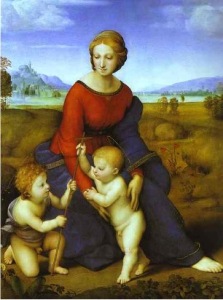
 Raphael’s oil painting on wood, “Madonna in the Meadow” was created and completed between the years of 1505 and 1507.  Raphael, whose full name was Raffaello Sanzio or Santi, was born in Duchy of Urbino, Italy, on April 6, 1483, and died April 6, 1520.  His parents, Margia di Battista Ciarla, died in 1491, and his father, Giovanni Santi, first taught him to paint, not too long before his death.  Giovanni had also exposed Raphael to humanist philosophy at the court.  The city in which Raphael had lived, Urbino, was a cultural center under the rule of Duke Federico da Montefeltro.  

Most of Raphael’s basic learning of the arts was while living in Urbino.  His talent was exceptional at barely 17 years old.  In circa 1495, Raphael went to Perugia and began his work through commissions by the Church between 1501 and 1503, through his connection to and learning from a great artist and master from Urbino named Pietro Perugino.  Perugino’s excellent style influenced Raphael, and later, also Leonardo da Vinci and Michelangelo’s amazing works.  He was one of their students (“Raphael”).

Raphael worked on his many paintings of the Madonna between 1505 and 1507.  In his painting, “Madonna in the Meadow,” it shows the Virgin Mary sitting on a large stone gently grasping baby Jesus and watching he and baby St. John the Baptist, who was just six months older than Jesus.  The colors used in Christian art are of great importance.  For example, the Virgin is dressed in red and blue clothing.  The red signifies her mortality or humanity and the blue, her holiness.  Raphael’s use of chiaroscuro in the painting was an influence of da Vinci, as well as by his sfumato – the use of very fine, soft shading in lieu of line/characterized forms and features.  He used aerial perspective to give the appearance that the landscape was far away.  Raphael created unique figures with round, tender faces that were not complex, but expressed basic human feeling.   His technique also elevated them to precision and peacefulness.  He strived to create a more personable style to make a popular and accessible form of visual connection (“Raphael”).

Raphael’s painting, “Madonna in the Meadow,” reflects the Renaissance period in which he lived.  There is the Classical aspect of the work reminiscent of ancient Greco-Roman Classical art, and there is the humanistic aspect of the Renaissance era, which stressed the excellence and integrity of the human being.  Christianity was still prevalent at the time, despite the troubles in the Catholic Church, the beginnings of the Protestant Reformation, and the ushering in of more reason than religious thinking.

These two artworks have many similarities. They share mystical and mythological representations.

Praxiteles’ “Hermes with the Infant Dionysus” depicts two Greek gods of Greek mythology, which was the religion of the Greeks throughout the ancient and Classical Greek periods. Raphael’s “Madonna in the Meadow” displays the blessed, holy Virgin and her son, Jesus Christ, reflecting the religion of Christianity’s true God incarnate.  

The forms are sculpted and painted in soft, beautiful lines and classical beauty.  With Hermes’ weight bearing on his right leg and his left leg gently touching the ground, his sinuous body curves in an S shape.  This lack of equilibrium in the statue was a new form at that time, which was called the “Praxitelean curve” (“Hermes and the Infant Dionysos”).   

There are smooth and graceful curves in Raphael’s oil painting through the soft curves of the Madonna’s shoulders against the gentle curves of the landforms behind her.  Both pieces of art contain children in them of great importance.  Infant Dionysus is the offspring of a god, Zeus, and a mortal, Semele, and likewise, Christ is the offspring of God, the Holy Spirit, and mortal, Mary.  

Baby St. John the Baptist is a messenger from God.  His purpose on earth was to pave the way for Jesus Christ’s entrance into the world and his future ministry.  Hermes is a messenger from the god, Zeus, and in this case, he is delivering Zeus’ son, Dionysus, to the nymphs for his safety and care.  

Another similarity between the two mediums is displaying the human body nude and also donning robes or cloaks.  Both art periods honored the human body and considered it beautiful.  The oil painting and sculpture share the depiction of a protective, gentle adult caring for a child.  In the Classical Greek tradition, the naked body portrayed moral virtue and heroism (Mount).  In Raphael’s era of the Renaissance, the naked human body was also considered beautiful and revered (Sorabella).  

There are differences in the two artworks.  Praxiteles’ work is a sculpture made of marble, whereas Raphael’s work is an oil painting on wood.  “Hermes with the Infant Dionysus” depicts two Greek gods from Greek mythology, which are demigods – they produce children and have relations with mortals/humans producing children.  They share human emotions, especially jealousy and anger (“Hermes”), but this is not so for the Christian God, who does not have such emotions as jealousy.  

In Praxiteles’ sculpture, Hermes’ body is off-balance, shaped in an S curve that makes it asymmetrical, which Praxiteles brought to the Late Classical Greek art (“Hermes with the Infant Dionysus”).  In Raphael’s painting, there is a pyramidal blueprint with the position of the three subjects that gives it a sense of quality, tranquility, and symmetry that was commonly employed by Renaissance artists (“Raphael”).  In the painting, “Madonna in the Meadow,” the viewer is able to see the scenic background of the meadow through its aerial perspective and two-dimensional form, but a background isn’t shown in “Hermes with the Infant Dionysus” largely because it is sculpted in the round, which means that it is not attached to a background and can be seen from any angle.  

In conclusion, Praxiteles’ “Hermes with the Infant Dionysus” and Raphael’s “Madonna in the Meadow” share the Classical style of both their eras and portray the mystical and gentle beauty in their lines and forms, and therefore complement each other.

~*~*~*~

Works Cited

“Hermes with the Infant Dionysus.”  Museum of Antiquities.  n.d.  Web.  3 March 2016. 

http://www.usask.ca/antiquities/our-collection-/greek/classical-greek/sculpture/hermes-with-the-infant-dionysus/index.php

“Raphael.”  Artsy.  2016.  Web.  3 March 2016.  https://www.artsy.net/artwork/raphael-

            madonna-on-the-meadow

“Hermes and the Infant Dionysos.”  Museum of Art and Archeology.  2016.  Web.  3 March

2016.  https://maa.missouri.edu/?q=collection/hermes-and-infant-dionysos

“Raphael:  Italian Painter and Architect.”  Encyclopedia Britannica.  2015.  Web.  3 March 2016.

http://www.britannica.com/biography/Raphael-Italian-painter-and-architect

Mount, Harry.  “Why Are Greek Statues Always NAKED?”  Daily Mail.  2015.  Web.  3 March

2016.  http://www.dailymail.co.uk/news/article-3010353/Why-Greek-statues-NAKED-

extraordinary-answer-s-laid-bare-magnificent-risque-exhibition-British-Museum.html

Sorabella, Jean.  “The Nude in the Middle Ages and the Renaissance.”  The Metropolitan

Museum of Art.  2008.  Web.  3 March 2016. 

https://www.metmuseum.org/toah/hd/numr/hd_numr.htm

“Hermes.”  GreekGods.org.  2016.  Web.  3 March 2016.  http://www.greek-gods.org/olympian-

            gods/hermes.php

From a Shrew’s Point of View

shrew photo


Below is a creative writing exercise I wrote in my university’s Shakespeare class a few years ago.

Journal piece on Taming of the Shrew from Katharina’s perspective in first person. Hope you enjoy.

[Baptista’s house and street]

            As I gaze out of the window onto the cobblestone streets below, there are a gaggle of knaves and gentlemen, all of whom are weak in heart and body.  They fear me, which I take pleasure in because I do not wish to marry if all men in Padua are in this state or manner, nor do I enjoy being forced into marriage.  I will not obey my father in marrying whomever he wishes to join with me into foolish matrimony.   Besides, he favors my delicate sister, Bianca, who has no backbone, who bends her will to nearly every man, believing her obedience is proper and in good female fashion.  Ay, but how does this act serve her in the end?  Will she marry one of the weak fools stumbling eagerly about before our father’s house?  For she bears her tender heart to those knaves, who will lord over her, I suspect.

No man is able to trick me with their trembling knees and wan faces into having me believe they are stronger than I and love me more than a hundred crowns.

Hark, who goes there?  Father is conversing with a rogue who calls himself Petruchio, who is crooning flowery proses and elaborate orations about me.  Oh, but he is relentless, keeping to me like a persistent hunting dog.  How clever he thinks he is!  And grossly tactless in his threatening to strike me if I were to slap him again!  Alas, he says he will marry me next Sunday, and he leaves my presence and my father’s house, giving me reprieve for a time.

I sit in wonder.  He hath the strength of an ox and the cunningness of a fox, flattering, lovely words that elevate my person, whilst at the same moment, spurts forth violent words with his acidic tongue.  He must be mad!  Yet, he is dedicated and determined with the deliverance and appearance of a rogue lord.  I am overcome with confusion and a swelling heart.  Father gives his blessing for us to be married.

The following Sunday, I’m robed in a beautiful wedding gown, but Petruchio not is he here.  Hath he made a fool of me?  After the efforts I’ve produced to be present for this farcical marriage, the brute has no tact, no feelings.

[Enter Petruchio in gaudy garments on a tattered horse]

            He hath arrived in garments meant for a jester, but he is present.  He and I marry before the priest, God, and the townspeople, and my new roguish husband wishes to leave our wedding banquet because of business.  Pray, what business?  He says not what business.  My heart beats obstinately, and I will please myself and stay with family and friends to feast and dance.  But he forbids my staying and carries me out, sets me on a donkey, and we travel to the long trek to his home in the cold, wet day and evening.

When we arrive, exhausted and famished, he gives me no meat, no food, no rest.  My strength has abated, and I am desperate for sustenance, but none is given to me for a day and more.  What knavery, what heartlessness!  Why hath my husband done such horror?  He does not love me as he incessantly declares.

He tears up my dress for my sister’s wedding before we are to leave to go to town.  I am more sorrowful, hopeless than bitter.  But a dress I do at last have.  I realize I cannot get what I want without obeying him.  I must agree with all he says for he, his servant, and I to go to the wedding.  In doing so, he softens a bit, and I, too, have softened my heart…although my heart did become tender toward him in that first encounter in which he visited my father’s house and wooed me in strange, unique ways and declared he was going to marry me.  I am pleased that my obedience has brought about gentleness from Petruchio.

It was fate that brought Petruchio and I together, inasmuch as he’s tamed my stubbornness and pride, I, too, have tamed his.


~*~*~*~