
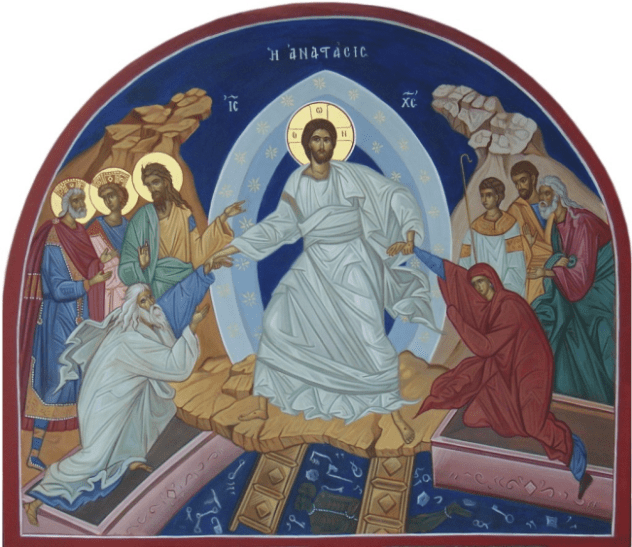
Let God Arise! Let His enemies be scattered!
When you take the journey with Christ from His entrance into Jerusalem on a donkey, praised and honored through the laying down of palms, through the grueling walk to Golgotha, wailing with His Mother, to experiencing the thunderous, earth-trembling from His death, His descent into Hades, breaking the chains and releasing those waiting in the tombs, preaching to those who did not know Him, to witnessing His glorious Resurrection, told to us by an angel at His Tomb, your body, mind, and soul are greatly and positively affected.
Your body aches from the hours of services, for which three quarters of the time you’re standing. Your mind is filled with the readings of his journey and what it all means. Your heart is torn into pieces listening, watching, and reading of the scourging, mockings, spitting, and especially the words “His blood be on us and on our children.” Lord, have mercy. *doing the sign of the cross* That line always gets you.

You take in the sweet smell of incense that reminds you of the realm of God’s Kingdom, the prayers of the Saints, and that you and your brothers and sisters in the nave of His Church are with Him through all of it. You’ve heard these passages hundreds of times, but something new and profound hits you every year this is read aloud. This time, you’re wishing you were the thief on the cross, hoping, praying, pleading, “Lord, remember me when you come into your Kingdom,” and you’re dying to hear Him say, “Today, you will be with me in Paradise.”
You weep when you hear His Mother, the Theotokos, wail and say to Him as He plods to His voluntary crucifixion, “”Where are you going, my Child? Why do you travel along so fast? Would there perhaps be another wedding in Cana, and you hurry there, to turn for them water into wine? Can I not come with You, my Child? Or tarry with you? Speak to me a word; You, Who are the Word. Pass me not by in silence, You, Who kept me pure. For You are my Son and my God.” In your humanity and being a mother of two sons, the words slice through you, cutting you deeply, and you feel Mary’s pain.
But then the Panagia tells Him to hurry and rise on the third day so that she can see Him glorified: “O my Son, where has the beauty of Your form vanished? I cannot bear to see You unjustly crucified; hasten, therefore, and rise up, that I too may behold Your Resurrection from the dead on the third day.” You realize that the Theotokos knew and understood immediately what Christ had been saying before His crucifixion that He’d rise on the third day, whereas all but one of the Apostles fled in confusion, fear, and sorrow. Beloved Apostle John stood by the Cross with Christ’s Mother and the other women.
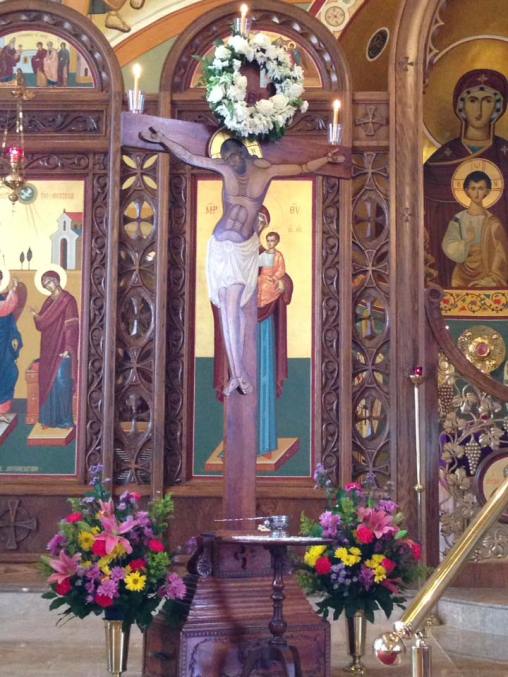
Pictured below:
Christ crucified. Holy Thursday evening is the Twelve Gospels Service that follows Christ’s Passion and Crucifixion. Our bishop was present for this service, so instead of being three hours, it was four. This night’s service is the longest, but this was the longest I’ve ever encountered, but it didn’t matter. When you experience such profound, glorious, and heart-wrenching events, you’re undone, heart, soul, body, mind, but in a good way.
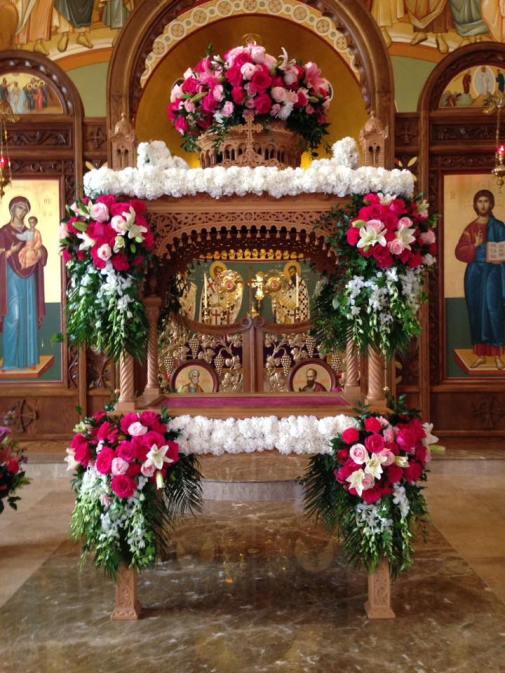
This is the kouvouklion — Christ’s Tomb — that the ladies of my church decorate each year ( took this picture personally on Friday. It is from my church). Gorgeous. It is carried around the church Friday evenings for the Lamentations service, where we join Joseph of Arimathea in carrying Christ’s body to the new Tomb.
Video taken by me at our “home” parish back in Colorado Springs, Colorado, (2011) that gives you a glimpse into Holy Saturday morning’s Divine Liturgy where Christ descends into Hades and destroys its chains and gates and opens the tombs. The pounding we made (and wish all Orthodox Churches did this) is to symbolize the breaking open of the gates and chains and the tombs. The priest throws basil leaves and flowers symbolizing Christ’s victory and that He is King and Lord. (It isn’t unusual that after the two and a half hour service the night before that this service is less attended, which is unfortunate because it’s such a beautiful and joyous experience).
Holy Saturday evening’s Resurrection Service is held around midnight with a vigil and then the Divine Liturgy.
Here’s a video from an Orthodox Church of a few years ago that shows what happens around midnight when the priest announces, “Come receive the Light,” which the candle represents Christ’s descent into Hades and darkness and through His Resurrection, the Light has come into the world and has trampled down Death by His death. After His entrance, you, along with your brothers and sisters in Christ, say joyously and triumphantly, “Christ is Risen!” and will chant this verse over and over again that early Sunday morning and the next several Sundays:
Christ is risen from the dead,
trampling down death by death,
and upon those in the tombs,
bestowing Life.
The Holy Fire descends on the Tomb of Christ inside the Church of the Holy Sepulchre in Jerusalem every Holy Saturday. The Greek Orthodox Patriarch receives the Holy Fire that miraculously lights his bundle of thirty-three candles each year). Here’s a video of this mystical and miraculous event from today:
At the end of the liturgy, you receive a red egg that symbolizes the blood of Christ, and Life. You gather with your family and brethren in the hall for some food and drink, and crack eggs with them. The cracking of the eggs symbolizes the cracking open of the tombs. If your egg survives the cracking contest, you are blessed.

It’s a blessing to return home each night smelling of sweet, heavenly incense, and body wrought from worshiping Christ God in body and spirit.
On Pascha Sunday, you attend the Agape Vespers Service where the proclamation of Christ’s Resurrection is read in several different languages. The most common languages spoken are English, Greek, Arabic, Latin, Albanian, Spanish, German, French, and sometimes Japanese and Swahili. Others also may be said if there are parishioners who know that language or come from the country that speaks that particular language. You enjoy hearing the Good News in many tongues, showing this message is universal.
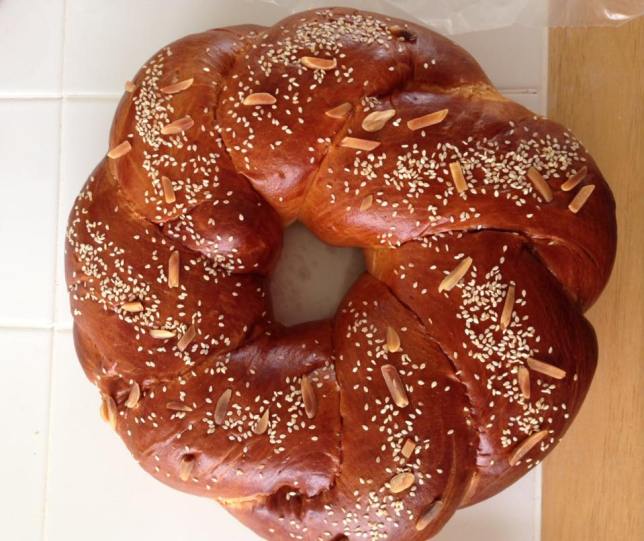
You enjoy a Paschal picnic of lamb and all other types of meat, etc., and Pascha sweet bread, called Tsoureki in Greek. We got one this year from the women’s monastery a few hours away:
Christ is Risen! Truly He is Risen!




 Modest Musings