
Finding Meaning in Silenced Voices

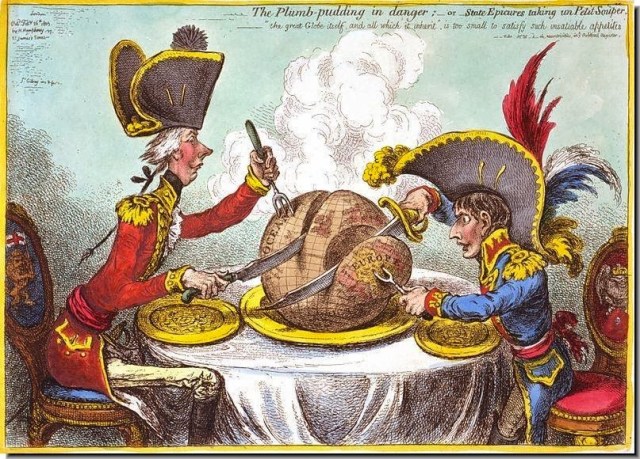
colonialism cartoon

Postcolonial theory emerged after WWII, in which it studied the colonizer and the colonized, meaning those people from imperialistic nations, such as England, France, Denmark, and America, and the people from the countries the former ones colonized.

The postcolonial theorist, Edward Said, used poststructuralist tools by deconstructing the West and East through binary opposition.  The West was given the center or privilege, while the East was given the marginalized or “other.”

The postcolonial critic, Homi Bhabha, focused on the interactions of the colonizer with the colonized and how each group was affected by the others’ cultures.

Lastly, Gayarti Chakravorty Spivak, an Indian-born Western academic studied the difference in the cultures of the colonizer and the colonized and paid close attention to both class and the effects of colonialism on the colonized women.

The critics analyzed literature for these aspects and also had to figure out how to categorize postcolonial literature from writers who were geographically not part of Europe or other colonial powers (Bertens).  This was done through using the term, “literatures in English” (Bertens).

The writers’ works under the oppression of the colonizers were still viewed and critiqued through the center, which were the English academics and critics.  Later, in the 1970s through today, this has changed and opened up to more autonomy for those postcolonial writers that were victims of colonization (Bertens).

Charlotte Perkins Gilman’s “The Yellow Wallpaper” shows the Western postcolonial view through an American wealthy, caucasian family.

yellow wallpaper book cover 2

Gilman, an American writer and feminist, wrote this in the late nineteenth century when colonialism was quite active.

In the story, we can see that John, the main character’s husband, represents the colonizer, or from Said’s point of view, the West, whereas the main character represents the East.  John is a doctor and wealthy.  His character aligns with the traits of the Western colonizer or “masculine pole” (Bertens) Said describes as “enlightened, rational, entrepreneurial, and disciplined” (Bertens).  The main character shows John to exhibit the traits of rational and enlightened when she says, “John is practical to the extreme.  He has no patience with faith, an intense horror of superstition, and he scoffs openly at any talk of things not to be felt and seen and put down in figures” (Gilman).  This also reflects the West’s or colonizer’s view of the East’s or colonized’s practices, beliefs, and cultures.

The main character reflects the postcolonial view of the colonized that helps or aids in the colonizer’s power when she says in regard to John, “He is very careful and loving, and hardly lets me stir without special direction.”  This also shows the trait of passiveness that Said mentions in his list of the “feminine pole” (Bertens).  These traits Said mentions that are displayed by the main character in this short story are “irrational, passive, undisciplined, and sensual” (Bertens).  The main character displays irrationality when she says, “I cry at nothing, and cry most of the time” (Gilman).  Her passivity is apparent when she says, “I tried to have a real earnest talk with him the other day and tell him I wish he would let me go and make a visit to Cousin Henry and Julia.  But he said I wasn’t able to go, nor to stand it after I got there; I did not make out a very good case for myself, for I was crying before I had finished” (Gilman).

Using the methods of Bhabha, the interaction between the main character and her husband reveal that the main character’s perceived madness from being cooped up in the room affect John at the end of the story.  After the main character has torn up nearly all the rest of the yellow wallpaper in the room to try and release her alter ego from the prison she imagines in the paper, John comes to the room and finds it locked, for which she tells him where the key is.  In obtaining the key, John opens the door and asks in astonishment, “For God’s sake, what are you doing?” (Gilman), and the main character says, “I’ve got out at last, in spite of you and Jane.  And I’ve pulled off most of the paper, so you can’t put me back!” (Gilman).  John proceeds to faint in reaction to this.  But this also depicts resistance by the main character/colonized against the colonizer.

The symbols of West and East and the colonizer and the colonized through the main character and her husband in the short story, “The Yellow Wallpaper” provide a good example of a postcolonial theory’s analysis through its lens.


~*~*~*~


Works Cited
Bertens, Hans.  Literary Theory:  The Basics.  3rd ed.  London and New York:  Routledge, 2014.
Gilman, Charlotte Perkins.  “The Yellow Wallpaper.”  Gutenberg.org.  5 November 2012.
https://www.gutenberg.org/files/1952/1952-h/1952-h.htm.  Accessed 10 August 2017.


Candy, Caroling, Community

suburb neighborhood clip art

As I sit in my bedroom and stare out at my neighbors’ snow-covered backyards, in the midst of the time of year commonly called “The Holidays,” I remember this special, wonderful season when I was a child. Thoughts and discussions about the word community have bounced around our media waves and public venues for the past few years. Some talking about the loss of community in our day. Trying to resurrect what has been lost behind 6-foot-tall fenced in homes, tiny front porches, and neighborhood sidewalks and streets devoid of people.

I’ve been pondering these changes over the last thirty to forty years in communities.  If you were a child in the 1970s like I was, you may relate to what I’ll be expressing here.

I grew up swinging on leathery-type seats with rusty chains to hold onto, pumping my legs to reach the sky so that I could jump out of the little seat, feeling the joy of that wisp of a moment of flying before my feet hit the ground–a ground of simple dirt.

old swings

I remember climbing up the huge metal slide’s ladder to its tower-like top. To my ten-year-old eyes, I had to be up at least twelve to fifteen feet from the ground. And being a fan of Mary Poppins, I opened my umbrella and jumped from the tower, waiting to glide gently down from the heights to land with a smile of triumph and contentment.

metal slide

Instead, that joy of flying lasted about two seconds before I came crashing down like a lead weight, hitting the ground hard and falling over on my side. I wasn’t hurt, though. But having learned that experiment didn’t work, I never tried the umbrella jump again.  However, it still was a lot of fun. I had such a fantastical imagination back then.

Every year, I looked forward to going trick-or-treating with my friends. And most every house, we knew the families that lived there. I knew these homes because the kids that met me at a mutual friend’s front yard would become acquainted with me, and soon, we’d all be playing together, the streets filled with kids playing ball, hide and go seek, ghost in the graveyard, and bloody murder (some folks don’t know this one, but it’s like the opposite of hide and go seek. The murderer hides and jumps out, surprising the group of kids going around looking for him/her, and the first kid tagged by the murderer had to be the murderer the next go around), etc.

We stayed out after the street lamps came on, and dove behind bushes, climbed trees, and hid behind anything we could find, while the person counted in the dark, then set out to find us. I distinctly remember one night, I hid up in a tree, and the kid never found me. I was such a monkey. So much so, my mother used to call me μαϊμού (Greek for monkey).

So, Halloween was lots of fun with the whole neighborhood participating. One year while we lived on Rhein Main Air Base in Germany, my mom dressed in black, painted her face white, and took residence in a makeshift coffin in the lobby to our stairwell (apartment building), so that when children came in, she’d sit up in the coffin, both terrifying and surprising them before they could scramble to the first apartment’s door. But it was all in fun because everyone knew everyone.

Halloween cartoon silhouette pic

So, it was in the past several months to year that I realized how important Halloween is because of its communal aspect. It was ruined in the mid 1980s and after due to sick people putting razor blades in apples, and other poisonous things in pieces of candy, followed by the disappearance of families’ cats (especially black ones) for other sick individuals who’d torture the poor creatures and kill them. When I was a senior in high school, a friend of mine lost her kitten Halloween night to some warped-minded teens who drowned her kitten in the local pool.

The communal aspect of Halloween splintered during and after this time out of fear and a new mistrust of fellow neighbors. I think this was also the time when privacy fences became popular. You no longer could see, wave, or converse with your neighbors while sitting in your backyard.

Back to my childhood memories when I recall community was strong. I remember with great joy the few weeks before Christmas, in the evenings, the faint but melodic voices of carolers outside our apartment on Rhein Main Air Base and off base housing in the suburbs of Virginia and Illinois at that time. I distinctly remember opening our third-story window at Rhein Main that overlooked the patch of cement below, and seeing a group of cheerful carolers, singing, despite the bitter cold evening. It made the coming of Christmas even more special.

Christmas carolers

But I’ve not seen any carolers since the one Christmastime at Fairchild Air Force Base back in either 2005 or 2006. It was both surprising and exciting to have encountered that, bringing a rush of sweet nostalgia through me.

Although there were people who didn’t celebrate Christmas in my neighborhoods growing up, they still seemed to appreciate the carolers and listened quietly with smiles. Caroling was another communal activity in our neighborhoods. I miss it.

I think I actually started realizing the closed up neighborhoods/housing units after we moved to Pennsylvania and lived in a rental home that sat on about a half acre of land with it partly fenced with criss-crossed logs in the backyard and open front yard. No privacy fences. Why? Because these homes were build in the late 1950s. There was so much more space between homes and you could see your neighbors out mowing their lawns, watering their flowers, filling their bird feeders. It was charming.

Before that time, as an adult, I’d believed in privacy fences, and keeping locked up in my house and didn’t make much of an effort to talk to our neighbors, except the ones right next door to us, like in Fountain, Colorado and Callaway, Florida. But besides those instances, there wasn’t much communal activities going on.

I also remember when I was a teen living in Fairfax, Virginia. We moved to the suburbs in a court/culdesac, and a few of the ladies from the houses next to us and a couple down from us actually knocked on our door. My mom opened it, and I watched curiously behind her, as the ladies welcomed us to the neighborhood and gave my mom a casserole dish of something home cooked.

Neighbours stand eating around a table at a block party

At our court in Castle Pines North in Castle Rock, Colorado, in my last year of high school, the neighbors came together a few times in the summer for block parties. Don’t see those anymore.

We moved to Castle Rock, Colorado, October 11 of this year, and we’re in a nice neighborhood with large single-family homes close together, and paired homes (duplex/townhomes), in which we live. Obviously, we were here for Halloween. I went out and bought a moderate amount of candy, not sure if we’d have any children coming to visit our home, because the last two places we lived in Lancaster, PA, and West Roxbury, MA, we had zero children come around our neighborhood, which was, I must say, both surprising and disappointing.

Well, lo and behold, more than fifty precious children knocked on our door this year, asking for tricks or treats, and we had plenty of treats to give them. This experience brought back my childhood and the hope of community.

I walk this beautiful neighborhood and its nature trails as much as I can because I’m in my favorite state with its glorious Rockies towering on the horizon every day. And seeing children playing outside, climbing trees, riding bikes, skateboarding, riding their scooters, and congregating in their small front yards sparks the child in me and a wave of hope and joy wash over me.

Community is still here. I’d like to believe there are many other neighborhoods that mirror this one. Human interaction is needed so much these days, I’m cherishing this as long as I can.

What were your experiences in your communities growing up compared to now?


~*~*~*~


Gregor’s Loss of Human Identity in His World

depressed man in sunset

The tenets of Marxist Theory are socio-economic, the ideology of materialism, alienation as a result of a capitalistic system, and class relations (Bertens).  This theory can be used to interpret the text of the short story, “The Metamorphosis,” through the central theme of class relations, as well as alienation, and a socio-economic atmosphere in which the main character and his family live.

Franz Kafka’s “The Metamorphosis” is about the transformation of the main character, Gregor, into a vermin, which is a literal representation of a man who has lost his humanity through the socio-economic environment in which he lives.

In the beginning of the story, Gregor wakes up and realizes his human body has transformed into the body of a hideous bug.  He curses his job, saying, “What a strenuous career it is that I’ve chosen!  … There’s the curse of traveling, worries about making train connections, bad and irregular food, contact with different people all the time so you can never get to know anyone or become friendly with them. It can all go to Hell!” (Kafka).  This shows he finds little if any pride or pleasure in his career.

Karl Marx’s views on the relationship between the worker and his or her career depends on if the person is using his creativity and finds pleasure in his work and that he is doing it for himself, or if the worker produces whatever product and toils only for the benefit of his employer with no recognition for his labors.  If the latter is the case, then the worker has alienated himself from his own identity and from his own humanity (Sokel).

This is apparent in Gregor’s complaints about his drone-like occupation and the literal physical change of his humanity to that of a vermin, which is considered nothing more than a parasite and the lowest creature one can be (Sokel).

Gregor acquired his position as a salesman a few years earlier to pay back his parents’ debts to his boss that had incurred when his father lost his job. Living as part of the base structure (working class) of society, Gregor took on the faults of his parents – their debts – and the responsibility for supporting them and his sister.

The money he made went to paying his parents’ debts with little coming back to him.  He explains this situation to the chief clerk when the latter comes to Gregor’s family’s house by saying, “Being a commercial traveller is arduous but without travelling, I couldn’t earn a living.  … You’re well aware that I’m seriously in debt to our employer as well as having to look after my parents and my sister, so that I’m trapped in a difficult situation…” (Kafka).  Gregor goes on telling the chief clerk of his challenges as a travelling salesman, saying, “Nobody likes the travellers” (Kafka).

Gregor’s boss is part of the superstructure – the well-educated businessman’s sphere – and Gregor is in the proletariat/working class–base.

Because Gregor is toiling for his father who is not working and whom the latter reaps the benefits of Gregor’s labors by receiving the majority of his son’s wages and gives him very little, Gregor’s father represents the capitalist and Gregor, the alienated, dehumanized laborer (Sokel).

His father’s negative view of his son is illustrated in the text, as it reads, “His father had decided to bombard him” (Kafka), and his father “threw one apple after another” (Kafka) with the last one hitting him “squarely and lodged in his back” (Kafka).  This apple stayed in Gregor’s flesh as a reminder of the cruel actions of his father.

Gregor became the lowest living being in the house, which is shown through the family’s maid calling him an “old dung beetle” (Kafka) and threatening to smash him with a chair. He’d become even lower than the lowest of the working class.

With this physical change came Gregor’s mental change where he felt himself the vermin he’d turned into and consented to this state.  He’d resigned the position of breadwinner.

This left the parents and sister to figure a new course ahead.  Gregor’s mother toiled sewing various garments while his sister, Grete, worked as a saleswoman at a fashion shop, and learned shorthand and French at night to hopefully better her chances in careers later on.  Gregor’s father did not take up a job, hence changing the dynamics of the household once again since Gregor’s transformation.

His parents ended up renting out one of their rooms to strangers and served them meals.  The living room and kitchen had become occupied and dominated by the lodgers, which represents the family’s enslavement to the capitalistic society noted in the text that says the lodgers “sat up at the table where, formerly, Gregor had taken his meals with his father and mother; they unfolded the serviettes and picked up their knives and forks” (Kafka).

Through Gregor’s loss of identity and humanity in the socio-economic environment in which he lived, he became the sacrificial lamb for the system.


~*~*~*~


Works Cited
Bertens, Hans.  Literary Theory:  The Basics.  3rd ed.  London and New York:  Routledge, 2014.
Kafka, Franz.  “The Metamorphosis.”  Gutenberg.org.  20 May 2012. Web. https://www.gutenberg.org/files/5200/5200-h/5200-h.htm. Accessed 12 August 2017.
Sokel, Walter H.  “From Marx to Myth:  The Structure and Function of Self-Alienation inKafka’sMetamorphosis.”  The Literary Review.  Web. http://learning.hccs.edu/faculty/david.brenner/engl2333/course-materials-required-reading/copy_of_argument-research-termpaper-essay/suggested-sources-stage-2-for-research-papers/source-kafka-and-alienation.  Accessed 12 August 2017.