Austen and Shelley:  Humanity’s Universal Connection and Its Struggle with Alienation and Loss in the Romantic Era

My University Essay, October 11, 2015

During the Romantic Era, the upper class of English society was a patriarchal one in which women had to rely on male family members or their husbands for them to have security, food, and shelter.  In Lady Susan, Austen presents Lady Susan as a widow seeking a weak man to marry, so she can carry out her destructive actions.   Her deceptive and flirtatious personality wreaks havoc on her family and friends, which alienates her from others.  

Shelley’s main character, Lionel Verney, in her work, The Last Man, is an orphan and a widower.  His family died years before, and the companions for whom he sailed with in the storm at sea, drowned, their boat destroyed in the crashing waves.  

Both Lionel and Lady Susan experience alienation and loss in their relationships, but the latter purposefully distances herself from others through her manipulative actions, whereas Lionel’s connection to his family and friends is torn from him through a deadly disease and the powers of Nature. 
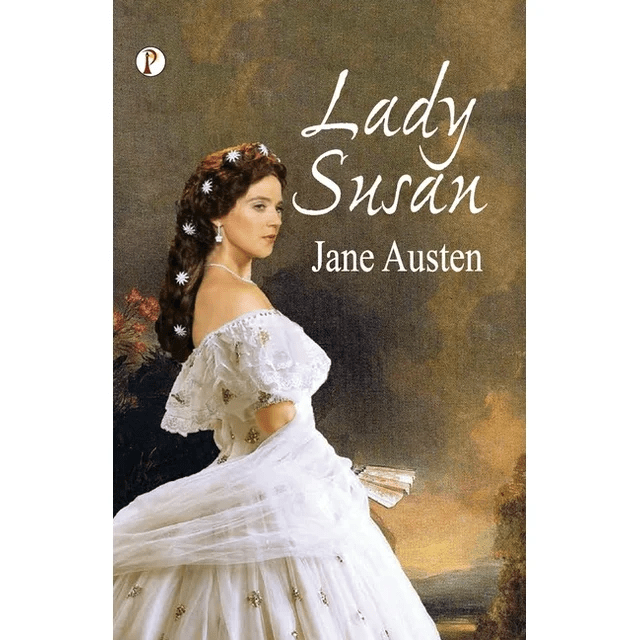
Lady Susan’s disregard for people’s feelings and their intimate and familial relationships shows her inability to have healthy relationships in either family or romantic love because she does not display a capability to love, but only to manipulate and deceive.  This is evident from the beginning of the story in which Lady Susan, while staying at her friends, the Manwaring’s house, manages to interfere with the courting of Maria Manwaring and Sir James Martin, as well as cause a rift between Mr. and Mrs. Manwaring, because of Mr. Manwaring’s interest in Lady Susan, and Lady Susan’s finding him “uncommonly pleasing” (Austen 481).  This interference she causes with Mr. Martin and Maria Manwaring, she claims is to match up Mr. Martin with her daughter, Frederica.  Her lack of compassion and maternal love for Frederica is evidenced in her calling her, “the greatest simpleton on earth,” (Austen 481) and “born to be the torment of my life” (Austen 481).  

Lady Susan informs her friend, Alicia, with regards to the Manwarings, “The females of the family are united against me” (Austen 481), which is due to her flirtations with Mr. Manwaring and Mr. Martin.  She has no consideration or compassion for her friend, Mrs. Manwaring, or for her daughter, Maria Manwaring.  Breaking up a friendship does not concern or upset Lady Susan, because she is ruled by her appetite for deception and power over the men she flirts with and the family members for which she feigns love and affection.

Catherine Vernon, Lady Susan’s sister-in-law, mentions to her mother that Lady Susan didn’t want her to marry Charles, the brother of her deceased husband, and believes Charles to be too lenient toward the lady.  Catherine says, “Her behaviour to him, independent of her general character, has been so inexcusably artful and ungenerous since our marriage was first in agitation, that no one less amiable and mild than himself could have overlooked it at all” (Austen 484).  

Additionally, Catherine warns her brother, Sir Reginald DeCourcy, of the powers of Lady Susan through her beauty and clever language, and says, “I’m sorry it is so, for what is this but deceit?” (Austen 484) Lady Susan reiterates her interference in Charles and Catherine’s initial engagement, saying to her friend, Alicia, “To be sure, when we consider that I did take some pains to prevent my brother-in-law’s marrying her, this want of cordiality is not very surprising” (Austen 483).  This pattern of driving a wedge between both married and courting relationships is prevalent throughout the story. 

Having been warned of Lady Susan’s destructive and deceptive behavior by his sister, Catherine, Sir Reginald initially heeds her warning, but it is forgotten once he meets her in person; he becomes captivated by her.  Conversely, Lady Susan enjoys garnering his attention and upsetting her sister-in-law, but she decides she is not interest in marrying Sir Reginald, which was suggested by her friend, Alicia, telling her, “I cannot easily resolve on anything so serious as Marriage; especially as I am not at present in want of money, & might perhaps, till the old Gentleman’s death, be very little benefited by the match” (Austen 487).  She recognizes Sir Reginald’s abilities to question her behavior toward her daughter and does not feel he will be compliant enough for her.

Lady Susan is interested in her desires first and foremost, with little consideration for the needs or wants of others. Literary critic, Michiko Soya, reiterates this point by saying, “She gives first priority to the pleasure of deceit, and as a result, she eventually becomes the object of love,” (Soya) as seen in Reginald’s falling in love with her.  

Lady Susan’s scheming and flirting give her power over her victims, but only for a while – until she is found out.  Sir Reginald eventually discovers the true nature of Lady Susan through the Manwarings, and he sends her a letter stating, “The spell is removed” (Austen 506).  Lady Susan does not pursue him, but only answers his two letters, closing their relationship, with a feeling of indifference toward his pain in the fact that he loved her.  

She continues to try and push on her daughter the match with Sir James, but her daughter is vehemently against it, and eventually, Lady Susan marries him herself, because she has exhausted all avenues of marriage possibilities by causing one man to cut off their relationship and the other to do the same because her schemes were exposed.  True, loving, and mutually respectful relationships are seemingly foreign to her, as she does not pursue this at any time.  Instead of embracing her family, friends, and male suitors, she distances herself from them through her desire for power, flirtation, and deception.

In Shelley’s work, The Last Man, main character, Lionel Verney, having been an orphan, already experiencing loss and alienation early in his life, grows up in childhood poverty for which he blames the king, who was supposed to have been a friend of his father’s, was indifferent to him.  He grew up with bitterness and resentment for the rich, the monarchy, and nearly everyone, but he changes when he finds love.  Yet, when he and his companions are caught up in a storm at sea, not only is he a widower, having lost his wife years before and survived his children, he is left vulnerable and at the mercy of Nature in his struggle to survive the rocky tempest. Determined to beat Nature, he said, “I breasted the surges, and flung them from me as I would the opposing front and sharpened claws of a lion about to enfang my bosom.  When I had been beaten down by one wave, I rode on another, while I felt bitter pride curl my lip” (Shelley 886).  

When the Plague stains humanity with its poison, and Lionel’s sailing companions perish at sea in the storm, he is left alone with no connection to humanity in the flesh for the third and last time in his life.  Lionel feels the rain joins him in his mourning, for which he states, “even the eternal skies weep” (Shelley 886).  His grief is heavy as he reflects on his companions who have perished, saying, “I shall never see them more. The ocean has robbed me of them – stolen their hearts of love from their breasts, and given over to corruption what was dearer to me than light, or life, or hope” (Shelley 889).  He thinks about his wife and children, saying, “I had not forgotten the sweet partner of my youth, mother of my children, my adored Idris” (Shelley 889).  He saw her in his youngest son, Evenlyn, and when he died, he “lost what most dearly recalled her to me” (Shelley 889).  He then kept her memory through seeing her in her brother, Adrian, who died, along with Clara, in the storm.  With profound sorrow, he says, “They were all to me – the sums of my benighted soul, repose in my weariness, slumber in my sleepless woe.  Ill, most ill, with disjointed words, bare and weak, have I expressed the feeling with which I clung to them” (Shelley 889).  

Lionel treasures his family and friends, and love penetrates his heart for them, as critic, Betty Bennett says, “…through love, which is true power; and he metamorphoses into an educated, sensitive, human-sized heroic figure…” (Bennett).

He wanders the empty cities of Italy and enters many houses where he tries to find some relation to humanity. Desperate for companionship with the living, he tries to befriend a goat family, but after the male goat charges him, he instinctively wants to hurt the animal for this, but doesn’t have the heart to do so. As they scurry off through the woods to seek protection from him, he cries, “I, my heart bleeding and torn, rushed down the hill, and by the violence of bodily exertion sought to escape from my miserable self” (Shelley 893).  He envied the animals with their dens and burrows and nests of families.

Believing the Plague carried out its obliteration of humanity in England and France first and Italy last, he says, “Reason methought was on my side; and the chances were by no means contemptible that there should exist in some part of Italy a survivor like myself – of a wasted, depopulated land” (Shelley 891).  While searching for people, he comes upon white paint and decides that he will write with that paint: “Verney, the last of the race of Englishmen, had taken up his abode in Rome.” This minute act brought about some comfort for him, and he added in his painted message, “Friend, come!  I wait for thee!” (Shelley 891) Hope is ever present inside him.

In entering a saloon, he did not recognize himself reflected in the mirror on the wall.  His meek existence left him in tattered clothes, and much growth of hair on his face and on his head.  But with the spark of hope in him that there may be some surviving people somewhere, he cleaned himself up a bit.  He found writing utensils and papers in the study of an author of the house he came upon, and decided, “I also will write a book” (Shelley 897) and said, “I will write and leave in this most ancient city, the ‘world’s sole monument,’ a record of these things.  I will leave a monument of the existence of Verney, the Last Man” (Shelley 897).  

After a year, Lionel still endured, saying, “…loneliness is my familiar, sorrow my inseparable companion” (Shelley 897).  He cries, “Without love, without sympathy, without communion with any, how could I meet the morning sun, and with it trace its oft repeated journey to the evening shade?” (Shelley 895) But he does find a companion in the form of a shepherd dog that “left his fold to follow me, and from that day has never neglected to watch by and attend on me, showing boisterous gratitude whenever I caressed or talked to him” (Shelley 897).  He decides to depart on one of the boats tied to the pier, and to take books, supplies, and his dog with him to sail wherever it takes him in which he says, “restless despair and fierce desire of change lead me on” (Shelley 898), so that he feels he has a purpose in the remaining years of his life, always with a perseverance, strength, and hope for what lies ahead.  Literary critic, Timothy Ruppert, says as much when he argues The Last Man means, “…a prophecy of hope justified by the regenerative power of the human imagination” (Ruppert).

Through Austen’s portrayal of Lady Susan and Shelley’s depiction of Lionel Verney, both characters have relations with family and friends, but both find themselves cut off from them and their communities. Lady Susan produces ostracization from others through her selfish and conniving behavior, while Lionel lost his connection to his family and friends as well as all humanity through the circumstances of death, in which he had no control. Austen and Shelley teach us through their characters’ experiences with desolation, loneliness, and destructive behaviors, that human unity and kinship in our lives is vital to our health and wellbeing.

Works Cited

Austen, Jane.  Lady Susan.  The Broadview Anthology of British Literature:  The Age of 

Romanticism.  2nd ed.  Broadview Press, 2010.  Print.

Shelley, Mary.  The Last Man.  The Broadview Anthology of British Literature:  The Age

            of Romanticism.  2nd ed.  Broadview Press, 2010.  Print.

Soya, Michiko.  “Lady Susan:  A Game of Capturing the Last Word from Lady Susan to

            Jane Austen and Then”  Jane Austen Society of North America.  Winter 2003.

Web.  15 October 2015.  http://www.jasna.org/persuasions/on-line/vol24no1/soya.html

Bennett, Betty.  “Radical Imaginings:  Mary Shelley’s The Last Man.”  Romantic Circles.

            Summer 1995.  Web.  15 October 2015. 

https://www.rc.umd.edu/editions/mws/lastman/bennett.htm

Ruppert, Timothy. “TIME AND THE SIBYL IN MARY SHELLEY’S THE LAST MAN.” Studies in the Novel 41.2 (2009): 141-56.  Web.  18 October 2015.

http://search.proquest.com.ezproxy.snhu.edu/docview/212636355/fulltext?accountid=3783

Required Reading

classic books in book shelf

The other day, my younger son, who’s in high school, informed me that he’d be reading the Hunger Games for his English class. Last semester he read In Cold Blood by Capote.

Times have changed, or it may have, depending on the school.

I’ll tell you the books I had to read (I hated reading when I was in school at any time from 1st-12th grade), but was pleasantly surprised, when I actually did read some of them. I actually liked them very much. Here are some that I had to read from junior high through high school and which ones I actually read (the ones I truly read are bolded):

The Hobbit

Call of the Wild

Romeo and Juliet

The Merchant of Venice (read in class)

For Whom the Bells Toll (didn’t get past the first page. Didn’t care for Hemingway’s simplistic writing)

Huckleberry Finn

A Tale of Two Cities

The Hound of the Baskervilles

The Great Gatsby

The Scarlet Letter

Out of the ones I read, the only one I didn’t care for was The Scarlet Letter. I really like detailed descriptions, but Hawthorne took it to the nth degree, and there were portions where he’d go off on tangents, and I’d forget where the characters were and where the scene was taking place.

But as for the others, I loved A Tale of Two Cities, The Hobbit, Huckleberry Finn, and The Great Gatsby.

In college, I had the good fortunate to be able to read all kinds of wonderful classics and interesting literature as well:

The Yellow Wallpaper

Frankenstein 

Dr. Jekyll and Mr. Hyde (portions)

Metamorphosis

Pride and Prejudice

Lady Susan 

Othello

The Last Man (portions)

Things Fall Apart (portions)

Twelfth Night

Taming of the Shrew

Beowulf (sorry, didn’t like this one!)

And other books from other countries, like the Thirteenth Night.

Lots of great stories. I especially loved The Yellow Wallpaper, Twelfth Night, Metamorphosis, The Last Man, and Frankenstein.

The portions of Dr. Jekyll and Mr. Hyde were brilliantly written. Stevenson’s words are like reading a psalm. Beautiful.

Mary Shelley’s writing is similar in that regard, as well. Poetic and stunning.

I read To Kill a Mockingbird on my own back in 2010 just because I wanted to. Great book.

So, I’m wondering when my son will be reading any of these or other classics. Perhaps I’m a literature snob, but the classics are incomparable and vital reading material for teens, in my opinion.

I wrote my son’s English teacher to see if he had a list of the books the students would be reading the rest of the semester. I’d like to see if there are any really good books on the list–classics, I mean. I’ve not gotten an email back as of yet. Hopefully, I will.

The previous private Christian school my sons were in in Lancaster, PA, had amazing reading lists with some of the books I mentioned above.

My older son took British Literature and World Literature his junior and senior years, and he read Fahrenheit 451, Wuthering Heights, Things Fall Apart, The Kite Runner, and Dr. Jekyll and Mr. Hyde, to name a few.

Am I being too picky? A literature or book snob? Do public schools not offer the classics anymore? Are In Cold Blood and The Hunger Games considered “classics” now? If the old classics aren’t being offered in English classes anymore, that’s a big disappointment to me.

I may have my son read Frankenstein on his free time over the summer. It’s a short book, and it’s awesome, with lots of important messages.


~*~*~*~


Relationships in Shakespeare’s Era and Today

orsino and viola

(Orsino & Viola by Frederick Richard Pickersgill)

Although human nature tends to be consistent in how it behaves and interacts in various relationships, such as between siblings and in romantic connections, an analysis can show how these relationships in cultures through the Elizabethan period in which Shakespeare reflects in his works, to the current era, have changed and how they’ve relatively stayed the same.

In Shakespeare’s Twelfth Night, the play reflects the Elizabethan culture of its time in how women were considered of lesser stature than men (Sharnette), the roles of the upper class and the commoners, and how it is centered around the festival of the twelve days of Christmas, even named after the twelfth night on the eve of Epiphany Day (“Twelfth Night”).

The theme of relationships is essential to Shakespeare’s play, Twelfth Night, because it demonstrates masking of the characters’ true identities causes confusion until their true selves are revealed. Once they no longer hide who they are, this brings about strengthening and growing romantic relationships for characters, Viola, Orsino, Olivia, and Sebastian. But it also produces the painful recognition of one’s own delusions of self-importance and unreciprocated love in the case of the character, Malvolio. These interactions can be seen in any generation of the history of human relationships.

In Shakespeare’s time, women were considered emotionally and physically weak and required the care of male relatives or husbands.  They were property of men and were expected to grow up to become wives and mothers with no other ambitions.  Those women who were able to work outside the home were employed in domestic occupations, such as maids or cooks.  They were not permitted to be lawyers, doctors, or politicians.  In addition, women were not permitted to be actors on stage (Sharnette).

The prohibition of women holding any jobs held by men is apparent in Shakespeare’s plays where women dressed as men in order to get jobs men possessed, such as Viola’s disguising herself as Duke Orsino’s young page.  The relationships between men and women and how they interact with each other are paramount in Shakespeare’s works.

In Shakespeare’s era, the twelfth night or eve of Epiphany was the last evening of festivities before the actual day of Epiphany and the Christmas season officially ended (“Twelfth Night”).  The twelve days of the Christmas season have festivities each day, and at the beginning of the celebrations, a person is chosen to play the Lord of Misrule, who is in charge of the Christmas festival, which allows men and women to relax their traditional roles and the regular order of things is reversed, or turned upside down.

In other words, the townspeople take on the opposite role of who they are in social status and sex.  For example, a peasant is chosen to be the Queen for that evening, and the Queen is then disguised as a peasant.  Women can dress as men and vice versa.  There are masquerades and pantomimes in these festivities.

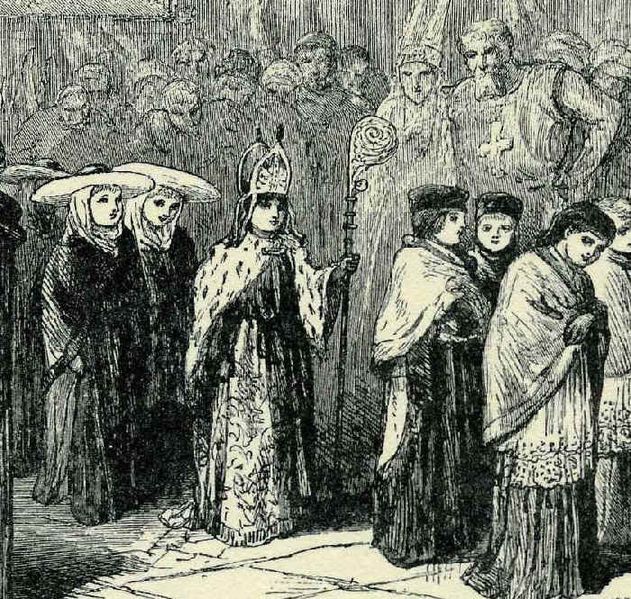
lord of misrule epiphany

The Lord of Misrule’s reign ends at the end of the evening on the eve of Epiphany, or the twelfth night, and then all social statuses and traditional roles return to normal (“Twelfth Night”).

Shakespeare’s Twelfth Night depicts the reverse in gender roles and social statuses and shows how these changes cause disorientation and anxiety for some of the characters involved in romantic relationships (Shakespeare 641-69).

In Twelfth Night, the protagonist, Viola, disguises herself by cutting off her long hair and dressing in male clothing which makes her nearly indistinguishable from her twin brother, Sebastian, who she believes drown in a shipwreck that washed her ashore only days before.

Because of the culture in which Viola lives, she must mask her womanhood in order to secure a job to support herself since she has no living male relatives to take care of her.  She thinks of this as a temporary occupation until she decides what she will do with her life as she still mourns the loss of her brother.

When she becomes the young page, Cesario, to the Duke Orsino, she quickly falls in love with him and is left in a terrible position of hiding her feelings for him to continue to support herself financially.

The duke is in love with a countess named Olivia.  His love is more of an infatuation, and he enjoys being immersed in the feelings of falling in love.  He sends Viola/Cesario to pass on his loving words to Olivia. Because of Viola’s beautiful way with words, she attracts both Orsino and Olivia.

Orsino is naturally drawn to Viola/Cesario because of the feminine traits she unintentionally exudes.  An example of this is when Viola/Cesario talks about love from a woman’s point of view. When Orsino asks what she knows about women and love, she says:

  Too well what love women to men may owe:

  In faith, they are as true of heart as we.

  My father had a daughter loved a man,

  As it might be perhaps, were I a woman,

  I should your lordship.

                                                                        (2.4.116-20)

When the Duke asks of the daughter’s history, Viola continues by saying:

  A blank, my lord.  She never told her love,

  But let concealment, like a worm i’th’bud,

  And, with a green and yellow melancholy,

  She sat like Patience on a monument,

  We men may say more, swear more:  but, indeed,

  Our shows are more than will; for still we prove

  Much in our vows, but little in our love.       

                                                                        (2.4.122-30)

Through Viola/Cesario’s perception of a woman’s love, Orsino ponders this and is drawn to Viola/Cesario (Shakespeare 652).  Likewise, in Viola’s personal awareness as a woman of what words move women, Olivia listens to Viola/Cesario and is drawn to Viola/Cesario instead of the duke.

olivia from 12th night painting

(Olivia from Twelfth Night painted by Edmund Leighton)

Olivia had sworn off men because of the recently double loss of her father and brother within months of each other.  She is left alone with no male guardian much like Viola’s situation, but Olivia is left financially well off in a beautiful house.  She had kept herself veiled and closed off from men until that time.  With the knowledge of how women think and respond to certain words and tones in language, Viola/Cesario is able to persuade Olivia to come out of mourning and consider the duke. But the countess also notices Cesario, and falls in love with him specifically because of Viola’s personal understanding of what women like to hear (Shakespeare 656).

Olivia’s steward, Malvolio, masks his true feelings for her, as well as his belief that he is above his current station in life.  He is disillusioned with self-importance and puffed up with arrogance and conceit.  This is revealed when he is in the garden before finding the letter Maria, Olivia’s gentlewoman in waiting, forged claiming Olivia’s love for him.

Malvolio sees himself marrying Olivia, saying, “To be Count Malvolio” (2.5.36).  His pride paves the way to his belief that he can marry the lady he is serving, saying, “There is example for’t; the lady of the Strachy married the yeoman of the wardrobe” (2.5.40-1).

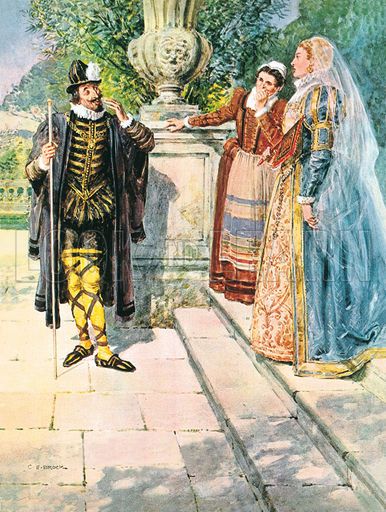
malvolio in yellow stockings

Malvolio dresses in outdated yellow stockings and fixes up his hair as if he is a young man, believing from reading the contents of the letter, that this is how Olivia wishes him to present himself to her, which only succeeds in making him look like a fool.  Olivia questions his health, if he is feeling all right.

Malvolio ends up locked inside a dark building–the nasty work of Sir Toby and his cronies.  They claim he’s gone mad.  Through humiliation and discovering the truth–Olivia does not love him (Shakespeare 669)–Malvolio learns he cannot be someone or something he is not and leaves his position at the Countess’ house.

When Sebastian shows up at the grounds of Olivia’s house, she mistakes him for Cesario.  But soon, both Sebastian and Viola are standing across from each other, and they are moved by seeing each other, as their sibling bond is very strong.

Viola reveals she is indeed his sister, and because of Sebastian’s being alive, Viola is able to tell who she truly is, which brings about relief, joy, and love Orsino has developed for his young page, and opens the door to Sebastian and Olivia’s new love for one another.

Since Viola and Sebastian are not of lower class, such as those of servants and pages, this makes their relationships with the duke and countess more socially acceptable in the Elizabethan era.

In Shakespeare’s plays, The Taming of the Shrew and King Henry the Fifth, the theme of relationships threads through and is the crux of the storylines.

There is camaraderie between King Henry and his men in fighting France, which he illustrates in his speech on St. Crispin’s Day by saying, “We few, we happy few, we band of brothers” (4.3.60). But there is also disloyalty and betrayal by three of his soldiers, one of which is one of his closest friends.

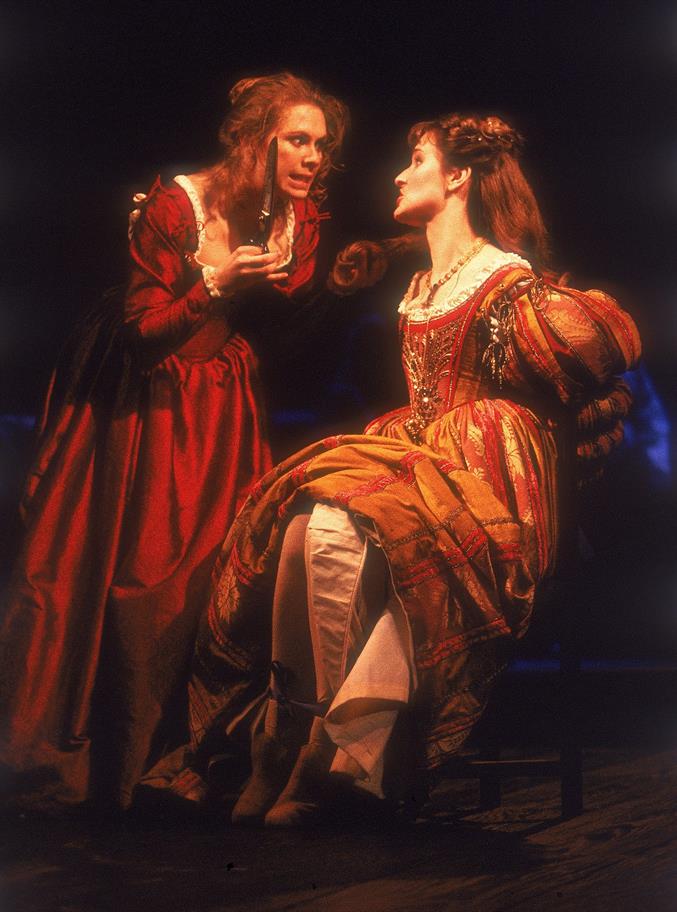
katherina and bianca

In The Taming of the Shrew, the display of the caustic relationship between Katherina and her sister, Bianca, is because of her jealousy of Bianca, in the beginning of the story when Bianca says, “Is it for him you do envy me so?” (2.1.12).

Additionally, Petruchio treats his wife, Katherina, as if she’s a mere pet to be controlled when he says, “My falcon now is sharp, and passing empty; And til she stoop, she must not be full-gorged, For then she never looks upon her lure” (4.1.181-83).

Throughout the play, their relationships show a lack of love but do turn in that direction for Petruchio and Katharina by the end of the play, once their masks of scornfulness are removed (Shakespeare 358).   Overall, their love is much more rough and defiant than Viola and Orsino’s.

In contrast to the loving sibling bond between the twins Viola and Sebastian, sisterly love is not totally repaired at the end of The Taming of the Shrew when the sisters switch their attitudes in which Katharina becomes obedient and Bianca does not (Shakespeare 358).

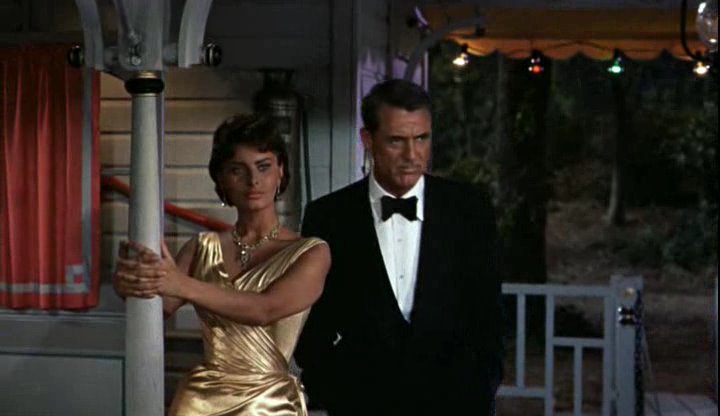
A contemporary example of the type of romantic relationship between Viola and Orsino is reflected in the 1958 movie, Houseboat, with the characters, Tom Winters (Cary Grant) and Cinzia Zaccardi (Sophia Loren).

Cinzia is an Italian woman from an upper class/wealthy family, for whom her father is a symphony conductor.  Feeling trapped under her father’s thumb and the stifling society of the rich, she escapes while her father is in the middle of a concert for which Tom and his three children are attending.

houseboat pic

At a fair nearby, Cinzia bumps into Tom’s youngest son, Robert, who also runs off feeling trapped, still dealing with the recent death of his mother (Tom’s ex-wife). Eventually, Cinzia returns Robert to Tom’s hotel room, and there is a misunderstanding on who she is and where she came from, and she is mistaken for a woman of lower class and a domestic servant. She accepts this incorrect assumption and pretends to be a nanny and a maid in order to stay away from her own life troubles.

As the story moves along, Tom has an attraction to Carolyn, his ex-wife’s sister, while Cinzia has fallen in love with him.  In the end, Tom does not agree to marry Carolyn, and has fallen in love with his nanny/maid.  He doesn’t know until the end of the movie that she is the daughter of a wealthy family (Variety).

Both Cinzia and Viola mask their true identities and fall in love with the men they serve, pretending to be someone and something they are not.  In the late 1950s in America, women had a bit more independence and freedom. They could obtain an education and were not forced into arranged marriages.  Women could also work outside the home. However, the jobs available were more stereotypical female positions, such as nurses, teachers, and secretaries, which paid less than men in the same jobs.

In present day, women have the freedom to choose who they wish to marry, can go to any college they want, and pursue whatever job they wish, for the most part.  Unfortunately, they still do not make the same income as men, generally speaking.

sisters from frozen

In regards to the sibling love of Viola and Sebastian, an example in contemporary society is the 2013 movie, Frozen, with the sisters, Anna and Elsa (Konnikova).  Their bonds are very close.  Of course, these are two sisters in comparison to a brother and sister, but the relationships are similar because of their devotion and deep love for one another.

Sebastian’s return from the dead gave Viola the strength and ability to reveal herself because with the realization that her brother was alive, she, once again, had a legitimate guardian and backing from a male relative so crucial in the culture in which she lived.

In Frozen, Anna, through her sacrificial love for her sister, saved Elsa from being killed by Hans.

In the same sense of sibling protection, Sebastian saved Viola from having to endure any more pain of love unrequited and masking her true identity.  As a result, Viola and Orsino’s loving relationship moved forward, and her unmasking gave way to the new loving relationship between Sebastian and Olivia (Shakespeare 665-68).

Modern sibling relationships are similar to ones from Shakespeare’s era, but women who have brothers are not reliant on them for their care.  They are able to be independent and care for themselves. Also, women today aren’t perceived as weak emotionally and physically by most of society.  Nevertheless, brothers are still considered protectors of their sisters in today’s society, and that’s okay with most sisters.  They appreciate their brothers’ looking out for them (Hall).

Shakespeare’s works have endured over time. Until his plays, there was little written and studied on the emotions and minds of people.  In his plays, Shakespeare revealed what it means to be a human being through the trials and joys of the relationships between people that his audience and readers up to the present day can relate to (Kotula et al.).

In literature, characters come to discover something about themselves and those they interact with.  Shakespeare displays this beautifully through Twelfth Night, for example, when Viola acknowledges her feelings for Duke Orsino, saying, “Yet, a barful strife!  Whoe’er I woo, myself would be his wife” (1.4.42-43).

Through the varied loving relationships in Twelfth Night, the revealing of a person’s true self and being oneself garners the love of others and the realization of who and what one is not.  Shakespeare’s works show the importance of love, friendship, loyalty, and sacrifice that are still relevant today.  Relationships require trust and loyalty, and these can only happen through honesty to oneself and to others.  These traits in relationships endure over the history of humanity.

~*~*~*~

Works Cited
Hall, Alena.  “Proof There’s Nothing Quite Like a Sibling Bond.”  Huffington Post, 22 Aug. 2014, www.huffingtonpost.com/2014/08/22/sibling-bond-relationship_n_5688921.html.  Accessed 30 March 2017.
Konnikova, Maria.  “How ‘Frozen’ Took Over the World.”  The New Yorker, 25 June 2014, www.huffingtonpost.com/2014/08/22/sibling-bond-relationship_n_5688921.html. Accessed 30 March 2017.
Kotula, Nadia, et al.  “The Education Theory of Shakespeare.”  NewFoundations, 2011, www.newfoundations.com/GALLERY/Shakespeare.html. Accessed 18 April 2017.
Shakespeare, William.  “Twelfth Night.”  The Complete Works of William Shakespeare.  The Edition of The Shakespeare Head Press Oxford.  New York:  Barnes & Noble, 1994, pp. 641-69.
—.  “King Henry the Fifth.”  The Complete Works of William Shakespeare. The Edition of The Shakespeare Head Press Oxford.  New York:  Barnes & Noble, 1994, pp. 485-519.
—.  “The Taming of the Shrew.”  The Complete Works of William Shakespeare.  The Edition of The Shakespeare Head Press Oxford.  New York:  Barnes& Noble, 1994, pp. 329-58.
Sharnette, Heather.  “Elizabethan Women.”  Elizabeth R, 1998-2017, www.elizabethi.org. Accessed 6 April 2017.
“Review: ‘Houseboat.’”  Variety, 31 Dec. 1957, variety.com/1957/film/reviews/houseboat-1200419130/. Accessed 30 March 2017.
“Twelfth Night.”  Religionfacts.com, 2016.  www.religionfacts.com/twelfth-night. Accessed 6 April 2017.