Austen and Shelley:  Humanity’s Universal Connection and Its Struggle with Alienation and Loss in the Romantic Era

My University Essay, October 11, 2015

During the Romantic Era, the upper class of English society was a patriarchal one in which women had to rely on male family members or their husbands for them to have security, food, and shelter.  In Lady Susan, Austen presents Lady Susan as a widow seeking a weak man to marry, so she can carry out her destructive actions.   Her deceptive and flirtatious personality wreaks havoc on her family and friends, which alienates her from others.  

Shelley’s main character, Lionel Verney, in her work, The Last Man, is an orphan and a widower.  His family died years before, and the companions for whom he sailed with in the storm at sea, drowned, their boat destroyed in the crashing waves.  

Both Lionel and Lady Susan experience alienation and loss in their relationships, but the latter purposefully distances herself from others through her manipulative actions, whereas Lionel’s connection to his family and friends is torn from him through a deadly disease and the powers of Nature. 
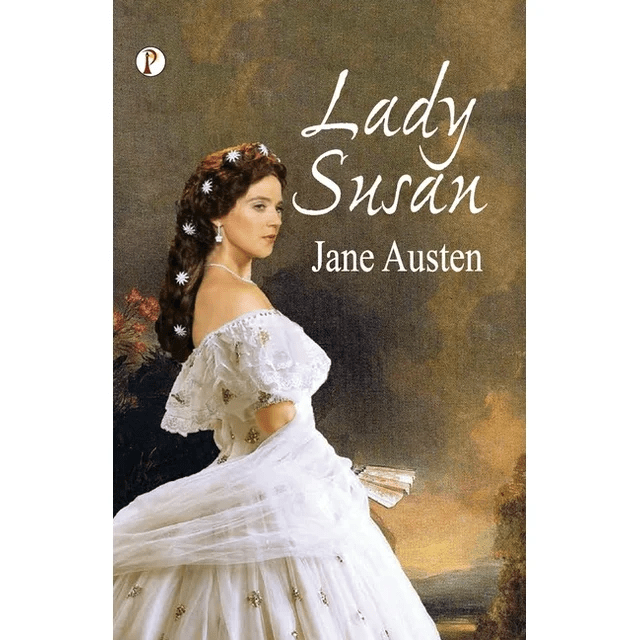
Lady Susan’s disregard for people’s feelings and their intimate and familial relationships shows her inability to have healthy relationships in either family or romantic love because she does not display a capability to love, but only to manipulate and deceive.  This is evident from the beginning of the story in which Lady Susan, while staying at her friends, the Manwaring’s house, manages to interfere with the courting of Maria Manwaring and Sir James Martin, as well as cause a rift between Mr. and Mrs. Manwaring, because of Mr. Manwaring’s interest in Lady Susan, and Lady Susan’s finding him “uncommonly pleasing” (Austen 481).  This interference she causes with Mr. Martin and Maria Manwaring, she claims is to match up Mr. Martin with her daughter, Frederica.  Her lack of compassion and maternal love for Frederica is evidenced in her calling her, “the greatest simpleton on earth,” (Austen 481) and “born to be the torment of my life” (Austen 481).  

Lady Susan informs her friend, Alicia, with regards to the Manwarings, “The females of the family are united against me” (Austen 481), which is due to her flirtations with Mr. Manwaring and Mr. Martin.  She has no consideration or compassion for her friend, Mrs. Manwaring, or for her daughter, Maria Manwaring.  Breaking up a friendship does not concern or upset Lady Susan, because she is ruled by her appetite for deception and power over the men she flirts with and the family members for which she feigns love and affection.

Catherine Vernon, Lady Susan’s sister-in-law, mentions to her mother that Lady Susan didn’t want her to marry Charles, the brother of her deceased husband, and believes Charles to be too lenient toward the lady.  Catherine says, “Her behaviour to him, independent of her general character, has been so inexcusably artful and ungenerous since our marriage was first in agitation, that no one less amiable and mild than himself could have overlooked it at all” (Austen 484).  

Additionally, Catherine warns her brother, Sir Reginald DeCourcy, of the powers of Lady Susan through her beauty and clever language, and says, “I’m sorry it is so, for what is this but deceit?” (Austen 484) Lady Susan reiterates her interference in Charles and Catherine’s initial engagement, saying to her friend, Alicia, “To be sure, when we consider that I did take some pains to prevent my brother-in-law’s marrying her, this want of cordiality is not very surprising” (Austen 483).  This pattern of driving a wedge between both married and courting relationships is prevalent throughout the story. 

Having been warned of Lady Susan’s destructive and deceptive behavior by his sister, Catherine, Sir Reginald initially heeds her warning, but it is forgotten once he meets her in person; he becomes captivated by her.  Conversely, Lady Susan enjoys garnering his attention and upsetting her sister-in-law, but she decides she is not interest in marrying Sir Reginald, which was suggested by her friend, Alicia, telling her, “I cannot easily resolve on anything so serious as Marriage; especially as I am not at present in want of money, & might perhaps, till the old Gentleman’s death, be very little benefited by the match” (Austen 487).  She recognizes Sir Reginald’s abilities to question her behavior toward her daughter and does not feel he will be compliant enough for her.

Lady Susan is interested in her desires first and foremost, with little consideration for the needs or wants of others. Literary critic, Michiko Soya, reiterates this point by saying, “She gives first priority to the pleasure of deceit, and as a result, she eventually becomes the object of love,” (Soya) as seen in Reginald’s falling in love with her.  

Lady Susan’s scheming and flirting give her power over her victims, but only for a while – until she is found out.  Sir Reginald eventually discovers the true nature of Lady Susan through the Manwarings, and he sends her a letter stating, “The spell is removed” (Austen 506).  Lady Susan does not pursue him, but only answers his two letters, closing their relationship, with a feeling of indifference toward his pain in the fact that he loved her.  

She continues to try and push on her daughter the match with Sir James, but her daughter is vehemently against it, and eventually, Lady Susan marries him herself, because she has exhausted all avenues of marriage possibilities by causing one man to cut off their relationship and the other to do the same because her schemes were exposed.  True, loving, and mutually respectful relationships are seemingly foreign to her, as she does not pursue this at any time.  Instead of embracing her family, friends, and male suitors, she distances herself from them through her desire for power, flirtation, and deception.

In Shelley’s work, The Last Man, main character, Lionel Verney, having been an orphan, already experiencing loss and alienation early in his life, grows up in childhood poverty for which he blames the king, who was supposed to have been a friend of his father’s, was indifferent to him.  He grew up with bitterness and resentment for the rich, the monarchy, and nearly everyone, but he changes when he finds love.  Yet, when he and his companions are caught up in a storm at sea, not only is he a widower, having lost his wife years before and survived his children, he is left vulnerable and at the mercy of Nature in his struggle to survive the rocky tempest. Determined to beat Nature, he said, “I breasted the surges, and flung them from me as I would the opposing front and sharpened claws of a lion about to enfang my bosom.  When I had been beaten down by one wave, I rode on another, while I felt bitter pride curl my lip” (Shelley 886).  

When the Plague stains humanity with its poison, and Lionel’s sailing companions perish at sea in the storm, he is left alone with no connection to humanity in the flesh for the third and last time in his life.  Lionel feels the rain joins him in his mourning, for which he states, “even the eternal skies weep” (Shelley 886).  His grief is heavy as he reflects on his companions who have perished, saying, “I shall never see them more. The ocean has robbed me of them – stolen their hearts of love from their breasts, and given over to corruption what was dearer to me than light, or life, or hope” (Shelley 889).  He thinks about his wife and children, saying, “I had not forgotten the sweet partner of my youth, mother of my children, my adored Idris” (Shelley 889).  He saw her in his youngest son, Evenlyn, and when he died, he “lost what most dearly recalled her to me” (Shelley 889).  He then kept her memory through seeing her in her brother, Adrian, who died, along with Clara, in the storm.  With profound sorrow, he says, “They were all to me – the sums of my benighted soul, repose in my weariness, slumber in my sleepless woe.  Ill, most ill, with disjointed words, bare and weak, have I expressed the feeling with which I clung to them” (Shelley 889).  

Lionel treasures his family and friends, and love penetrates his heart for them, as critic, Betty Bennett says, “…through love, which is true power; and he metamorphoses into an educated, sensitive, human-sized heroic figure…” (Bennett).

He wanders the empty cities of Italy and enters many houses where he tries to find some relation to humanity. Desperate for companionship with the living, he tries to befriend a goat family, but after the male goat charges him, he instinctively wants to hurt the animal for this, but doesn’t have the heart to do so. As they scurry off through the woods to seek protection from him, he cries, “I, my heart bleeding and torn, rushed down the hill, and by the violence of bodily exertion sought to escape from my miserable self” (Shelley 893).  He envied the animals with their dens and burrows and nests of families.

Believing the Plague carried out its obliteration of humanity in England and France first and Italy last, he says, “Reason methought was on my side; and the chances were by no means contemptible that there should exist in some part of Italy a survivor like myself – of a wasted, depopulated land” (Shelley 891).  While searching for people, he comes upon white paint and decides that he will write with that paint: “Verney, the last of the race of Englishmen, had taken up his abode in Rome.” This minute act brought about some comfort for him, and he added in his painted message, “Friend, come!  I wait for thee!” (Shelley 891) Hope is ever present inside him.

In entering a saloon, he did not recognize himself reflected in the mirror on the wall.  His meek existence left him in tattered clothes, and much growth of hair on his face and on his head.  But with the spark of hope in him that there may be some surviving people somewhere, he cleaned himself up a bit.  He found writing utensils and papers in the study of an author of the house he came upon, and decided, “I also will write a book” (Shelley 897) and said, “I will write and leave in this most ancient city, the ‘world’s sole monument,’ a record of these things.  I will leave a monument of the existence of Verney, the Last Man” (Shelley 897).  

After a year, Lionel still endured, saying, “…loneliness is my familiar, sorrow my inseparable companion” (Shelley 897).  He cries, “Without love, without sympathy, without communion with any, how could I meet the morning sun, and with it trace its oft repeated journey to the evening shade?” (Shelley 895) But he does find a companion in the form of a shepherd dog that “left his fold to follow me, and from that day has never neglected to watch by and attend on me, showing boisterous gratitude whenever I caressed or talked to him” (Shelley 897).  He decides to depart on one of the boats tied to the pier, and to take books, supplies, and his dog with him to sail wherever it takes him in which he says, “restless despair and fierce desire of change lead me on” (Shelley 898), so that he feels he has a purpose in the remaining years of his life, always with a perseverance, strength, and hope for what lies ahead.  Literary critic, Timothy Ruppert, says as much when he argues The Last Man means, “…a prophecy of hope justified by the regenerative power of the human imagination” (Ruppert).

Through Austen’s portrayal of Lady Susan and Shelley’s depiction of Lionel Verney, both characters have relations with family and friends, but both find themselves cut off from them and their communities. Lady Susan produces ostracization from others through her selfish and conniving behavior, while Lionel lost his connection to his family and friends as well as all humanity through the circumstances of death, in which he had no control. Austen and Shelley teach us through their characters’ experiences with desolation, loneliness, and destructive behaviors, that human unity and kinship in our lives is vital to our health and wellbeing.

Works Cited

Austen, Jane.  Lady Susan.  The Broadview Anthology of British Literature:  The Age of 

Romanticism.  2nd ed.  Broadview Press, 2010.  Print.

Shelley, Mary.  The Last Man.  The Broadview Anthology of British Literature:  The Age

            of Romanticism.  2nd ed.  Broadview Press, 2010.  Print.

Soya, Michiko.  “Lady Susan:  A Game of Capturing the Last Word from Lady Susan to

            Jane Austen and Then”  Jane Austen Society of North America.  Winter 2003.

Web.  15 October 2015.  http://www.jasna.org/persuasions/on-line/vol24no1/soya.html

Bennett, Betty.  “Radical Imaginings:  Mary Shelley’s The Last Man.”  Romantic Circles.

            Summer 1995.  Web.  15 October 2015. 

https://www.rc.umd.edu/editions/mws/lastman/bennett.htm

Ruppert, Timothy. “TIME AND THE SIBYL IN MARY SHELLEY’S THE LAST MAN.” Studies in the Novel 41.2 (2009): 141-56.  Web.  18 October 2015.

http://search.proquest.com.ezproxy.snhu.edu/docview/212636355/fulltext?accountid=3783
A Historical Figure’s Memory Still Vital Today

In the early years of the 20th century, women in Europe began to rise up to fight for their right to vote.  

One of these women was British suffragette, Emmeline Pankhurst.  She led the women’s suffrage movement by employing militant tactics, such as destruction of property, hunger strikes, and crashing Labor Party meetings, and changed these tactics depending on the actions or inactions of the Parliament.  

Her ability to adjust the movement’s demonstrations and responses to the British government’s actions helped bring about the votes for women and the wider place of women in British society in the years after her death and up to the present day.

Emmeline Pankhurst was born Emmeline Goulden in Manchester, England, on July 14, 1858.  She grew up in a politically radical family, which influenced her activism later in her adolescence and the rest of her life.  After studying in Paris, she returned home and met Richard Pankhurst, whom she married in 1879.  He was a lawyer and very active in many political causes, including women’s suffrage.  He wrote a book called the Married Women’s Property Acts of 1870 and 1882, which permitted women the ability to keep what they earned or their property obtained before and after marriage.  He supported and encouraged Emmeline’s participation in their shared political causes.  They had five children, for which one of them, Frank, died in childhood.  The four living children were daughters, Christabel, Sylvia, and Adela, and son, Harry.  

Richard continued to encourage Emmeline’s passion for political causes, as well as, and especially, women’s suffrage.  

This gesture was not the norm in English society at the time, where women were expected to tend to the children and the home as their primary duties and support their husbands in their endeavors.  Women were treated as second-class citizens with no voice in politics or social issues, such as the legal rules for men and women in marriages.[1]

Richard died nineteen years later in 1898, which struck Emmeline with much grief and shock.  She was then a widow with four children in which to care for, and in the first year following Richard’s death, Emmeline did get support from siblings and from friends by a fund that was established for Richard.  Emmeline moved the family into a smaller home in London and opened up a clothes and hat shop.  At that time, the Chorlton Board of Guardians also offered her a job as Registrar of Births and Deaths.  She accepted the position with the satisfaction of having a steady income and a pension.[2]               

In 1900, Emmeline was elected to the Manchester School Board as an Independent Labor Party candidate.  In late 1901, She and her oldest daughter, Christabel, who was considered her favorite according to Sylvia and Adela, joined the North of England Society for Women’s Suffrage.  

In 1903, Pankhurst created her own all-women’s organization called the Women’s Social and Political Union (WSPU), in which their motto was Deeds Not Words.  Two years later, they were following bills in the Parliament pertaining to women’s suffrage, one of which was brought forth, but was not even voted on.  Instead, the men dismissed it and exchanged crude jokes about women and celebrated this dismissal at the end of the day.  

This would be the start to moving the movement to a more militant response to the British government.  Pankhurst and her group of women who had gathered in the waiting area outside the Commons, called the women to have a meeting to protest the government.  

This was the first confrontation the women had with the police, wherein the police attempted to stop the women by shoving the women down the House of Commons’ steps.  But Emmeline was resolute and pressed the police to tell her where their meeting could take place.  The police obliged her and led the group to a spot near the gate of West Minster Abbey, where Pankhurst proceeded to speak, with Keir Hardie, a Scottish man who was a member of the Labor Party in Parliament, standing beside her.  He was a strong supporter of women’s suffrage.[1]  

These rallies were carried on, as well as heckling members of the Labor Party in meetings.  In one of those meetings, Emmeline’s daughter, Christabel and another suffragette from WSPU were arrested.  They refused to pay the fine and were put in jail overnight.  When they were released the next day, their stories made the newspapers, and in this revelation of garnered attention through her daughter’s and sister suffragette’s actions, Pankhurst saw an avenue to take to increase notice and their message.  

She realized it would only be through more militant actions that disrupted the lives of those men in Parliament and businessmen that change could happen.  She employed such tactics as throwing rocks through store windows, setting incendiary bombs in empty homes and buildings, and slashing works of art at the National Gallery.  

In a letter to her WSPU readers, she dictated the importance of these destructive methods, in which she said that the level of militancy each woman did was of her own judgment, but it must be done at some level because, as she said, “I know that the defeat of the Amendments will prove to thousands of women that rely on peaceful, patient methods, is to court failure, and that militancy is inevitable.”[1]

In her most famous speech, “Freedom or Death,” given to an American audience in Hartford, Connecticut, on November 13, 1913, while on one of her short hiatuses from jail at that time, she explained more explicitly why she had employed the militant methods used by her and her group.  

She first explained how men had used violent methods in revolutions and revolts, such as the one in Ireland, to bring about the change they wanted, with both the acknowledgement and understanding that lives could and would be lost in these movements.  But, she herself, did not believe in losing lives in movements, especially her own.  She believed life to be sacred and only wished to stir these lives through destruction of property.  

She said in her speech, “We had to get the electors, we had to get the business interests, we had to get the professional interests, we had to get the men of leisure all unitedly saying to the government, relieve the strain of this situation and give women the vote,” and further along said, “There is a homely English proverb which may help to clear the situation which is this:  You cannot rouse the Britisher unless you touch his pocket.”  

She expressed that it is not through comfort but only through the continued discomfort felt by these people through destruction of their property, thus their loss of money (their pocket) that prompts them to want it to stop and therefore, capitulate to changing the laws on votes for women.[2]

Along with these tactics, another risky one was adopted while in jail by one of the suffragettes, which all followed:  hunger strikes.  

These also drew much attention and the early release of the women before they starved themselves to death.  

In counter to the women’s hunger strikes, the jail wardens and doctors violently force-fed some of these women, of which Emmeline wrote of one account in her book, My Story, 1914, of suffragette, Lady Constance Lytton.  She participated in many demonstrations that led to confrontations with the police in which many of her sister suffragettes were throttled.  Because of her status, she was not manhandled, but incensed over what she saw had happened to her sisters, she cut off all of her long hair, changed into tattered clothing, called herself “Jane Warton,” and went back out to march in the streets with the others and was arrested and put in jail.  

Because the police and jail wardens did not know her true identity, they did not give her special treatment and subjected her to forcible feedings.  

Being of higher social class, she was not accustomed to such rough treatment and forcible feedings, and Pankhurst wrote, “…she suffered frightful nausea each time, and when on one occasion the doctor’s clothing was soiled, he struck her contemptuously on the cheek.”  Emmeline said that this horrible treatment continued until her identity was revealed, and she was then released.  Pankhurst closed this story saying, “…she never recovered from the experience, and is now a hopeless invalid.”[3]  Pankhurst, herself, was never subjected to forcible feedings.  

Women made great sacrifices for the cause of votes for women. 

In giving women the right to vote, it would give them power to change laws in areas concerning women, such as marriage, divorce, and later on, equal wages in the workplace and rights to contraception and abortions (**this is a historical paper stating facts. As a pro-lifer, obviously I have some views on the latter, but this essay isn’t about my personal thoughts, other than the advancement of women being active and valued participants in their societies and treated with respect).  

In Britain in the few years before World War One, Emmeline had explained in her speech in Connecticut that women had no voice in the raising of their children, in where they went to school.  They were paid much lower wages than men and if they were widows, women who had siblings or parents to take care of, how were they to support them and their families?  

She spoke of girls lawfully married at age twelve, and for wives, all of the sacrifice, effort, tears, and joy they put into raising their children and taking care of their husbands was taken away from them and left penniless if a husband decided to leave his wife.  

The laws needed to be changed, and these laws could only be changed if women were given the power to vote because then they had a voice and eventually a spot in Parliament to change such laws.[4]  

Emmeline was a charismatic woman and leader who galvanized all women and women’s groups, but her group was the only one that was all women and made militancy part of their strategy for votes for women.  She did have support at times from the leader of the women’s suffrage group, The National Union of Woman’s Suffrage Societies, Millicent Garrett Fawcett.  Their group was more reserved and tried to make changes through letters and meetings, which did not garner much attention from the men in Parliament.  

Some women were part of the Socialist Party and did also rally for votes for women but were more centered on equal wages.  One of the women who was most opposed to Pankhurst and her style used in her movement was her own daughter, Sylvia, who was a socialist, feminist, and pacifist.  

When World War One broke out, Emmeline called a halt to WSPU’s militant methods and encouraged the suffragettes to help in the factories and support the men going to the front.  

Sylvia was angered by her mother’s support of the war and her perceived belief that her mother was obsessed with her cause and too centered just on votes for women.  Sylvia protested against the war and continued the fight for women in the workplace throughout the war, and she ended up writing two books on the women’s movement in Britain and a personal account that showed resentment toward her mother.  

Her book became very well-known and was adopted by many feminist socialists in the subsequent decades.  There were also women that admired her.  One of those women was suffragette, Rebecca West, who was a member of the Women’s Social and Political Union.  She had written positive words in regards to Pankhurst, saying, “There has been no other woman like Emmeline Pankhurst.  She was courageous, small, and fragile…. She put herself in the way of horses’ hooves, she stood up on platforms under a reign of missiles, she sat in the darkness of underground jails hunger struck…”[5]  

After the Great War, Emmeline was much older, and she had lost interest in the Labor Party and socialism.  She still carried on her cause for votes for women, but without the militancy practiced in the early years of the movement before the war.  She believed to make headway for women, the former tactics were not needed.  

She had said of this, “Now, I think I deserve to be allowed to work for the general questions affecting women and the country generally.”  

Emmeline Pankhurst died on June 14, 1928, before she could finish campaigning as a candidate for the Conservative Party.  

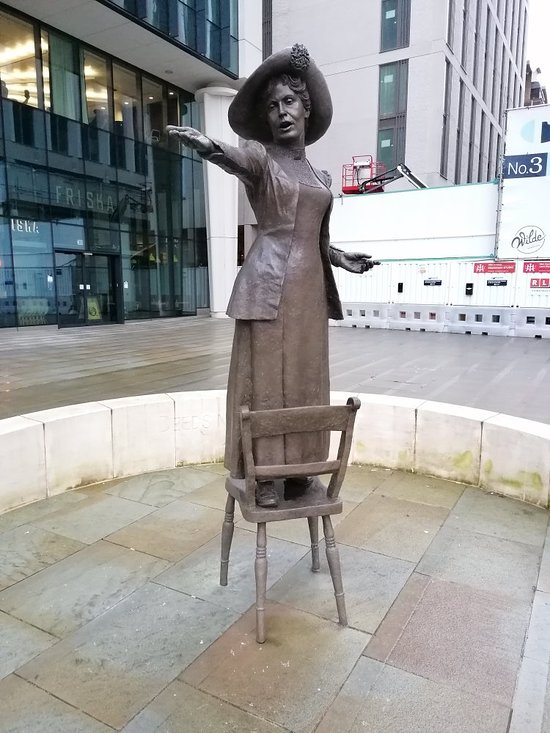
A month later on July 2, a law established voting rights for women equal to men.  Two years later, Emmeline Pankhurst was recognized for her achievements with the unveiling of a statue made in her honor next to the House of Commons.[6]  

Presently, this year (2017), a statue is in the works in honor of Mrs. Pankhurst.  

Emmeline’s great-granddaughter, Helen, was there collaborating with 19 top sculptors.  She said that people recognize her name, Pankhurst, and said, “…they say, ‘I voted because of your great grandmother.”  It is to be completed in 2019, and presented in St. Peter’s Square in Manchester, England.[7]

With the progressive hard work of Pankhurst and her group, she helped to give visibility to women’s causes and votes for women in British society.  Through her work, many women, including her daughters Christabel and Sylvia, in different ways, carried on her work and inspiration to the subsequent generations of women, especially in the 1960s and 1970s, which brought about women’s rights to divorce, and more in Europe and elsewhere.[8]  Their fight for equal pay continues today.  


~*~*~*~

Footnotes:

      1.  Jane Purvis, “Emmeline Pankhurst (1858-1928), Suffragette Leader and Single Parent in Edwardian Britain,” Women’s History Review 20, no. 2 (February 2011), 87-108, accessed July 21, 2016, http://eds.b.ebscohost.com.ezproxy.snhu.edu/eds/pdfviewer/pdfviewer?sid=b80666a7-b246-4bcb-b327-0fdb04cbc9c2%40sessionmgr101&vid=3&hid=111

      2.  Ibid.

      3.  Carl Rollyson, “A Conservative Revolutionary:  Emmeline Pankhurst (1857-1928),” VQR 92, no. 3, last modified 2003, accessed July 14, 2016, http://www.vqronline.org/essay/conservative-revolutionary-emmeline-pankhurst-1857-1928

4.  “The Suffragettes:  Deeds not words,” The National Archives, accessed July 26, 2016, http://www.nationalarchives.gov.uk/documents/education/suffragettes.pdf

      5.  Emmeline Pankhurst, “Freedom or Death,” The Guardian, last modified April 27, 2007, accessed July 13, 2016, https://www.theguardian.com/theguardian/2007/apr/27/greatspeeches2

      6.  Emmeline Pankhurst, “My Story, 1914,” Europe in the Contemporary World:  1900 to the Present, (Boston/New York:  Bedford/St. Martin’s, 2007), 107-110.

      7.  Emmeline Pankhurst, “Freedom or Death,” The Guardian, last modified April 27, 2007, accessed July 13, 2016, https://www.theguardian.com/theguardian/2007/apr/27/greatspeeches2

      8.  Carl Rollyson, “A Conservative Revolutionary:  Emmeline Pankhurst (1857-1928),” VQR 92, no. 3, last modified 2003, accessed July 14, 2016, http://www.vqronline.org/essay/conservative-revolutionary-emmeline-pankhurst-1857-1928

      9.  Ibid.

      10.  Jennifer Williams, “Emmeline Pankhurst statue will be ‘rallying point for modern feminists’,” Manchester Evening News, last modified July 20, 2016, accessed July 24, 2016, http://www.manchestereveningnews.co.uk/news/greater-manchester-news/emmeline-pankhurst-statue-rallying-point-11640431

      11.  Felix Gilbert and David Clay Large, The End of the European Era:  1890 to the Present, (New York:  Norton and Company, 2009)

      3.  Carl Rollyson, “A Conservative Revolutionary:  Emmeline Pankhurst (1857-1928),” VQR 92, no. 3, last modified 2003, accessed July 14, 2016, http://www.vqronline.org/essay/conservative-revolutionary-emmeline-pankhurst-1857-1928

Between Privilege and Poverty

Dido Belle


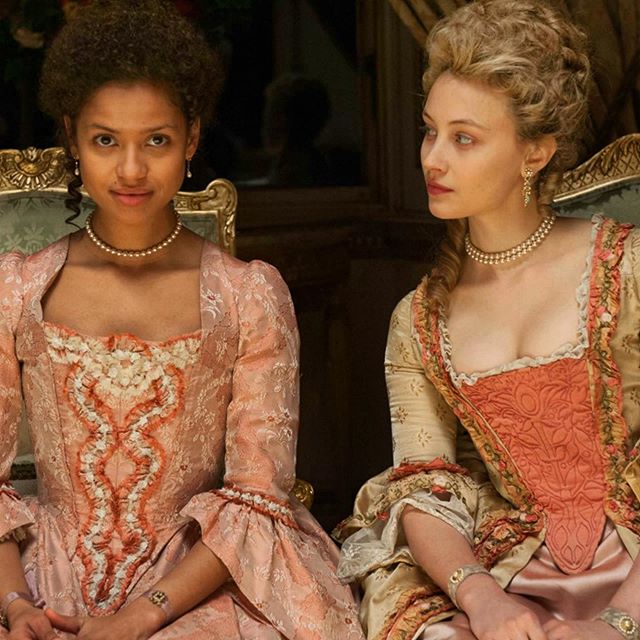
In the movie, Belle, the aspect of power structure and relations is evident throughout, especially in the depictions of rites of passage and cultural art and symbols in art in British life.

Belle is a film set in the years 1769-1781 in Britain when the country was a colonial empire and leader in trade. In this movie, the plot centers on Britain as a slave trade capital.

Belle is based on the true-life story of Dido Elizabeth Belle, who was the daughter of Sir John Lindsay and an African slave, Maria Belle.  Sir Lindsay placed Dido in his uncle’s care, and left for the West Indies, as he was a captain in the King’s Royal Navy.  Lord Mansfield and his wife raised Dido and her cousin, Elizabeth.  Lord Mansfield was also the Lord Chief Justice of England.  He presided over the court appeal case of the Zong slave ship whose captain and crew threw 132 diseased and dying slaves over the ship’s side to drown in the ocean.  The owners of the ship wanted to collect insurance for the human cargo that perished at sea.

There is cultural change that comes about in England through the Zong case before the highest court in England with Lord Chief Justice Mansfield presiding.  The case consisted of whether the insurance companies should compensate the owners/traders of the Zong ship for the loss of human cargo.  The horrid case drew much attention through strong, vocal protestations of local abolitionists that spread the news of the case to men of high position – anyone of influence.  By 1807, a law abolishing slave trade was enacted (Understanding Slavery, 2011).  It later led to the Slavery Abolition Act in 1833 (Gates, Jr., 2014).

Power Structure

The movie depicts power structure in the examples of Lord Mansfield and his family, as well as the Ashfords, who are nobility, or aristocrats.  The aristocrats, or wealthy landowners, had the power at that time, besides the highest power of the monarchy (Smitha, 2015).  These societies were patrilineal.

With this power structure, Dido lived within it, hovering between nobility and servant.  Her white bloodline elevated her above servant and commoner, but her African slave bloodline put her below a commoner.  So, for Dido, she was not permitted to dine with her family when dinner guests were present, and she had no coming out in the rites of passage the young English women of nobility normally did.

An example of this was near the beginning of the film, when Dido became a young lady, she did not understand her position in the family and society.  Because of not being permitted to eat or join at the dinner table when guests were present, and the looks Lady Ashford gave her while visiting, Dido hated her African slave bloodline.  In a poignant scene where she smacks her fists on her chest and neck and rakes her hands over her cheeks, it showed she hated her skin color, hence, hated her African heritage.  Also, because she was a woman, Dido was considered lower than men, and did not have much independence.

Dido had fallen in love with John Davinier, but she could not pursue it because they came from different social classes.  Mr. Davinier, the son of a reverend, was a passionate man with the desire to become a lawyer or judge.  He was an activist and abolitionist.  Dido and John shared the same beliefs about abolishing slavery and agreed that the owners of the Zong should not be compensated for throwing a large portion of the slaves into the ocean to die.  John also treated Dido as an equal, and saw the beauty in her through her mother’s lineage.

Oliver Ashford, who had wanted to marry Dido, did not recognize Dido’s mother’s contribution to Dido’s features.  He found Dido a unique and pretty specimen, in which he could “overlook” her mother’s African bloodline and heritage because her father had given her such “loveliness and privilege” (Jones & Asante, 2013).  Although, he thought he was being complimentary to Dido, it was really an insult to her.

Rites of Passage

In the film, a rite of passage consisted of English women being presented to social groups of their same class once they transitioned from a girl to womanhood.  This was a common ritual in the upper classes of European society.  The transition is common in all cultures in which a rite of passage happens when one is between two positions.  The person is no longer part of the old position and not yet part of the new one (International Encyclopedia of the Social Sciences, 2008).

In the noble English culture, endogamy was practiced.  Women were to be matched with a suitable husband from the same social class through the decision of her father or male equivalent.  As was said above, because Dido lived in a patrilineal society and culture, it was the man who made decisions and took care of the woman financially and in all things.  In Belle, it was Dido’s cousin, Elizabeth, who “came out” for this purpose of matching her up with a husband.

Dido’s finances were unique in that, although she was illegitimate, her father left her a great amount of money after his death.  He died when Dido was a young woman.  She was given 2000 pounds a year, which was a lot of money at that time.  So, with this inheritance, Lord Mansfield and Lady Mansfield did not have to worry about Dido marrying into a social class, because they felt a nobleman wouldn’t marry her because she was a mulatto, and she would shame the family marrying a commoner or servant below her noble status.  Because of this, Dido did not go through the rite of passage of being presented to society to be matched with a husband.

Elizabeth Murray, Dido’s cousin, did not receive an inheritance from her father, even though she was legitimate.  Her father gave his money to his other children and new wife.  So, Elizabeth was at the mercy of the man Lord Mansfield and Lady Mansfield chose for her.  Her father was also a naval officer, and deposited his daughter with Lord Mansfield before Dido arrived.

Cultural Art and Symbolism

The portraits of aristocrats were quite prevalent at the time in England.  The many portraits shown in the Kenwood home of Dido were of her relatives, and many of them showed a nobleman standing and a black servant kneeling below him.  This symbolized both the status and inequality of the two men.  The nobleman was seen as higher in importance and social status.  The black servant had little social status.

The film’s producer/director, and its writer, were inspired in creating their movie by the portrait of Dido and her cousin, Elizabeth.  The painting portrays Elizabeth seated on a bench reaching out her right hand and touching Dido’s left arm, who stood near by, smiling with a finger to her cheek, and a basket of fruit in her left arm.  This was a powerful picture that symbolized equality.  Dido was not kneeling before her cousin, but standing next to her.  The portrait hung in the house until 1922.  It is now in the Scone Palace in Scotland where Lord Mansfield was born (Jones & Asante, 2013).

In conclusion, this analysis of the power structure, rites of passage, and cultural and art symbolism in England enlightened me to the enculturation of England’s aristocratic societies and how power and money influenced trade and treatment of African Americans and those in lower classes.  It taught me what life had been like for a mulatto woman in eighteenth century England and the environment in which she lived — a patrilineal culture and society and its racial boundaries.  Many societies are still patrilineal, and the effects of racism and sexism are still around today, regardless of the eradication of slavery and the progression of the women’s movement.   With this knowledge, I am able to better understand cultures around the world – how they came about and evolved over time — and hope to contribute in a positive way to the progression of equality for all people.


PS: If you haven’t seen this movie, go watch it as soon as you can. One of the best of the 21st century in script, acting, classiness, and storyline.


~*~*~*~


Works Cited
Understanding Slavery.  (2011). The Zong case study.  Understanding Slavery. Retrieved fromhttp://www.understandingslavery.com/index.php?option=com_content&view=article&id=373&Itemid=236
Gates, Jr., H.  (2014).  Who Was the Real Dido Elizabeth Belle?  The Root.  Retrieved from http://www.theroot.com/articles/history/2014/05/did_belle_really_help_end_slavery_in_england.1.html
Smitha, F.  (2015).  Britain in the mid 1700s.  Macrohistory and World Timeline.  Retrieved from http://www.fsmitha.com/h3/h29-fr.htm
Encyclopedia of the Social Sciences.  (2008).  Rites of Passage.  Encyclopedia of the Social Sciences.  Retrieved from http://find.galegroup.com/gic/infomark.do?&idigest=fb720fd31d9036c1ed2d1f3a0500fcc2&type=retrieve&tabID=T001&prodId=GIC&docId=CX3045302291&source=gale&userGroupName=itsbtrial&version=1.0
Jones, D. (Producer), & Asante, A. (Director).  (2013).  Belle [DVD].  United States.  Bankside Films.