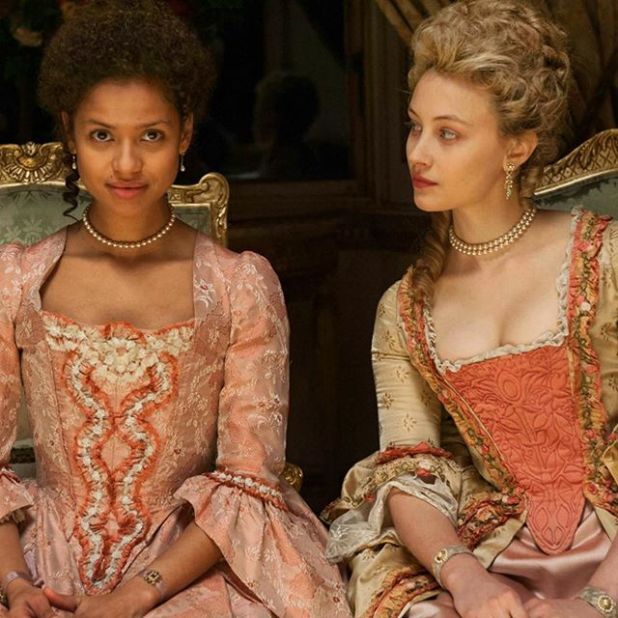
In the movie, Belle, the aspect of power structure and relations is evident throughout, especially in the depictions of rites of passage and cultural art and symbols in art in British life.
Belle is a film set in the years 1769-1781 in Britain when the country was a colonial empire and leader in trade. In this movie, the plot centers on Britain as a slave trade capital.
Belle is based on the true-life story of Dido Elizabeth Belle, who was the daughter of Sir John Lindsay and an African slave, Maria Belle. Sir Lindsay placed Dido in his uncle’s care, and left for the West Indies, as he was a captain in the King’s Royal Navy. Lord Mansfield and his wife raised Dido and her cousin, Elizabeth. Lord Mansfield was also the Lord Chief Justice of England. He presided over the court appeal case of the Zong slave ship whose captain and crew threw 132 diseased and dying slaves over the ship’s side to drown in the ocean. The owners of the ship wanted to collect insurance for the human cargo that perished at sea.
There is cultural change that comes about in England through the Zong case before the highest court in England with Lord Chief Justice Mansfield presiding. The case consisted of whether the insurance companies should compensate the owners/traders of the Zong ship for the loss of human cargo. The horrid case drew much attention through strong, vocal protestations of local abolitionists that spread the news of the case to men of high position – anyone of influence. By 1807, a law abolishing slave trade was enacted (Understanding Slavery, 2011). It later led to the Slavery Abolition Act in 1833 (Gates, Jr., 2014).
Power Structure
The movie depicts power structure in the examples of Lord Mansfield and his family, as well as the Ashfords, who are nobility, or aristocrats. The aristocrats, or wealthy landowners, had the power at that time, besides the highest power of the monarchy (Smitha, 2015). These societies were patrilineal.
With this power structure, Dido lived within it, hovering between nobility and servant. Her white bloodline elevated her above servant and commoner, but her African slave bloodline put her below a commoner. So, for Dido, she was not permitted to dine with her family when dinner guests were present, and she had no coming out in the rites of passage the young English women of nobility normally did.
An example of this was near the beginning of the film, when Dido became a young lady, she did not understand her position in the family and society. Because of not being permitted to eat or join at the dinner table when guests were present, and the looks Lady Ashford gave her while visiting, Dido hated her African slave bloodline. In a poignant scene where she smacks her fists on her chest and neck and rakes her hands over her cheeks, it showed she hated her skin color, hence, hated her African heritage. Also, because she was a woman, Dido was considered lower than men, and did not have much independence.
Dido had fallen in love with John Davinier, but she could not pursue it because they came from different social classes. Mr. Davinier, the son of a reverend, was a passionate man with the desire to become a lawyer or judge. He was an activist and abolitionist. Dido and John shared the same beliefs about abolishing slavery and agreed that the owners of the Zong should not be compensated for throwing a large portion of the slaves into the ocean to die. John also treated Dido as an equal, and saw the beauty in her through her mother’s lineage.
Oliver Ashford, who had wanted to marry Dido, did not recognize Dido’s mother’s contribution to Dido’s features. He found Dido a unique and pretty specimen, in which he could “overlook” her mother’s African bloodline and heritage because her father had given her such “loveliness and privilege” (Jones & Asante, 2013). Although, he thought he was being complimentary to Dido, it was really an insult to her.
Rites of Passage
In the film, a rite of passage consisted of English women being presented to social groups of their same class once they transitioned from a girl to womanhood. This was a common ritual in the upper classes of European society. The transition is common in all cultures in which a rite of passage happens when one is between two positions. The person is no longer part of the old position and not yet part of the new one (International Encyclopedia of the Social Sciences, 2008).
In the noble English culture, endogamy was practiced. Women were to be matched with a suitable husband from the same social class through the decision of her father or male equivalent. As was said above, because Dido lived in a patrilineal society and culture, it was the man who made decisions and took care of the woman financially and in all things. In Belle, it was Dido’s cousin, Elizabeth, who “came out” for this purpose of matching her up with a husband.
Dido’s finances were unique in that, although she was illegitimate, her father left her a great amount of money after his death. He died when Dido was a young woman. She was given 2000 pounds a year, which was a lot of money at that time. So, with this inheritance, Lord Mansfield and Lady Mansfield did not have to worry about Dido marrying into a social class, because they felt a nobleman wouldn’t marry her because she was a mulatto, and she would shame the family marrying a commoner or servant below her noble status. Because of this, Dido did not go through the rite of passage of being presented to society to be matched with a husband.
Elizabeth Murray, Dido’s cousin, did not receive an inheritance from her father, even though she was legitimate. Her father gave his money to his other children and new wife. So, Elizabeth was at the mercy of the man Lord Mansfield and Lady Mansfield chose for her. Her father was also a naval officer, and deposited his daughter with Lord Mansfield before Dido arrived.
Cultural Art and Symbolism
The portraits of aristocrats were quite prevalent at the time in England. The many portraits shown in the Kenwood home of Dido were of her relatives, and many of them showed a nobleman standing and a black servant kneeling below him. This symbolized both the status and inequality of the two men. The nobleman was seen as higher in importance and social status. The black servant had little social status.
The film’s producer/director, and its writer, were inspired in creating their movie by the portrait of Dido and her cousin, Elizabeth. The painting portrays Elizabeth seated on a bench reaching out her right hand and touching Dido’s left arm, who stood near by, smiling with a finger to her cheek, and a basket of fruit in her left arm. This was a powerful picture that symbolized equality. Dido was not kneeling before her cousin, but standing next to her. The portrait hung in the house until 1922. It is now in the Scone Palace in Scotland where Lord Mansfield was born (Jones & Asante, 2013).
In conclusion, this analysis of the power structure, rites of passage, and cultural and art symbolism in England enlightened me to the enculturation of England’s aristocratic societies and how power and money influenced trade and treatment of African Americans and those in lower classes. It taught me what life had been like for a mulatto woman in eighteenth century England and the environment in which she lived — a patrilineal culture and society and its racial boundaries. Many societies are still patrilineal, and the effects of racism and sexism are still around today, regardless of the eradication of slavery and the progression of the women’s movement. With this knowledge, I am able to better understand cultures around the world – how they came about and evolved over time — and hope to contribute in a positive way to the progression of equality for all people.
PS: If you haven’t seen this movie, go watch it as soon as you can. One of the best of the 21st century in script, acting, classiness, and storyline.
~*~*~*~
Works Cited
Smitha, F. (2015). Britain in the mid 1700s. Macrohistory and World Timeline. Retrieved from http://www.fsmitha.com/h3/h29-fr.htm
Jones, D. (Producer), & Asante, A. (Director). (2013). Belle [DVD]. United States. Bankside Films.


 Modest Musings